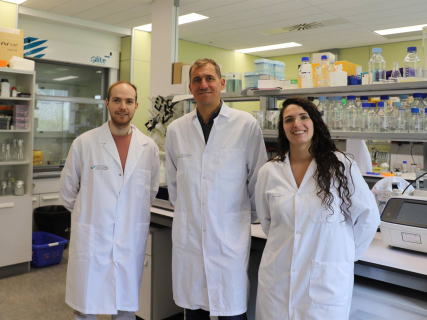

A team from the Institut de Recerca contra la Leucèmia Josep Carreras has demonstrated in laboratory experiments how tumor cells protect themselves from a toxin, formaldehyde, that they produce as a consequence of their own metabolic activity.
The work, publicized in "Science Advances" and in which the University of Leicester, the Instituto de Biomedicina de Buenos Aires, and the Universitat Internacional de Catalunya have collaborated, explains that formaldehyde occurs naturally within cells and can damage DNA by binding it to nearby proteins. To counteract this effect, cells resort to glutathione, a key molecule that protects them against chemical assaults.
Glutathione also prevents ferroptosis, a type of cell death caused by the deterioration of membrane lipids. Both functions depend on the same glutathione reserves, so using it to eliminate formaldehyde can reduce the amount available to stop ferroptosis.
The research has focused on the NRF2 protein, which tends to show high activity in many tumors and allows malignant cells to deactivate formaldehyde without consuming their glutathione stores.
NRF2 increases the synthesis of the SLC7A11 protein, responsible for introducing into the cell interior a molecule called cystine, which is converted into cysteine capable of reacting directly with formaldehyde without needing to resort to glutathione.
Blocking the protection pathway
This reaction produces a stable compound called thioproline, which the research group has identified in cancer cells, and by providing more cystine, the cells manage to neutralize formaldehyde and conserve glutathione in order to continue preventing ferroptosis.
When SLC7A11 was blocked in cells exposed to high concentrations of formaldehyde, protein synthesis was halted and cell death was triggered.
The same team used drugs to inhibit both the entry of cystine into the cells and the production of glutathione at the same time, which led to the death of leukemia cells and several types of solid tumors, including lung cancer, colon cancer, and various brain tumors.