
During the session 'Transforming public health procurement through social and environmental value', held at the Espacio Comet in Madrid with the impetus of Ferrer and in collaboration with Vinces Consulting, the ten-point guide 'Transforming the procurement of medicines. The incorporation of social and environmental value' was presented. The document is presented as a tool to guide the incorporation and application of social and environmental criteria in the public procurement of medicines.
Each of its ten principles is accompanied by the regulatory references and the instruments that guide its application, from the Law on Public Sector Contracts and Directive 2014/24/EU to the National Strategy for Public Procurement 2023-2026. The starting point is that the public procurement of medicines has a strategic dimension: each contracting decision guides the companies' efforts and determines which contributions the healthcare system recognizes.
🔎 #ENDIRECTO | Comienza la jornada sobre la incorporación de criterios sociales y medioambientales a la adquisición pública de medicamentos organizada por la farmacéutica @ferrerforgood y la consultora @VincesAffairs Consulting.
— demócrata (@democrata_info) November 17, 2026
📲 Todos los detalles en Demócrata:… pic.twitter.com/Pyb6MWBkw7
The welcome was delivered by David Martorell, Ferrer’s Country Manager for Spain, and the inaugural speech by Rafael Vilasanjuan, President of Ashoka. The moderation of the event was handled by Carmen Obregón, journalist for DEMÓCRATA.
A cross-cutting look at the procurement model
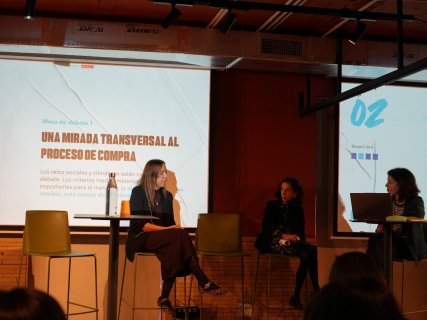
The first panel of the event opened with the presentation by César Hernández, General Director of the Common Portfolio of Services of the SNS and Pharmacy of the Ministry of Health. The debate included José María Gimeno, co-director of the Public Procurement Observatory; Marta Anglada, Chief Social Justice Officer at Ferrer; Miguel Ángel Calleja, pharmacist at the Pharmacy Service of the Virgen de las Nieves University Hospital; Eloína Núñez, a member of the Board of Directors of SEDISA and coordinator of its Observatory of Value-Based Management; and Raquel Sánchez, General Director of the Foro Español de Pacientes.
Marta Anglada defended that social and environmental aspects should be valued at the same level as quality. She pointed out that the social dimension still has room to grow and called for the bidding documents to account for both jointly and to recognize the practices of companies that already incorporate them into their activity.
From hospital pharmacy, Miguel Ángel Calleja, of the Pharmacy Service of the Virgen de las Nieves University Hospital, proposed that centers review their own processes to identify which ones can be made more sustainable. In his view, social and environmental impact will have an increasing weight in purchasing decisions.
🔎 #ENDIRECTO | Primera mesa: Una mirada transversal al modelo de compra.
— demócrata (@democrata_info) November 17, 2026
Cómo incorporar el valor social y medioambiental a la contratación sanitaria desde
distintas perspectivas.
Forman parte de la mesa:
-Miguel Ángel Calleja, miembro del Servicio de Farmacia del Hospital… pic.twitter.com/bPJgofpky3
José María Gimeno, co-director of the Public Procurement Observatory, placed the debate in a European context. He recalled that the European Union has been driving an agenda since 2020 to strengthen the responsiveness capacity of strategic sectors such as healthcare and warned of the vulnerability that the relocation of pharmaceutical production can generate. In his view, valuing bids beyond price allows public procurement to contribute not only to strengthening the industry but also to attracting talent.
The panel highlighted that sustainability and social objectives are increasingly present in business strategies. However, that effort does not always find a match in tenders, where price continues to carry a decisive weight. To acknowledge this, comparable evidence is needed that allows decisions to be made with objective criteria and guarantees for everyone.
The debate also addressed the ultimate purpose of this work: meeting patients’ needs. The incorporation of these criteria must be compatible with the availability of treatments and ensuring continuity of supply. From the care perspective, humanization and sustainability must be integrated into contracting to contribute to proper care.
For her part, Eloína Núñez argued that administrations should prioritize the value for money and that this change be compatible with economic efficiency and the guarantee of supply.
Núñez stated that there are differences in judgment between autonomous communities and also between administrations and companies. She proposed a common methodology that facilitates the evaluation of bids and allows it to be verified how the criteria have been applied in each award.
Raquel Sánchez placed access to treatments at the center of the debate. She argued that social and environmental value be used as a award criterion, in such a way as to allow certain bids to receive more points.
Her concern is that turning it into a condition in order to be allowed to compete would exclude small companies, reduce the number of suppliers and increase the risk of shortages.
🔎 #ENDIRECTO | Segunda mesa: El aterrizaje práctico.
— demócrata (@democrata_info) November 17, 2026
Dedicada a las dificultades que encuentran las administraciones para incorporar estos criterios a sus procedimientos de contratación.
Representantes vinculados a la gestión económica, la contratación pública y los servicios… pic.twitter.com/T69jv2IrPS
The practical landing in the autonomous communities
The second panel moved the debate to the operational level with the experience of five communities. José Nieves, general director of Economic-Financial Management of the Servicio Madrileño de Salud and director of the Sanitary Contracting Agency of the Community of Madrid; Neus Colet, general director of Public Contracting of the Generalitat de Catalunya; Guayarmina Luján, deputy director of Pharmacy of the Servicio Canario de Salud; Jorge Aboal, director of Support Processes of the Health Area of Santiago de Compostela and Barbanza; and Rafael Marcote, deputy director of Purchasing and Logistics of the Health Service of the Balearic Islands, took part.
Madrid, Catalonia, the Canary Islands, Galicia and the Balearic Islands already have guides, strategies or guidelines that can serve as a basis for a more homogeneous application. The speakers stressed that the pharmaceutical market has specific characteristics, so contracting bodies need guidance adapted to that reality. The panel recalled that medicines can represent up to a quarter of the carbon footprint of the healthcare sector, although their consideration remains uneven among hospitals. To move forward, the managerial leadership, training and technical capabilities of those who prepare tenders were identified as necessary conditions, always preserving economic efficiency and competition.
Conclusions: a ten-point plan to bring social and environmental value into the tender documents
The technical closing was carried out by Jorge Vázquez, partner and director of the Health area of Vinces Consulting, who gathered the main ideas from the debate and presented the ten-point plan. "If we want companies to keep moving forward, public procurement must be able to recognize the improvements they bring to service provision," he said.
The document specifies the responsibilities of the administrations, contracting bodies and pharmaceutical companies in the planning, justification, measurement and accreditation of these criteria. Each principle is accompanied by the regulatory references and instruments that guide its application, from the Law on Public Sector Contracts and Directive 2014/24/EU to the 2023-2026 National Public Procurement Strategy.
To put the ten-point plan into practice, Vázquez set out three priorities. The first, to develop model criteria for the tender documents for medicines, with defined indicators and means of accreditation. The second, to improve the available data on the degree of incorporation of these criteria and their results, using the experience of the autonomous communities.
The third, to maintain a space for dialogue between public administrations, managers, healthcare professionals, patients, and industry. "The efficiency of public contracting must be assessed by the results we obtain with the resources available and by its contribution to the general interest," he concluded. "Recognizing in an objective and proportionate way the social and environmental commitments linked to the service allows us to bring purchasing decisions closer to the strategic objectives of the healthcare system".