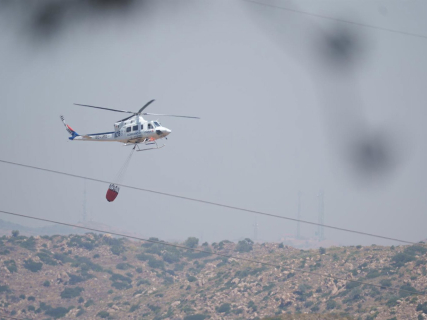

The nurse of the Scientific Culture Unit of the General Council of Nursing, Héctor Nafría, has underlined the relevance of knowing how to react to a forest fire and has insisted that the first step should be to notify the emergency services and, then, head to a safe area.
The General Council of Nursing (CGE) has conveyed its condolences to the relatives of the fatalities of the fire declared in the surroundings of Los Gallardos (Almería) and has expressed its deep sorrow for the situation the province is going through, where there are more than 20 people missing.
"One more summer we are facing a new fire crisis, which once again puts the health and integrity of thousands of people across the country at risk. From the General Council of Nursing, we want to convey all our pain to the families and loved ones of the victims and we hope for a speedy recovery for all those affected. There is no comfort for these moments and we must all fight to stop this wave of fires that devastate the country year after year," said the president of the CGE, Florentino Pérez Raya.
How to protect yourself and help in a fire
Through its Spanish Nursing Research Institute, the CGE has recalled the main measures that should be followed in the event of a fire, disseminating a list of prevention and action recommendations for those who are nearby or are affected by the fire.
"What we are seeing in these last few days is an impressive disaster. A situation that endangers the health of the population, as well as thousands of homes and cultural heritage. We consider it essential that the population knows some guidelines for action in these cases to avoid greater problems and safeguard, above all, their health," stated Pérez Raya.
In the presence of a fire, the General Council of Nursing (CGE) indicates that one should call 112 immediately, providing the most precise location possible and detailing what is burning and the direction in which the fire is spreading. Afterwards, it advises moving away from the flames by descending slopes and positioning oneself against the wind. Likewise, it recommends breathing through the nose and covering the mouth and nose with a damp cloth.
Next, a safe area should be located, preferably already burnt areas, rocky areas, roads or riverbanks, avoiding places with dense vegetation or low branches. If the fire is close, it is essential to follow the instructions of the authorities and official sources, including the eventual use of a mask.
At home, the CGE suggests closing doors and windows and not using air conditioning. If the person is trapped, it suggests taking refuge in a hollow in the ground or in an area without vegetation. If clothing catches fire, one should not run: one must throw oneself to the ground, roll and cover oneself.
Action in case of burns and smoke inhalation
When a burn occurs or smoke has been inhaled, the CGE advises moving the victim away from flames, embers or hot surfaces and cooling the affected area with cold running water (not icy) for between 5 and 20 minutes. It insists that ice or very cold water (below 8 ºC) should not be used, as it increases the risk of tissue necrosis, nor should seawater be used.
The professional body recommends covering the person to prevent hypothermia and removing tight clothing and objects, such as rings, watches or belts, as long as they are not stuck to the skin.
Afterwards, the burn should be covered with sterile gauze or a clean, dry cloth, maintaining the best possible aseptic conditions both at the scene of the incident and during transport to the health center. Compresses or towels soaked in saline solution or water can also be used to protect the injuries.
Similarly, the CGE indicates that creams, toothpaste or oils should not be applied to the burn and that it is essential to start fluid replacement as soon as possible, either at the scene of the event or in the first medical facility that attends to the person. Furthermore, it highlights the need to control pain and ensure maximum comfort during transport.
Finally, the CGE recalls that it is essential to seek urgent medical attention when the burn is deep or extensive, affects the face, hands, feet, genitals or joints, or if respiratory distress or cough occurs after smoke inhalation.