
The Vithas Neurociences Institute (INV) has announced the launch of new medical equipment and units focused on neurological pathologies that cover the full life cycle, from childhood and adolescence through adulthood and senior people. These units cover all areas of knowledge, including neuropediatrics, technopathies, neurological emergencies, neurosurgery, and neurorehabilitation.
According to Vithas, thanks to this expansion of services, the Vithas university hospitals Madrid La Milagrosa, Vithas Madrid Aravaca, and Vithas Madrid Arturo Soria will be able to offer an interdisciplinary approach and treatments tailored to each patient, with professionals “highly specialized” and “with extensive experience in the different areas of neurology.”
With this reorganization, the INV in Madrid consolidates its care model through highly specialized clinical units. Under the direction of David Ezpeleta, a neurologist, vice president of the Spanish Society of Neurology and of the Spanish Brain Council, the Vithas Neurociences Institute in Madrid proposes a continuous approach to complex neurological diseases from childhood through the senior stage.
Vithas emphasizes that the INV has structured its care activity into different specialized units: Functional Neurological Disorders, Headaches, Cognitive and Behavioral Neurology, Movement Disorders, Neuroimmunology and Neurooncology, Neuropediatrics and Transition Neurology, Sleep and Wakefulness Disorders, Clinical Neurophysiology, Epilepsy, and General Neurology.
“This reinforcement allows us to provide more precise, interdisciplinary neurological care centered on the patient, with an approach that combines science, technology, and humanization. Having an outstanding multidisciplinary team allows us to move toward tailor-made neurology and increasingly more individualized care to guarantee an up-to-date, cutting-edge diagnostic and therapeutic offering,” Ezpeleta said.
At the national level, the group notes that the INV is configured as a clinical-technological ecosystem in which advanced diagnosis, innovative therapies, and individualized follow-up are integrated. Among the services it offers are minimally invasive surgery, deep brain stimulation, non-invasive neurostimulation, disease-modifying treatments, and participation in clinical trials.
Scientific day on current challenges in neurology
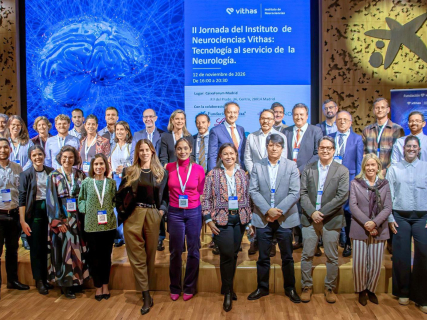
The update of the INV, conceived as a cross-cutting project across the group’s 22 hospitals, has been presented at a scientific day in which specialists from Vithas and other hospital centers have reviewed the latest advances in neurology, emerging clinical challenges, and the importance of coordinated and networked work in the care of neurological patients.
In four working sessions, the experts debated topics such as sleep disorders in childhood and adolescence, genetics applied to neuropediatrics, the management of stroke, epileptic seizures, high-risk headaches, progress in functional neurosurgery, and new applications of technologies such as transcranial magnetic stimulation, robotics, virtual reality, or brain-computer interfaces.
"For five years now, the Vithas Neurosciences Institute represents very well the way we understand medicine: knowledge that is not shared loses an important part of its value," Vithas CEO Pedro Rico has highlighted.
The top executive of the group has reiterated that the model of Vithas Institutes "is not only a sum of excellent specialists, but a network of knowledge capable of connecting professionals, hospitals, disciplines, and clinical experiences; of sharing protocols and good practices; and, above all, of ensuring that this knowledge reaches the patient, regardless of the center where they are treated".
A vision shared by the Corporate Director of Assistance, Quality and Innovation at Vithas, David Baulenas, who has insisted on the need for a multidisciplinary approach for neurological conditions, "and this is only achieved in environments like that of the Vithas Neurosciences Institute".
The president of the Spanish Society of Neurology, Jesús Porta-Etessam, has closed the day by reminding that neurology is heading toward greater subspecialization in order to offer more tailored responses to each disease.
"The future of neurology will need super-specialized centers," Porta-Etessam has emphasized, highlighting the model driven by the INV. He has also pointed out that meetings of this kind broaden the perspective on the challenges and units of the specialty: "This day opens your mind even more to everything that is coming and everything we can do in the future".