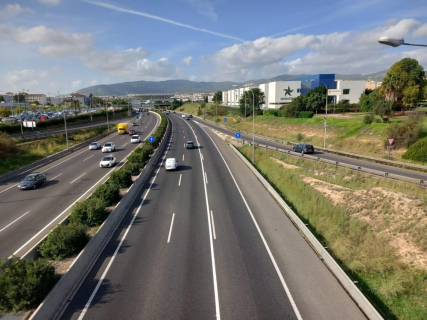

The full sitting of the Parliament is expected to give final approval next Tuesday to the law that will regulate the entry of vehicles in Mallorca and to the reform of the Law of Menorca Biosphere Reserve, which will make it possible to set access limits along the same lines.
It is expected that both measures will move forward with the support of all the groups in the regional Chamber except Vox, which will opt for abstention. This will reproduce the same balance of forces that made it possible to begin the parliamentary processing of these texts.
However, the closing of the process will not be free of controversy. The spokesperson for Més per Menorca, Josep Castells, has publicly accused the PP of "hypocrisy" and has argued that "it has no intention" of actually applying an effective regulation on the entry of vehicles.
"The laws will be approved but the insular councils will not have time to carry out the regulatory rollout, but the PP will already have sent the message to the public," the Menorcan deputy warned, questioning the will of the regional Executive to implement the measures in the short term.
For its part, Vox spokesperson Manuela Cañadas has explained that her group will abstain—after initially having opposed the initiative—because, although they share the diagnosis of overcrowding, they consider that limiting the entry of cars "is not the solution".
Law content for Mallorca
The specific regulations for Mallorca provide for setting an annual or biennial cap on vehicles and the creation of an access fee. Shipping companies will assume the management of authorizations, the collection of the fees, and the application of exemptions for residents and temporary workers. In addition, a maximum number of rental cars is established and a penalty regime with fines of between 300 and 30,000 euros.
Proof for entry and stay on the island, as well as the management of the payment of the fees that are determined, will be done electronically via the procedure that is set out in the corresponding tax ordinance. The installation of cameras in the ports is also planned, with license-plate reading systems.
Non-residents who have housing in Mallorca will be excluded from the limit, although they will only be able to link one vehicle to that property. Likewise, residents of other islands who must travel to Mallorca for medical reasons are exempt, as well as residents in Mallorca who are outside and need to return for medical or family reasons.
Vehicles of persons with duly accredited reduced mobility, as well as official vehicles and public service vehicles, will be exempt from paying the fee. Nor will vehicles dedicated to the transport of goods and merchandise or those for commercial distribution pay the fee.
Changes to the Menorca Biosphere Reserve Law
In the case of Menorca, the amendment to the Biosphere Reserve Law will make it possible to set a maximum capacity of vehicles, restrict their entry and stay during certain periods of the year, establish an overall ceiling, and approve measures that promote public transport and a more sustainable mobility model.
One of the key points of the reform is that vehicles owned by natural persons registered in Menorca will be excluded from the entry and stay limiting system. Likewise, non-residents who have housing on the island will be able to have one vehicle per property.
Vehicles of persons who prove the need to travel to Menorca for professional reasons and those of persons with reduced mobility will also be exempt. Similarly, the rule will not affect official vehicles and public service vehicles; emergency services; public and school transport; taxis; freight and commercial distribution transport vehicles, as well as machinery and vehicles for industrial, livestock, and agricultural use.
Other matters from Tuesday’s plenary session
In addition to the debate on these laws, the plenary session will address a motion by Unidas Podemos concerning general housing policy and an interpellation by the PSIB on equality.
In the control session with the Govern, the councillors will have to respond to questions related to youth unemployment, the dependency system, the housing crisis, the pilot plan for free language choice, the integration of the IB3 workforce, the increase in the SMI, and feminism.
A large part of these questions will be conditioned by the general elections of next November 29. In several cases, the electoral programs and commitments of different parties are referred to directly.
The president of the Government, Marga Prohens, will have to respond about the salary that, in her opinion, a person from Menorca should receive in order to live with dignity (Més per Menorca), about how she considers that progress can be made on rights (MÉS per Mallorca), the Government’s reaction to the request to exempt the Balearic Islands from the immobilization of a percentage of olive oil (Vox), and whether she understands that the proposals of the PP and Vox candidates “are good for the Balearic Islands” (PSIB).