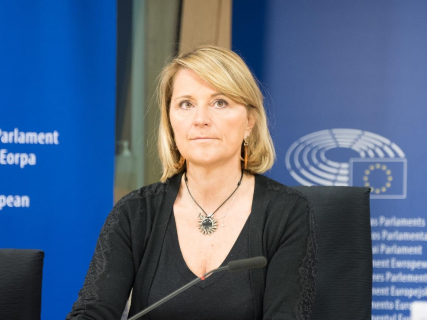

The PP MEPs Rosa Estaràs and Javier Zarzalejos have reiterated in the European Parliament their criticisms of the operation of domestic abuse monitoring bracelets in Spain, considering that "they are not working" and that "they put the lives of women and their families at risk".
During the debate, held to coincide with the International Day for the Elimination of Violence against Women, the 'popular' representative for the Balearic Islands stressed that, according to European directives, these devices "were supposed to be safe and reliable and they have not been". In her view, this situation has occurred "all this with the knowledge and inaction of the Government of Spain".
Estaràs has responded in this way to the Socialist MEP Lina Gálvez, who defended that the domestic abuse monitoring bracelets do work and accused the PP of sowing doubts about the system, as the Partido Popular has reported in a statement.
The MEP has underlined that the European Public Prosecutor's Office keeps an investigation open and has pointed out that judges, the Prosecutor's Office, the Court of Auditors, the General Council of the Judiciary, and the technical experts involved have alerted to shortcomings in these devices.
In her remarks, she also mentioned the case of a woman from Eivissa who, as she indicated, "was admitted several times to the ICU due to the malfunction of her bracelet".
Estaràs added that "facts like prostitution paid for with public money or the hundreds of sentence reductions for rapists are indefensible and show that never before had women been so unprotected".
For his part, Javier Zarzalejos has defended that it is essential to review the effectiveness of the existing protection measures and draw conclusions from the errors made to strengthen prevention and victim protection policies.
The MEP insisted that "we have to learn from the lessons" and described as "deeply worrying" that a legislative reform promoted by "a Government that claimed to be progressive" has led to the early release of hundreds of sexual offenders.
Likewise, Zarzalejos referred to the European Public Prosecutor's Office investigation into the purchase of domestic abuse monitoring bracelets and warned that the quality of these mechanisms is "more than questionable".
In addition, he has lamented that the "immense majority" of sexual abuse content that circulates on the Internet has women of all ages as victims, and he has warned that this phenomenon has been worsened by the use of artificial intelligence.
In this vein, he has emphasized the shared responsibility between public authorities and digital platforms when it comes to combating this type of violence.
Estaràs has also alerted that cyberviolence is not limited to the virtual environment, but that it "harasses, monitors, humiliates and silences many women, with real consequences for their health, safety and participation".
Both Members of the European Parliament have called for speeding up the transposition of the European directive against violence against women and domestic violence, whose deadline ends in June 2027.
Zarzalejos has demanded that the European Commission go beyond mere support for the Member States and require them to carry out a correct transposition, denouncing those who do not comply with their obligations.
For his part, Estaràs has demanded that the transposition of the directive be immediate in order to "move from words to action," and he has recalled that both this rule and the Victims Protection Directive set out the obligation of the Member States to protect women and prevent violence.
"Women's rights have to be a priority in all European agendas," Estaràs has asserted, who has called for a change in policies so that women "feel truly protected."