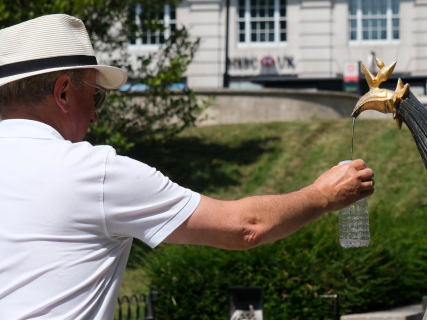

The grand celebration of the 250th anniversary of the United States arrives marked by a wave of extreme heat that is altering the events of July 4th in a large part of the country. High temperatures are particularly affecting the center and east of the United States and have forced authorities to suspend parades, limit hours, and reinforce security measures to prevent heatstroke among attendees.
The impact is especially noticeable in Washington, the main stage for the Independence Day commemorative events. Organizers have canceled the parade scheduled for Saturday morning on the National Mall, the large esplanade stretching between the Capitol and the Lincoln Memorial, for security reasons. The decision was made, according to the organization Freedom 250, after assessing the risk to participants, spectators, and staff.
Alerts in 30 states and temperatures up to 44 degrees
The National Weather Service has issued extreme heat alerts in 30 states, with temperatures that could reach 44 degrees. The heatwave coincides with one of the busiest outdoor weekends in the United States, with parades, barbecues, family trips, concerts, and fireworks across the country.
Authorities have urged extreme caution, especially among the elderly, children, chronically ill, and those participating in large gatherings. In Washington, access controls to National Mall activities have been relaxed to allow the entry of non-glass water bottles and portable coolers, in addition to installing shaded areas, air-conditioned tents, and water supply points.
The goal is to prevent the celebration from turning into a health emergency. Paramedics and firefighters have already responded to calls and incidents related to heatstroke in the capital, while the Centers for Disease Control and Prevention warns of very high rates of illnesses linked to high temperatures among Philadelphia, Washington, Maryland, and Virginia.
Washington reduces events and hours
The Great American State Fair, one of the activities planned in Washington to highlight the national commemoration, has also reduced its hours. On Friday, the hottest day, opening was postponed until 5:00 PM, and on Saturday, entry has been set from noon, two hours later than planned.
The organization has insisted that the safety and well-being of attendees, volunteers, artists, vendors, and staff are the priority. The decision reflects the extent to which the weather has conditioned a celebration prepared for months and designed to project an image of national unity on the most symbolic anniversary of the United States in decades.
The threat is not just the heat. Meteorologists also warn of the risk of thunderstorms during the afternoon and evening, just when President Donald Trump's speech and the fireworks display are scheduled in the capital.
Philadelphia suspends its grand parade
The impact has also been felt in Philadelphia, the city where the founding fathers signed the Declaration of Independence. There, the grand parade planned for Friday, which was to feature 20 floats and around fifty marching bands, has been suspended.
The cancellation carries a strong symbolic weight. Philadelphia holds a central place in the founding memory of the United States and was meant to be one of the main stages for the 250th-anniversary celebration. However, the heatwave has forced a prioritization of safety over festive programming.
Heatstrokes and health emergencies
The episode has already left significant incidents. Nearly fifty cities have registered heat records since Thursday, and about 100 people required medical attention in Muhlenberg Township, Pennsylvania, during an event they had attended to see the arrival of a Union Pacific steam locomotive.
Organizers had to activate a mass casualty incident protocol to deploy more emergency resources, ambulances, tents, and cooling facilities. The case illustrates the risk of organizing large outdoor activities in the midst of a heatwave, even when they are not political events or large national gatherings.
Experts also warn that elevated nighttime temperatures offer little relief and that humidity increases the risk of heat-related illnesses. The combination of persistent heat, high humidity, and mass events makes this July 4th a particularly delicate day.
A historic anniversary conditioned by the climate
The United States reaches its 250 years of independence with a celebration marked by extreme weather. The country commemorates a foundational date, but a good part of the planned events are being conditioned by heat, health alerts, and the risk of storms.
The image summarizes a paradox of the current American moment: a big national party designed to celebrate the country's historical continuity is forced to adapt to a climatic phenomenon that affects millions of people and strains infrastructures, electrical grids, health services, and security devices.
July 4th will still have fireworks, speeches, and patriotic symbols. But this year, on the 250th anniversary of independence, the authorities' message is less epic and more practical: hydrate, seek shade, avoid risks, and do not underestimate a heatwave that has already altered the big national celebration.