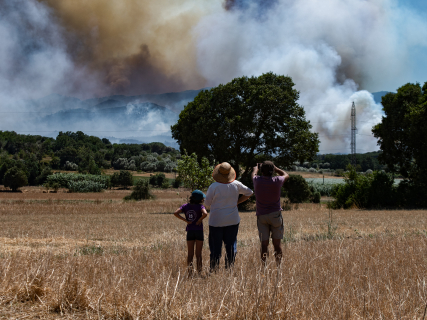
Second day of the fire in Costa Brava: affected houses and 2,300 hectares

The fire in the Costa Brava remains active this Saturday after ravaging some 2,300 hectares and reaching homes in Calonge. The fire, which originated in La Bisbal d’Empordà, maintains confinements in Les Gavarres and forces emergency services to work against the wind and heat.

1 minute

EuropaPress 7640755 varias personas observan humo incendio bisbal demporda girona catalunya

EuropaPress 7640755 varias personas observan humo incendio bisbal demporda girona catalunya

Add DEMÓCRATA to Google

Ask FREN

Published

Last updated

1 minute

Most read


Second day of fire on the Costa Brava. The fire declared in La Bisbal d’Empordà has burned about 2,300 hectares, has forced about 10,000 people to be confined, and has reached homes in a development in Calonge

The news since last night's update is significant: the flames have reached the Cabanyes development in Calonge, where one house has burned down and other homes have suffered damage to gardens and fences.

The fire affects the protected area of Les Gavarres and has been driven by the tramontana, the sea breeze, and high temperatures. Emergency teams are working with the priority of stabilizing the perimeter before the wind complicates things again.

Homes affected in Calonge

The spread to a residential area changes the reading of the news. It is no longer just hectares burned. It is a direct risk to homes, residents, and tourist towns in the middle of high season.

About 120 people spent the night in a sports pavilion in Calonge, while mobility restrictions and requests to avoid travel to the area remain in place. 

Vulnerable groups have also been evacuated or confined, including children who were at summer camp

The origin of the fire and the role of the wind

The Mossos arrested a man for his alleged connection to the origin of the fire, linked to the use of a circular saw in an area with restrictions due to extreme risk.

The fire combines three maximum risk factors: dry vegetation, changing winds, and heat. This context explains why the fire has advanced rapidly and why the priority is to close the perimeter before instability increases.

More key points, information and questions with FREN

AI-GENERATED CONTENT

What protocols do emergency services in Catalonia follow to stabilize large forest fires?

In Catalonia, emergency services follow the protocols of the Special Emergency Plan for Forest Fires in Catalonia (INFOCAT) and the state and regional fire regulations to stabilize large forest fires. These protocols organize the chain of command, coordination between Firefighters, Agents Rurals, Civil Protection, and other bodies, as well as specific tactics on the ground. Stabilization is understood, based on official reports, as the moment when the operational perimeter of the fire is closed and its spread is halted, especially on the flanks and the head of the fire. All this is framed within a recent climate change adaptation strategy that strengthens procedures, resources, and safety measures.

Regulatory and organizational framework (INFOCAT and basic regulations)

The general protocol is defined by INFOCAT, approved by Agreement GOV/141/2014 and developed in its documentation in Spanish available from the Generalitat (INFOCAT plan and annexes) and in the updated report (INFOCAT Report 2026). The plan's objective is to “establish the organizational framework” for a coordinated and effective response to large-scale fires, also requiring municipalities to have local plans aligned with these guidelines.

As explained by Civil Protection in presentations of the new INFOCAT to municipal officials in Central Catalonia (Berga note), the plan revision was made to respond to increasingly frequent scenarios of extreme risk and simultaneous fires. The new INFOCAT:

– Improves the structure of operational groups and decision-making flow.
– Expands population protection measures and the number of municipalities required to have a municipal plan.
– Adapts the organization for rapidly evolving fires and sudden impact on the population.

At the state level, the Ministry for the Ecological Transition includes Catalan and general forest fire regulations on its portal (Catalonia regulations). For the tactical use of fire in extinguishing, personnel follow Decree 312/2006 on technical fire management, as well as state safety standards such as the OACEL Protocol and the “10 rules in forest fire fighting” compiled by MITECO (safety rules and protocols).

Activation of INFOCAT and operational coordination

When the risk is very high or a large fire is declared, Civil Protection activates INFOCAT in alert or emergency phase, as detailed in successive notes on plan activations and deactivations (INFOCAT deactivation 2024; heatwave alert 2025). Political and civil protection leadership coordinates with the operational command of Generalitat Firefighters, Agents Rurals, and Mossos d’Esquadra.

In recent campaigns, the Interior Minister has emphasized that work is done “with maximum coordination between Generalitat Firefighters, Agents Rurals, Civil Protection, and other involved services” to provide the best response, especially in the face of simultaneous fires (2026 campaign presentation). Within the forest strategy, “containment axes” have been identified, i.e., areas designed to limit the spread of large fires and facilitate their stabilization.

When the fire crosses administrative borders, protocols of mutual direction and assistance between autonomous communities are activated, as seen in joint exercises (“Ebro 2021”) described in Ministry materials (coordination exercise).

Specific tactics to stabilize large fires

Operationally, stabilization is based on a combination of advanced fire behavior analysis, massive deployment of resources, and prioritization of critical perimeter points. The Generalitat highlights the role of the Forest Action Group (GRAF), which monitors meteorological parameters daily and, when there is an active fire, evaluates fire-atmosphere interaction through virtual simulations to anticipate extreme phenomena such as pyrocumulus clouds, as explained in Interior's 2025 forest campaign documents (2025 forest campaign).

Official reports of recent fires show how these protocols are applied in practice. In the Batea forest fire (Terra Alta), Firefighters mobilized 149 personnel and 57 vehicles, including GRAF, EPAF, and other groups, and worked jointly with Aragón resources to “close the tail of the fire” and thus declare it stabilized at 08:00 hours (Batea fire). In the Figuera fire (Priorat), Firefighters prioritized the right flank to prevent the wind from opening it toward the Figuera and Cabacés nuclei, and stopped the head's spread in fields and along the T‑730 road before declaring it stabilized (Figuera fire).

Preventively and for first intervention, devices such as the Special Forest Fire Prevention Groups (GEPIF) are reinforced, with 10 bases and 95 operational personnel in 2026, dedicated both to surveillance during high-risk episodes and rapid first intervention to prevent outbreaks from becoming large fires (2026 campaign). The Government complements this with structural prevention and damage restoration measures (urgent measures package 2025) and awareness campaigns such as “FOC és FOC,” which stresses self-protection and restrictions on risky activities during critical periods (FOC és FOC campaign; harvest campaign).

Overall, the INFOCAT system and associated protocols seek that, in the event of a large fire, Catalan emergency services have clear command, advanced analysis tools, strategic containment points, and a combination of ground and aerial resources that allow closing the perimeter and stabilizing the fire with the highest possible safety for the population and responders.

Into which official phases does the INFOCAT Plan divide the management of a large forest fire, and what exactly does it mean for a fire to be “stable” or “controlled”? What specific role do municipalities and their municipal fire plans have within the INFOCAT protocols when a large fire is declared? How do Generalitat Firefighters and the UME coordinate when state support is requested for a forest fire in Catalonia?

What are the competencies of the Mossos d'Esquadra regarding the investigation of forest fires?

In Catalonia, the investigation of forest fires is divided among several bodies: the Agents Rurals handle the technical-administrative investigation (origin, causes, environmental infractions), while the Mossos d’Esquadra assume the criminal investigation as judicial police when the fire constitutes a crime. This action is integrated into the Catalan public safety and civil protection system, where Generalitat Firefighters and, if applicable, the Guardia Civil and other state bodies also intervene. The direction of the criminal procedure always corresponds to judges and prosecutors; Mossos act under their authority, coordinating with technical teams (Agents Rurals, firefighters) to obtain evidence.

General competence framework of the Generalitat and the Mossos

The Statute of Autonomy of Catalonia (Organic Law 6/2006) recognizes the Generalitat's competencies in public safety and civil protection. Its articles establish that the Generalitat can create and organize the Police of the Generalitat–Mossos d’Esquadra and that it exercises, throughout Catalonia, “all the functions typical of a police force,” including judicial police and criminal investigation, “under the terms established by law.”

The Law 10/1994, of the Police of the Generalitat – Mossos d’Esquadra (Law 10/1994) develops this mandate and emphasizes that the force must act in judicial police functions according to the Constitution and the Organic Law of the Judiciary, and that assisting judges, courts, and prosecutors in the investigation of crimes and the discovery and arrest of offenders is an essential and permanent activity.

At the state level, the Organic Law 2/1986, of Security Forces and Corps (LO 2/1986) defines the general functions of police forces, including crime investigation and collaboration with civil protection. It also assigns the Guardia Civil, generally, functions of surveillance and protection of forest wealth and the environment but allows intervention and collaboration of autonomous police in judicial police functions.

Specific role of Agents Rurals and technical fire investigation

The Law 17/2003, of the Corps of Agents Rurals (Law 17/2003; consolidated Catalan text Llei 17/2003) is key to understanding who investigates the causes of forest fires:

Its article on functions establishes that the Agents Rurals Corps is responsible for prevention, surveillance, detection, and investigation of forest fires. Another provision specifies that this body must “investigate infractions” within its competence areas, aiming to determine their scope, causes, and alleged perpetrators. The law also indicates that Agents Rurals exercise special administrative police functions and, as provided by law, judicial police functions.

Additionally, the law foresees a specific specialization area in “prevention and investigation of forest fires,” consolidating its role as the technical reference body in determining fire origin, propagation models, breaches of preventive measures, etc.

Criminal competencies of Mossos d’Esquadra in forest fires

When a forest fire shows indications of crime (e.g., gross negligence, intent, massive damage, risk to people), the competence for criminal investigation corresponds to judicial police bodies. In Catalonia, according to the Statute and Law 10/1994, this means that:

  • Mossos d’Esquadra assume the police proceedings (securing the scene, identifying suspects, taking statements, chain of custody of evidence, police reports).
  • They act under the functional direction of judges and the Public Prosecutor's Office (article 126 CE and procedural legislation).
  • They integrate into the criminal case the technical reports prepared by Agents Rurals and, if applicable, by Generalitat Firefighters.

The Law 4/2003, on the Organization of the Public Safety System of Catalonia (Law 4/2003) configures a unique public safety system integrating police, civil protection, traffic, and other areas, and assigns the competent minister the superior command of the Mossos and coordination with local police. Within this framework, the criminal investigation of forest fires by Mossos is conceived as part of this integrated system.

Coordination with Firefighters, civil protection, and Guardia Civil

In emergencies, the Law 4/1997, of Civil Protection of Catalonia (Law 4/1997) places the Police of the Generalitat within the civil protection device, alongside Firefighters and other services. For the specific risk of forest fires, the Special Plan INFOCAT also relies on Law 5/2003, on forest fire prevention measures (Law 5/2003), which links municipal and self-protection plans to the Catalan civil protection structure.

At the state level, the Basic Directive for Civil Protection Planning for Forest Fire Emergencies approved by Royal Decree 893/2013 and the State Civil Protection Plan for Forest Fire Emergencies (Resolution of October 31, 2014, with correction in BOE 23-1-2015) establish coordination between the General State Administration and autonomous communities. These texts contemplate:

  • The participation of the State Security Forces and Corps (General Directorate of Police and Guardia Civil) in surveillance, access control, citizen security, and emergency management support.
  • The integration, in states of national interest emergency, of security forces “competent in the territory of the autonomous community concerned,” which includes the Mossos d’Esquadra in Catalonia.

Therefore, in a large forest fire in Catalonia, the typical functional chain is: Firefighters direct extinguishing on the ground; Agents Rurals investigate origin and causes from a forest and environmental perspective; Mossos d’Esquadra assume the criminal investigation and refer it to the judge or prosecutor; and Guardia Civil or other state bodies collaborate when the emergency acquires supra-autonomous dimension or as provided within the state civil protection framework.

Operational summary

In summary, Mossos d’Esquadra are not the primary technical body to determine the physical causes of fires (a role that falls to Agents Rurals), but they are the police competent in Catalonia for the criminal prosecution of forest fire crimes, acting as judicial police. Their intervention is articulated in close coordination with Agents Rurals, Firefighters, and, when appropriate, Guardia Civil and other bodies, within the autonomous and state civil protection plans.

What specific role do Agents Rurals have in investigating the causes of a forest fire and how are their reports integrated into the criminal case? Under what circumstances does the Guardia Civil also intervene in forest fires occurring in Catalonia and how do they coordinate with the Mossos d’Esquadra? What does the Special Plan INFOCAT foresee regarding the participation of Mossos, Firefighters, and Agents Rurals during a major forest fire emergency?

What legal requirements exist in Catalonia for the use of dangerous machinery during periods of extreme fire risk?

In Catalonia, the basic regime affecting the use of machinery during periods of extreme fire risk derives from Decree 64/1995, of March 7, on forest fire prevention measures, amended by Decree 206/2005, and is integrated into the general framework of the Law 6/1988, Forest Law of Catalonia. In situations of extreme risk (art. 18 of Decree 64/1995), forest exploitation and the circulation of people and vehicles not linked to the area are prohibited, which in practice blocks the ordinary use of much forest or agricultural machinery in forest lands and their 500 m buffer zone. Between March 15 and October 15, there is also a stricter seasonal regime with additional prohibitions and a system of prior authorizations. The regulations do not explicitly mention the Pla Alfa, which is an operational instrument of the administration, but its levels are based on this legal framework.

1. Main legal framework

The prevention and usage regime during risk periods is structured around:

LAW 6/1988, of March 30, Forest Law of Catalonia: establishes the Administration's competence for forest fire prevention and foresees the declaration of high fire risk zones (arts. 39 and 39 bis), as well as the obligation of municipal prevention plans (art. 40, cited by Law 5/2003).
DECREE 64/1995, of March 7, establishing forest fire prevention measures, which contains the core prohibitions and authorizations by periods and risk levels.
DECREE 206/2005, of September 27, which modifies art. 17.2 of Decree 64/1995, reinforcing restrictions in high-risk zones and periods.
LAW 5/2003, of April 22, focused on urbanizations and buildings in forest lands, complementing preventive obligations (buffers, self-protection plans, hydrants, etc.).

2. General regime March 15–October 15

Chapter 4 of Decree 64/1995 regulates the “Rules of application during the period between March 15 and October 15”:

– Art. 15 (“Prohibited actions”) establishes that, in forest lands, wooded or not, and in the 500 m buffer zone around them, during that period it is “prohibited”:
  • Lighting fires for any activity, including burning forest, agricultural, or gardening residues.
  • Throwing lit objects or pouring residues that could start a fire.
  • Launching rockets, fireworks, or other fire devices.
  • Using blowers or similar in works carried out on communication routes crossing forest lands (fully affecting certain public works machinery for paving, maintenance, etc.).

Art. 16 regulates an exceptional authorization regime by the Department of Agriculture, Livestock, and Fisheries for some activities in art. 15 (mainly burnings and use of blowers), processed through municipalities and county offices; these authorizations can be revoked on site by rural agents when weather conditions worsen.

3. High-risk zones (June 15–September 15)

Art. 17 of Decree 64/1995, as amended by Decree 206/2005, declares high forest fire risk zones from June 15 to September 15 in certain municipalities listed in the annex.

In this context:

– Art. 17.2, after the modification by Decree 206/2005, provides that, during that period and in those zones, “the activities mentioned in article 15 cannot be carried out” and “forest works generating plant residues will not be authorized”, except by express and exceptional authorization of the Director General of Natural Environment.
– This effectively tightens conditions for the use of forest machinery (chainsaws, processors, large-scale brushcutters), since most work generates plant residues.

4. Extreme risk periods (extraordinary measures)

Art. 18 of Decree 64/1995 foresees an additional level: “extraordinary measures” when meteorological conditions are of extreme risk (18.1). On those days and zones, which the Department of Agriculture must publicly communicate, it establishes (art. 18.3):

– Prohibition of “lighting any type of fire,” including gas stoves and barbecues of any kind.
– Prohibition of “carrying out any type of forest exploitation.” This implies, in practice, the halt of mechanized forest work (forest harvesters, processors, mechanized dragging, etc.) and much agricultural machinery work if it involves exploitation in forest land or its buffer.
– Prohibition of the circulation of people and vehicles not linked to the area, restricting the entry of machinery not strictly necessary and linked to essential services.
– Suspension of all previously granted authorizations (18.4).

5. Sanctioning regime

Art. 19 of Decree 64/1995 establishes that violations of its provisions are sanctioned according to the Law 6/1988, Forest Law of Catalonia and the current state forest fire legislation (Law 81/1968 is cited). The amounts are not detailed in this text but refer to those sanctioning frameworks, which contemplate minor, serious, and very serious infractions with increasing fines and possible additional liabilities if a fire is caused.

In summary, during the summer period (March 15–October 15) and especially in high-risk zones and extreme risk episodes, the use of dangerous machinery in forest lands of Catalonia is heavily restricted or directly prohibited, subject only to very exceptional and always revocable authorizations depending on risk evolution.

How is this regime of Decree 64/1995 coordinated with the operational levels of the Pla Alfa applied by Agents Rurals? What specific obligations do municipalities and urbanizations have according to Law 5/2003 to prevent fires when there is extreme risk? What types of infractions and sanctions does the Forest Law of Catalonia foresee for violating machinery use restrictions during high-risk periods?

Play

Test your knowledge with FREN!

How much do you know about this topic? Answer the following 3 questions.

In which municipality did the fire in the Costa Brava originate?

Question 1 of 3

Approximately how many people have been confined due to the fire?

Question 2 of 3

What factors have favored the rapid spread of the fire?

Question 3 of 3

Hola, soy Fren. ¿Cómo te ayudo?