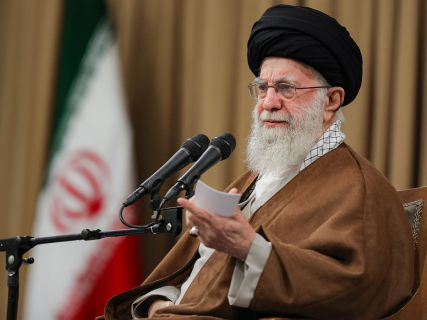

Iranian authorities have ordered this Thursday the suspension of rail traffic between Tehran and the city of Mashhad due to the latest series of air attacks carried out by the United States against the country, a few hours before the start of the burial of the former supreme leader, Ayatollah Ali Khamenei, in a prominent mausoleum in this northeastern city.
"Following the criminal attack perpetrated this morning by the Zionist-American enemy on one of the points of the railway route between Tehran and Mashhad, the circulation of passenger trains on this route has been interrupted," the Islamic Republic of Iran Railways indicated in a message published on social networks.
The agency specified that technical teams "were immediately sent to the site" and added that "reconstruction work is already underway." "Efforts are being made to repair this route as soon as possible," it stated, before emphasizing that affected passengers are being transported by other means.
Khamenei's Funeral and the Mausoleum's Relevance
The funeral ceremonies in memory of Khamenei, assassinated on February 28 in the early moments of the surprise offensive launched by the United States and Israel against the Asian country, began on Friday in Tehran. After a day of processions in the Iraqi cities of Najaf and Karbala on Thursday, his body will be buried today in the mausoleum of Imam Reza, considered one of the main pilgrimage centers of Shiism.
Damage to Strategic Infrastructure
According to the Iranian news agency FARS, the bombings have also impacted a bridge located in the province of Golestan, in the north, through which runs the railway line connecting Tehran with China and which is also used for the transport of goods to Russia, given the blockade imposed by the United States on Iranian ports operating through the Strait of Hormuz.
The affected viaduct is located in the town of Aqala and constitutes a key point of the corridor between Iran and China, its main trading partner. This route, integrated into the Belt and Road Initiative, crosses Turkmenistan and Kazakhstan and has gained special importance in recent months due to the aforementioned US blockade.
Military Escalation Between Iran and the United States
The United States has carried out several waves of bombings against Iranian territory between Tuesday and Thursday, alleging that it is retaliation for Iran's attacks against ships in the Strait of Hormuz, where Tehran claims that maritime traffic be coordinated with its forces until a definitive peace agreement is reached that puts an end to the open conflict in the Middle East due to the Israeli-American offensive.
In response to these attacks, which have caused at least fourteen deaths and nearly 80 injuries in two days, Iran has launched missiles and drones against American interests in various countries in the region. Both sides accuse each other of violating the terms of the memorandum of understanding signed in June, and warnings about a possible collapse of the ceasefire agreed upon on April 8, in which Israel also participates, are multiplying.