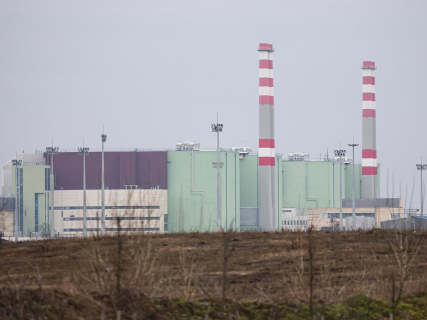

Paks, the only operational nuclear power plant in Hungary, has interrupted its activity this Saturday morning after a sharp reduction in its production, caused by the collapse of the Danube's flow to levels never seen before. This has been communicated by the Hungarian Prime Minister, Peter Magyar, who has urgently constituted a working group to manage an unprecedented blackout in the history of the plant, which in the past decade contributed approximately half of the electricity consumed in the country.
"Shutdown at Paks. The water level of the Danube has dropped even further. The current production is only 480 megawatts, compared to the normal 2,000 megawatts. Important announcements will soon be made regarding the decisions taken by the Defense working group," the Prime Minister explained in a message published on social media.
The shutdown ordered this Saturday is, for now, temporary, although Magyar had already indicated on Friday afternoon that the plant would be forced to halt its operations for several weeks starting next Tuesday or Wednesday, given that the flow of the Danube—key for the cooling of the reactors—will continue to decline in the coming hours.
In light of this scenario, the head of the Government has addressed the public to confirm that the situation is "critical," as Hungary is resorting to all available generation plants, including some facilities that required repair work to operate at full capacity.
"In recent days, we have asked the largest industrial energy consumers to voluntarily reduce their consumption. A significant number of the contacted companies have agreed to reorganize their production and reduce energy demand during the peak afternoon period," he explained.
Around 6:00 PM, Magyar appeared again on social media to announce the reactivation of the Dunamenti thermal power plant, which has added an additional 360 megawatts to the system.
Reduction of transport and extension of teleworking
To alleviate the pressure on the grid, Magyar has announced that, starting Monday, freight rail traffic will be suspended during the peak consumption hours, between 5:00 PM and 10:00 PM, in order to "reduce the energy demand of the rail system during the afternoon and free up additional reserves."
The Executive has also ordered that, during the first three days of next week, all public administration personnel whose position allows it switch to teleworking, with the aim of reducing energy expenditure in official buildings.
"We ask companies and employers to, in the coming days, offer the possibility of working from home to all employees whose work can be done remotely, and to minimize energy consumption in office buildings as much as possible," it has indicated.
In parallel, decorative lighting and all non-essential lights in state institutions will be turned off, and the Government trusts that municipalities and local administrations will also apply the strictest energy-saving measures within their reach.
Support from Slovakia in the face of the risk of energy crisis
Slovakia has offered to support Hungary to mitigate, as much as possible, supply problems. The Slovak Prime Minister, Robert Fico, has assured that he is closely monitoring the crisis triggered by the shutdown of Paks.
"We express our solidarity with our neighboring country, as well as our willingness to help. The possibility of a total shutdown of the nuclear power plant due to the lack of water from the Danube for cooling the reactors threatens Hungary with an unprecedented energy crisis," Fico has warned.
The Slovak leader has analyzed emergency electricity supply alternatives for Hungary together with the Deputy Prime Minister and Minister of Economy, Denisa Sakova, and with Branislav Strycek, Chairman of the Board of Directors of Slovak Power Plants.
Fico has added that the two Slovak nuclear power plants, Bohunice and Mochovce, are currently operating normally, despite the fact that the decrease in the flow of the Danube is also beginning to be felt in Slovak territory.