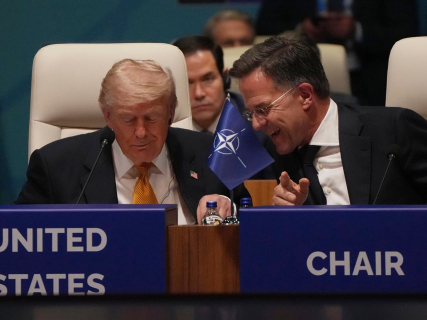

The NATO summit held in Ankara concluded this Wednesday after two days of maximum tension, during which the President of the United States, Donald Trump, began by agitating his partners, rescued his aspirations for Greenland, and even branded Spain as "bad people," to end by describing the meeting as "a success" marked by "unity" and "love."
The head of the White House went from the "disappointment" he expressed upon arriving in Turkey to speaking of "unification" among the allies, after realizing that his reproaches had little effect on the partners. They seem to have learned to turn a deaf ear to the attacks of the US leader, framing them as "rhetoric" that rarely transcends words.
"I told the Secretary General, Mark (Rutte), that it was a shame the press couldn't see what was going on. The unity in that room has been incredible (...) If you could have seen the respect and love in the room, love for our country," Trump recounted about the impression with which he left the meeting held this Wednesday with the 32 heads of state and government of the Atlantic Alliance.
This final turn contrasts with the cascade of reproaches that Trump himself had launched just a few hours earlier. "A lost cause," "a terrible partner," "hostile," "bad people." With these expressions, the North American leader disqualified Spain for refusing to increase military spending to 5% of its GDP.
On the eve, he also lashed out at the Prime Minister of Italy, Giorgia Meloni, against the British 'premier', Keir Starmer, and against other European partners such as France or Germany, whom he accused of not supporting him in the war in Iran. And the controversy amplified with Denmark, since, when it seemed that Trump had shelved his plans for Greenland, he again claimed sovereignty over the island.
"Denmark was invaded by the Nazis in less than a day, Hitler beat them in a day, he took control. They asked us to take care of Greenland. In fact, we took Greenland and then, stupidly, we gave it back. We shouldn't have given it back, because we are the ones who need it," he stated.
"You have to live" with "the rhetoric" of Trump
Faced with this noise, the NATO heads of state and government opted to minimize the criticism, emphasizing that Europe is already assuming a more relevant role in its own security and is redistributing the financial burden within the organization.
"The United States is the most important partner and that does not change because a president is a bit critical. We will listen to him, but that does not question the existence of the Alliance at all," stated the Prime Minister of Belgium, Bart de Wever, to the media.
The Prime Minister of Norway, Jonas Gahr Store, spoke in the same vein, framing Trump's attacks as "rhetoric" and warning that "we have to live with it." "If you look at the evidence, Europe is stepping up, not only in the way we spend, but because we spend wisely, without duplication."
A similar strategy was adopted by the President of the Spanish Government, Pedro Sánchez, who decided to defuse Trump's criticisms by taking the American's commercial threats "with calm and patience." He also revealed a brief informal meeting before the family photo in which they both conversed without "any tension" about football and golf.
Allies Reach 4% in Investment
Against this backdrop, the Secretary General of the Alliance, Mark Rutte, gave the occupant of the White House the opportunity to close the Ankara meeting with a speech to the other partners, in which he conveyed the same message as in public: that there was "a lot of love in the room," according to government sources.
The highest political official of NATO preferred to focus on "facts." "We know there is disappointment from the American side regarding Iran, but it has to do with isolated cases (...) And as for money and spending, Europe is now catching up with the United States," he told the press this Wednesday.
Rutte celebrated that, one year after the allies agreed to dedicate 5% of their respective GDPs to military capabilities by 2025, "already this year," by adding purely military spending and defense-related spending, the 32 member states have reached "4% investment."
Allies Pass Trump's Test
The Ankara meeting was designed for the bloc's partners to overcome the US president's scrutiny on defense spending. In Trump's opinion, most countries "have answered the call" of the last Hague summit and have committed to investing 5% of their GDPs in defense, except for "a couple" of states that have not yet taken that step.
The North American leader also expressed confidence that countries that have not yet adopted that objective —including Spain— will end up doing so "quite soon," after they showed themselves "very positive" about it this Wednesday.
In parallel, the allies exhibited industrial strength by announcing a package of joint purchases that includes some 37 billion in anti-drone capabilities, the joint acquisition of a fleet of Airbus A400M aircraft, and a project to strengthen supply chains for critical defense raw materials.
Although Trump's words did not alter the partners' serenity, the summit's iron security measures were breached by some of the best-known neighbors of Turkey's large cities: stray cats, which managed to sneak into the presidential palace under the curious gaze of journalists.
The most striking note of a meeting that ended with the staging of peace was the gift from the host, Recep Tayyp Erdogan, who gave the 32 NATO heads of state and government a revolver, according to allied sources confirmed to Europa Press.