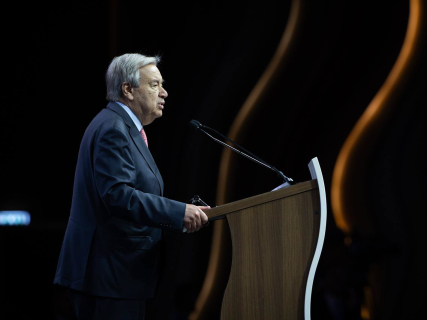

The Secretary-General of the United Nations, António Guterres, has stated this Sunday his “deep disappointment” at the outcome of COP31, held in Turkey, which has concluded without a global consensus pact. In this scenario, he urged governments to adopt immediate measures and to significantly raise their commitments to curb the climate crisis, accelerate the energy transition more rapidly, and strengthen the protection of the countries most exposed.
“This setback does not change the facts,” Guterres warned, emphasizing that although the negotiations have failed to reach a consensus, “there is no ambiguity in science.” He recalled that temperatures continue to set records, extreme weather events are intensifying, and emissions continue at very high levels, while the planet dangerously approaches the point of exceeding the limit of 1.5 degrees of warming.
The top UN official reiterated that the response to the climate emergency depends on decisively cutting dependence on coal, oil, and gas, which he identified as central engines of the current crisis. At the same time, he denounced that interests linked to the fossil fuels industry resort to tactics of disinformation, political obstruction, and decision-dragging, comparable to those used in the past by the big tobacco companies, all while they obtain “enormous profits.”
After calling to mind the commitment assumed by all States at COP28 in Dubai to progressively phase out fossil fuels in a “just, orderly, and equitable” manner, Guterres stressed that the challenge now is to provide sufficient financing and accelerate that transformation.
In this context, he also expressed his support for the roadmaps promoted by the Brazilian Presidency of COP30, aimed at moving forward on the energy transition and curbing deforestation and forest degradation, backed by the United Nations Climate Promise.
Dates, figures, and climate justice
In line with these objectives, Guterres has called for "deep and rapid" cuts in emissions throughout this decade, with a leadership role for the largest emitters and strict respect for financial commitments by developed countries. In addition, he has asked for the commitment to triple funding for climate adaptation to be specified with deadlines and amounts, in order to ensure that resources reach the communities that need them most.
"Lives depend on this," he emphasized, insisting that the countries that have contributed the least to the climate crisis should not have to shoulder its effects alone, an issue he has defined as "climate justice."
As a benchmark for measuring real progress, the Secretary-General has cited the reduction in fossil fuel consumption, the expansion of clean energy, the modernization of electricity grids, methane cuts, the restoration of forests, and the effective delivery of financing to developing countries. He has also highlighted the importance of strengthening protection against extreme phenomena through initiatives such as "Early Warnings for All".
Guterres has assured that the United Nations will maintain its commitment to this agenda and has concluded by addressing civil society, young people, indigenous peoples, the scientific community, and the most vulnerable populations, whom he has encouraged to continue putting pressure on governments and companies. "The climate crisis will not wait for governments to find common ground. We also cannot do that," he has ruled.