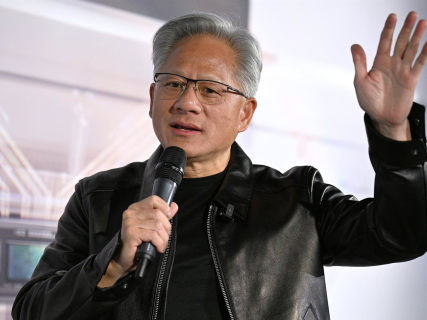
Nvidia returns to Jensen Huang as chief executive officer ten days after his resignation

The board of directors unanimously reinstates the founder of the chip giant eleven days after announcing his resignation. The company keeps open the investigation into any possible links to a foreign intelligence operation

fotonoticia 20261123144556 1920

fotonoticia 20261123144556 1920

Add DEMÓCRATA to Google

Ask FREN

Published

Last updated

3 minutes

Most read

Elecciones 29N · Encuestas

La media de las encuestas

Media a 23 de noviembre de 2026 · 22 institutos

  • PP31,3 %
  • PSOE28,6 %
  • Vox18,3 %
  • Frente Amplio6,1 %
  • ERC2,6 %
01020304050ene 2024jul 2024ene 2025jul 2025ene 2026jul 2026

Media del último estudio de cada instituto en 30 días y su evolución semanal desde el 23J. Partidos con al menos un 2 %.

Todas las encuestas

Elecciones generales del 29 de noviembre · Demócrata

The US semiconductor giant Nvidia has announced this Monday the reinstatement of Jensen Huang as chief executive officer, executive chairman and a member of its board of directors, just eleven days after his departure from the company. The decision, adopted unanimously, represents a turn in the internal crisis the company is going through and comes after public pressure from the president of the United States, Donald Trump, to bring back one of the most influential businessmen in the artificial intelligence industry.

As Nvidia has stated, the board has received information from senior officials of the US Administration before deciding to bring Huang back, and considers that his reinstatement does not compromise national security. The company, however, will keep open the investigation into any possible links between its founder and a foreign intelligence operation.

Trump pushed to get Huang back

Over the past few days, Huang’s continued absence from Nvidia had sparked a debate among the leading US technology executives and the Trump Administration itself. The US president again defended his reinstatement on Sunday and said it would be the best decision for both the company and the United States.

The president’s public intervention took place while the board of directors still maintained its refusal to bring back the founder. On November 17, during the presentation of quarterly results, the chairman of the board, Harvey Jones, had said that the directors had no intention of returning his previous responsibilities.

Six days later, Nvidia has reversed that position. The statement released this Monday confirms that the board held several meetings with Huang before approving his return, although the company does not identify the representatives of the US Government that provided the information reviewed during the process.

A resignation linked to an investigation for espionage

The crisis began in early November, when reports emerged about Huang’s personal relationships, including a suspected relationship with a Chinese businesswoman who is being investigated for her possible contacts with the intelligence services of Beijing.

In light of these revelations, Nvidia opened an independent investigation on November 8 to determine whether its founder had been the subject of a foreign intelligence operation. Four days later, the company announced his immediate resignation as chief executive officer and a member of the board of directors, attributing his departure to personal conduct incompatible with internal standards and the business code of conduct.

The interim management was then placed in the hands of Colette Kress, until that moment Nvidia’s chief financial officer, while the board initiated the search for a new executive officer.

The investigations gained special relevance due to Nvidia’s strategic position in the global market for advanced semiconductors. Its processors are essential for the development of artificial intelligence systems, a technology subject to increasing commercial restrictions between Washington and Beijing.

The investigation will continue despite his return

With Huang’s reinstatement, Nvidia regains its principal executive officer, although it maintains the oversight measures announced during the crisis.

The company will continue examining the possible connections with foreign intelligence services and will strengthen its internal mechanisms for regulatory compliance, including the creation of a specific position to oversee these issues. It will also continue collaborating with U.S. authorities in investigations that remain open.

Huang’s return thus restores executive leadership to the person who founded Nvidia in 1993 and turned it into one of the world’s leading technology companies, at a time of particular commercial tension between the United States and China over control of the most advanced chips.

More key points, information and questions with FREN

AI-GENERATED CONTENT

What are the usual procedures and processes for the reinstatement of a CEO in a listed American company?

I cannot answer that question in detail because it is outside my scope: I am an assistant specialized in Spanish politics and public institutions, not in corporate law or corporate governance of listed American companies.

My field of action focuses on:

  • Regulations, procedures, and institutions of the Spanish political system (Government, General Courts, regional parliaments, etc.).
  • Laws, decrees, public consultations, and parliamentary processing in Spain.
  • Political actors, parties, votes, and processes related to the Spanish public sphere.

For a reliable answer about the usual procedures and processes for the reinstatement of a CEO in a listed American company, you should consult:

  • Sources of American corporate law (for example, manuals or corporate governance guides from U.S. law firms).
  • The company's own corporate governance documentation (bylaws, corporate governance guidelines, board charters).
  • Regulations and guides from the SEC and stock exchanges (NYSE, Nasdaq), which usually set standards for board conduct.

If you wish, I can help you with analogous issues but within the Spanish context, for example:

  • Which Spanish regulations govern the appointment and dismissal of CEOs in listed companies.
  • How corporate governance of listed companies in Spain is structured in relation to the CNMV.
  • What transparency and public communication obligations exist when senior executives are appointed or dismissed in Spanish issuers.

If you reformulate the question around these aspects within the Spanish context, I can provide a detailed and structured explanation.

What legal functions and powers correspond to the executive chairman of a technology company like Nvidia?

I can only help you in a very general way here. I specialize in politics and public institutions in Spain (laws, parliaments, governments, parties, regulation, etc.), not in the details of corporate law applied to a specific company like Nvidia, which is also a U.S. company mainly subject to Delaware law and U.S. securities market regulations.

That said, at a purely conceptual level and without entering the specific legal framework of that company, in many jurisdictions the executive chairman or CEO / executive chairman of a listed technology company usually concentrates these major functions:

  • Executive business management: leading the daily management of the company, making the main operational and strategic decisions (product segments, R&D investment, geographic expansion, acquisitions, etc.) within the limits set by the board of directors.
  • External representation: acting as the public face of the company before investors, media, business partners, major clients, and also before regulators and public authorities during hearings, consultations, or audits.
  • Strategy proposal and execution: proposing to the governing body (board) the strategic plan, major budgets, and main product and market lines, and then executing what the board approves.
  • Supervision of the management team: appointing and dismissing, within the framework set by the board, the main executives (CTO, CFO, business unit heads, etc.) and assigning them objectives, resources, and responsibilities.
  • Risk management and compliance: ensuring the company has adequate internal control and regulatory compliance systems (for example, regarding data protection, competition, intellectual property, or financial market regulation), although ultimate supervision usually corresponds to the board and its committees.
  • Shareholder relations: participating in shareholder meetings, earnings presentations, and other interactions with capital, explaining results, prospects, and business risks (always following securities market disclosure rules).
  • Promotion of corporate culture and ethics: setting the tone from the top regarding values, integrity, diversity, innovation, and social and environmental responsibilities, which in technology companies is very relevant to attract talent and manage reputational risks.

In strictly legal terms, the specific powers of an executive chairman depend on:

  • The applicable corporate law (for example, Delaware law in many U.S. tech companies, or the Capital Companies Act in Spain for Spanish companies).
  • The company’s bylaws, which allocate functions among the shareholders’ meeting, the board of directors, and executive officers.
  • Internal board agreements (internal regulations, delegations of authority, executive contracts).

In almost all legal systems, the legal power center is the governing body (board), which:

  • Sets the general strategy.
  • Approves relevant operations (major investments, significant indebtedness, mergers and acquisitions).
  • Controls and evaluates the executive chairman himself.

The executive chairman receives by delegation part of those powers: signs contracts on behalf of the company within a certain range, executes board decisions, and manages the company day-to-day. In complex listed companies, a chairman of the board – more focused on governance and oversight – may coexist with a CEO / managing director who handles executive management, or both roles may be combined in one person, as allowed by law and bylaws.

To know precisely the legal functions of the person holding that position at Nvidia, one would need to review:

  • The company’s bylaws and internal regulations.
  • The public corporate governance documentation filed with the U.S. securities regulator.
  • The corporate and securities market regulations applicable in its jurisdiction.

If you are interested, I can help you in detail with positions and powers in the Spanish public sphere (Prime Minister, ministers, heads of regulatory agencies, etc.) or with how relations between large tech companies and institutions are regulated in Spain and the EU.

What has been Jensen Huang's professional career and academic background up to now?

Jensen Huang has developed his career in the semiconductor industry: he started as a microprocessor engineer and went on to lead NVIDIA, the company he co-founded in 1993. His education combines a degree in Electrical Engineering from Oregon State University and a master's in the same specialty from Stanford. As of November 23, 2026, the most recent information from Demócrata about his reinstatement indicates that he has regained leadership of NVIDIA after a brief departure.

Academic background

Jen-Hsun Huang, professionally known as Jensen Huang, was born on February 17, 1963, in Tainan, Taiwan. During his childhood, he also lived in Thailand and later moved to the United States, where he completed his studies. This path preceded a university education focused on engineering and his entry into the U.S. technology sector.

In 1984 he obtained a Bachelor of Science in Electrical Engineering at Oregon State University. He then continued his specialization while working in the semiconductor industry: in 1992 he completed a master's degree in Electrical Engineering at Stanford. Both degrees appear in his corporate biography and in academic information published by Caltech.

Early jobs: AMD and LSI Logic

After graduating, he worked at Advanced Micro Devices —AMD— between 1984 and 1985 as a microprocessor designer. This was his first professional stage in designing the circuits that enable a computer to perform operations.

In 1985 he joined LSI Logic, where he stayed until 1993. He held various technical and management responsibilities and eventually led the Coreware division. This stage expanded his experience from chip design to managing a technology activity. The Stanford profile records these antecedents prior to NVIDIA.

Foundation and transformation of NVIDIA

In April 1993, at age 30, he founded NVIDIA along with Chris Malachowsky and Curtis Priem. He assumed the presidency, executive management, and a seat on the board of directors. The company was created to develop graphics processors for personal computers, video games, and multimedia applications, according to its profile at the Computer History Museum.

Two milestones stand out in this trajectory. In 1999, NVIDIA went public and launched the GeForce 256, presented by the company as the first graphics processing unit or GPU. In 2006 it introduced CUDA, a platform that allowed leveraging those processors for non-graphics calculations, as explained in the biography published by Demócrata.

Under his leadership, NVIDIA extended its applications to scientific research, data centers, autonomous driving, and artificial intelligence. The GPUs’ ability to perform many operations simultaneously proved especially useful for training AI models. Thus, his trajectory went from developing graphics for video games to leading a provider of advanced computing infrastructure.

Most recent stage

His continuity was interrupted in November 2026. According to Demócrata, on November 12 he resigned from his positions amid an independent investigation into an alleged foreign espionage attempt that would have targeted the businessman; Colette Kress temporarily assumed executive management.

On November 23, the same newspaper reported his reinstatement as CEO, executive chairman, and board member while the investigation continued. These reports do not prove that Huang participated in espionage. Overall, his path combines academic specialization, technical experience, and more than three decades linked to NVIDIA’s leadership.

Play

Test your knowledge with FREN!

How much do you know about this topic? Answer the following 3 questions.

How many days after his departure was Jensen Huang reinstated as CEO of Nvidia?

Question 1 of 3

Who publicly pressured for Jensen Huang's reinstatement at Nvidia?

Question 2 of 3

What decision did Nvidia's board of directors make regarding Jensen Huang's reinstatement?

Question 3 of 3