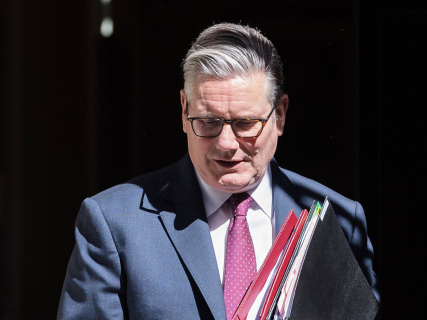

The British Prime Minister, Keir Starmer, faces the biggest political crisis since he came to power in 2024. The debacle of the Labour Party in the local and regional elections has triggered an internal rebellion that threatens to open a formal process to remove him from leadership if the number of critical MPs within the Labour Party increases.
The crisis also arrives at an especially delicate moment for the United Kingdom, with nervousness in the markets, a fall in the pound, and the meteoric rise of Nigel Farage and Reform UK as the main antiestablishment force and against the country's bipartisanship .
Various British media outlets assure that dozens of Labour MPs openly question Starmer's leadership after the poor electoral results, especially in former working-class strongholds in the north of England and in Wales.
The resignation this morning of Minister Miatta Fahnbulleh, the first member of Starmer's executive to leave the government, amid criticism of the policy that has been developed and of the prime minister himself - whom she has said has lost the trust of public opinion and of herself - is more fuel for the fire of this crisis.
Starmer, for his part, has communicated to his cabinet this Tuesday that he intends to continue in his post as British prime minister and Labour leader.
The key threshold: 81 Labour MPs
The internal mechanism of the Labour Party establishes that a leader can be forced to face a formal challenge if at least 20% of Labour MPs in Westminster request a leadership election.
With the current parliamentary composition of the Labour Party, that would mean around 81 MPs. If that figure were reached, a process of internal challenge would be formally triggered, Starmer would have to compete in a new leadership election, and other candidates from the party could present themselves.
Unlike the Conservative system, where a private letter to the so-called 1922 Committee is enough, Labour requires a more structured and regulated procedure.
In case the process is opened, the deputies, the affiliates, and the unions historically linked to the party would vote.
The rise of Reform UK exacerbates internal fear
The great concern within the Labour Party is not only the wear and tear on Starmer, but the growth of the populist formation Reform UK. Farage's party has managed to capitalize on economic discontent, rejection of immigration, frustration with the cost of living, and the feeling of exhaustion with the British two-party system.
Some polls even place Reform UK as the leading force in national voting intention, something unthinkable just two years ago.
This has caused panic among numerous Labour MPs who fear losing their seats if Starmer continues to weaken.
Economic nervousness and fear of another political crisis
The political pressure on Downing Street also coincides with a new episode of financial tension.
The profitability of British long-term debt has soared in recent days and some analysts are already partially comparing the political atmosphere with that experienced during the Liz Truss government crisis in 2022.
Markets fear a prolonged internal war in Labour, abrupt changes in economic policy, and a loss of institutional stability.
Who could replace Starmer?
Although officially there is no succession operation open, in Westminster several names are already circulating as possible alternatives if the crisis escalates.
Among the most mentioned leaders appear Angela Rayner, Wes Streeting and Andy Burnham. Burnham, positioned further to the left than Starmer, is seen by some of the rank-and-file as a profile capable of recovering working-class votes lost to Farage.
Rumors about dates and possible replacement
For now, there is no official date for an eventual replacement of Starmer, but the British press is already talking about several internal scenarios.
One of them involves waiting until summer and analyzing new polls, by-elections, and economic evolution. Another scenario contemplates internal movements before the Labour Party's annual conference scheduled for autumn, a traditionally sensitive time for leadership changes. Some MPs also fear that delaying a decision too much will allow Farage to consolidate himself as the main national political alternative before the next general election.