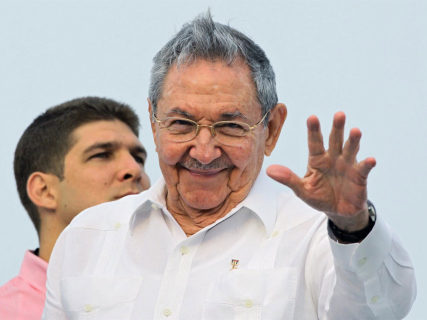

Raúl Guillermo Rodríguez Castro, grandson of former Cuban president Raúl Castro, has expressed his willingness to "negotiate" with the United States government on the future of Cuba. His words come at a time of increased pressure exerted by the administration of US President Donald Trump on Havana.
"I can negotiate with anyone designated by the United States," Rodríguez said in an interview with 'USA Today'. "If given the opportunity, (of course) with Trump," he asserted, before showing the island's willingness to release, "under appropriate conditions, those considered political prisoners."
Rodríguez, 42, popularly known on the island as 'El cangrejo' (The Crab), stressed that he does not see himself as a leader: "politics has never interested me." "But if at some point the revolution asks me to, I would do it," he declared, insisting that he "would never sacrifice the principles of the 1959 Cuban Revolution nor the country's sovereignty."
"The men who made this revolution were just, but they were not fools. My grandmother was an extremely sweet person. She taught me the role that Cuban women should have in society," Rodríguez declared. ""It hurts me a lot that people cannot live like me. My greatest regret is that people struggle. But I get up every day to reverse that situation," he added.
Outside Cuba, Rodríguez remains an almost unknown figure and holds no official position within the Government. He barely appears in state media and until now had not granted interviews to the US press. Despite this, various voices consider that he could come to play a relevant role in eventual conversations about the country's political future.
Cuba is going through an increasingly deep crisis marked by the impact of the economic blockade, the deterioration of the humanitarian situation, and continuous power outages. Added to this are warnings from Washington, which has hinted that the island could face a scenario similar to that of Venezuela, where in January the US Army carried out a military operation that ended with the capture of Nicolás Maduro and his wife, Cilia Flores.
Raúl Castro, 95, was indicted at the end of May by the US Justice Department for his alleged involvement in the downing, in 1996, of two civilian planes in international waters belonging to the organization of Cuban exiles Brothers to the Rescue, an event in which three US citizens and one resident of the North American country died.
According to the formal indictment, Castro and five other co-defendants allegedly participated in a conspiracy that "culminated in the launch of missiles from Cuban military aircraft against civilian aircraft, causing the death of four nationals," as stated by US prosecutors.