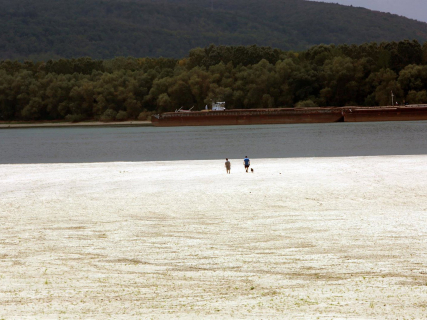

The Romanian Ministry of Defense reported this Saturday the successful completion of a controlled explosion in the Bala River, with the aim of increasing the flow of the Danube and ensuring the operation of the Cernavoda nuclear power plant.
The drop in water levels in one of Europe's main rivers has called into question the security of energy supply in several riparian states that depend on its flow to cool the nuclear power plants located on its banks.
The most critical case is that of Hungary, where the Paks nuclear power plant has been experiencing intermittent outages for several days, and Prime Minister Peter Magyar considers a total shutdown almost inevitable in the coming hours if the level of the Danube drops by just one more centimeter.
In light of this scenario, experts from the Romanian Army carried out a controlled detonation this Sunday to detach a rock formation from the bed of the Bala in order to "redistribute the flow" towards the Danube, an intervention that "took place without incidents and complying with all safety measures," according to an official statement.
The action comes after Nuclearelectrica, the Romanian state nuclear energy company, ordered the shutdown of reactor 1 earlier this week due to insufficient flow in the river to feed the cooling system of the plant. Authorities warned that, without this explosion, reactor 2 was also at risk of going offline.
Together, the two reactors of Cernavoda contribute around 20% of Romania's electricity production, making this facility an essential element for the national energy system.