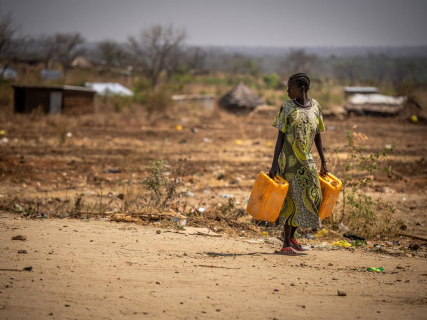

South Sudan marks this Thursday the 15th anniversary of its separation from Sudan, proclaimed on July 9, 2011, after the overwhelming victory of 'yes' in the referendum held in January of that same year. The anniversary arrives with the country still trapped in deep political uncertainty due to the paralysis in the implementation of the 2018 peace agreement, signed after a bloody civil war, and with an increasingly serious humanitarian crisis affecting large segments of the population.
The origin of the secession dates back to Sudan's independence from British and Egyptian rule in 1956, which led to successive civil wars between the north and the south, fueled by religious and ethnic divisions. These conflicts concluded with the peace agreement signed in 2005, which put an end to decades of fighting and set the date for a self-determination referendum for the south.
The consultation, held between January 9 and 15, 2011, resulted in 99.57 percent of the votes in favor of 'yes', an outcome that was accepted by the regime of Omar Hassan al-Bashir. In parallel, another referendum on Abyei was to be held, but it was suspended due to disputes over the census and the delimitation of the territory, which continues to be a source of friction between the parties.
Sudan was the first state to officially recognize its new neighbor, and Al-Bashir attended, along with the then UN Secretary-General Ban Ki Moon, the independence ceremony in Juba. The event took place in the new South Sudanese capital when a countdown clock reached zero and the national anthem of the brand-new country began to play.
Al-Bashir, who had signed the peace agreement with the Sudan People's Liberation Army (SPLA) -- whose historic leader since 1983, John Garang de Mabior, died in a plane crash a few days before sealing the pact -- expressed his willingness to maintain a constructive relationship with Juba, key to the economic development of both African countries, highly dependent on energy resources.
With this, the youngest state on the planet formally proclaimed its independence in July 2011, opening a stage in which the new authorities aspired to close decades of violence and take control of their own destiny, after years of complaints of discrimination, institutional neglect, and plunder of their resources by Khartoum.
However, tensions over the model of federalism, the distribution of power, and oil revenues quickly surfaced and marked Salva Kiir's first term as president. These disputes led to a new civil war in 2013 between factions of the Sudan People's Liberation Movement (SPLM), led by Kiir, of Dinka ethnicity, and by the then-Vice President Riek Machar, of Nuer ethnicity.
The Civil War and the Fragile Peace Agreement
The outbreak of the conflict occurred after Kiir dismissed Machar -- who had already clashed with Garang, leading to his expulsion from the movement -- after the latter expressed his presidential ambitions. Machar then accused the head of state of an authoritarian drift, which triggered fighting between rival factions within the SPLM and the subsequent fragmentation of the group.
The war quickly took on a marked inter-communal character and led the UN Security Council to authorize the reinforcement of the blue helmet contingent deployed in the country. Despite this, the fighting intensified, exacerbating an already extreme humanitarian crisis and causing successive waves of internal displacement and refugees, with serious abuses against civilians by both sides.
International diplomatic efforts allowed Machar's return to Juba in April 2016 to resume the Vice Presidency, but violence flared up a few months later and the opposition leader fled again. Since then, several rounds of dialogue have followed and multiple ceasefires have been signed which were repeatedly violated, until in January 2018 a new peace agreement was concluded which provided for a power-sharing, Machar's return to the Executive, and the formation of a national unity government as a prelude to elections.
The pact, sponsored by Uganda, initially generated expectations of change and a certain political momentum. However, constant delays in the implementation of its key points, such as the integration of rival armed forces into a single national army and the drafting of a new Constitution, have blocked the electoral calendar. The elections, initially scheduled for 2023, have been postponed on several occasions and the citizenry has not been able to vote since independence.
The stalemate became evident at the beginning of 2025, when violence erupted again. The militia known as the White Army --composed mostly of Nuer and which the Yuba Government links to Machar-- carried out a series of attacks in areas near the border with Ethiopia. These incidents led to the arrest of the vice president and caused his faction to declare the 2018 peace agreement broken.
Calls for stability amid humanitarian emergency
In this context, the Special Representative of the UN Secretary-General and Head of the United Nations Mission in South Sudan (UNMISS), Anita Kiki Gbeho, has stressed this week that the 15th anniversary of independence "is an opportunity to honor the courage and determination of the South Sudanese people," and has urged them to "reflect on the future they aspire to: a future marked by peace, opportunity, justice, and unity."
"The path to stability and security is not easy. However, across this young nation, communities continue to demonstrate unwavering faith in a more prosperous future," she indicated, before emphasizing that "at this crucial moment, those aspirations demand a renewed commitment to dialogue, trust, and the common good."
For his part, the president of the commission overseeing the implementation of the 2018 agreement, George Aggrey Owinow, has urged South Sudanese leaders to accelerate the implementation of pending provisions. He insisted that this anniversary must serve as a reminder of the importance of completing reforms to achieve "lasting peace" and "democratic governance," as reported by the local broadcaster Eye Radio.
These warnings coincide with a sharp deterioration of the humanitarian situation. According to the UN Office for the Coordination of Humanitarian Affairs (OCHA), the country faces multiple emergencies stemming from climate shocks, violence, disease outbreaks, and economic collapse. The agency estimates that 9.9 out of 14.4 million inhabitants require some form of assistance.
OCHA details on its website that the cumulative impact of these crises has severely weakened the resilience of numerous communities, which are also pressured by the increase in refugee returns and the arrival of new displaced people from Sudan, where a new war between the Army and the Rapid Support Forces (RSF) has caused another wave of violence and displacement.
The NGO Save the Children has warned that the situation is especially critical for children. Its director in South Sudan, Chris Nyamandi, has pointed out that "the first generation that grew up with the youngest nation has suffered multiple conflicts, displacements, and climate shocks."
"It is vital that children are recognized as key leaders with a right to define the country, not just in the future, but today," he has argued, before remarking that "every decision made now, from education and climate resilience to peace, will affect their lives for decades to come." "Their voices must be heard and their rights placed at the center of decision-making," he has concluded.