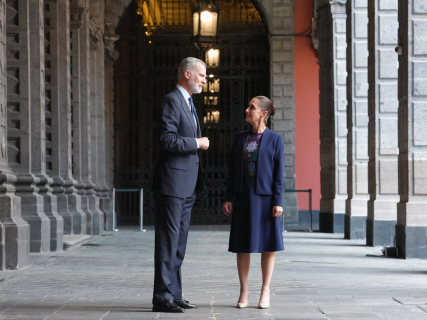

A handshake to stage a diplomatic rapprochement after years of diplomatic friction. King Felipe VI and the president of Mexico, Claudia Sheinbaum, sealed this Thursday in Mexico City a reunion that both countries had been waiting for for years.
An institutional gesture that, beyond the photograph and protocol, symbolizes the closing of a period of diplomatic coldness between Madrid and Mexico City that has lasted for seven years of political tensions.
The chosen setting was not accidental. The meeting took place at the National Palace, in the heart of the Mexican capital, a building steeped in historical symbolism that stands on what was the last residence of the Mexica emperor Moctezuma and which was later transformed by Hernán Cortés into his own palace.
The meeting comes after a period in which relations between the two countries went through one of their most delicate moments. During the presidency of Andrés López Obrador, Mexico demanded from Spain a formal apology for the abuses committed during the conquest of America, a gesture that notably strained the link between the two governments and cooled institutional dialogue channels.
Today, however, the tone is different. Much more measured and, above all, more oriented towards rebuilding a relationship that never ceased to be relevant in economic, cultural, and strategic terms.
A discreet, brief reunion marked by rain
The welcome ceremony was more sober than usual. The rain, persistent for much of the morning in Mexico City, forced the reduction of part of the planned protocol, detracting from the visual solemnity of the event but not its political importance.
Upon the arrival of the Spanish monarch at Mexico City International Airport, he was received by the Secretary of Foreign Affairs, Roberto Velasco, before proceeding directly to the National Palace, where the Mexican president was waiting for him for the official greeting.
Both posed briefly for the press before beginning a bilateral meeting held behind closed doors and lasting approximately one hour. Spanish diplomatic sources report that the meeting was "cordial and frank", two words that in diplomatic language usually translate into something more important than it appears.
A reunion that seemed complicated in the short term and which, however, occurred with institutional naturalness.
Diplomacy, history, and also football
Felipe VI's trip to Mexico is part of an official visit that includes his attendance at the match that the Spanish national team plays in the Football World Cup against Uruguay this Friday at 2:00 am (Spanish peninsular time).
From the Royal Household and the Ministry of Foreign Affairs, it is emphasized that the trip responds to a strategy to intensify relations with Mexico, a country considered key in Latin America both for its economic weight and for its political and cultural relevance.
The Mexican Chancellery itself has insisted on the same line, highlighting that both States seek to strengthen diplomatic ties for the benefit of the well-being of their societies.
From diplomatic conflict to an attempt at normalization
The relationship between Spain and Mexico has gone through different phases over the past few years, but the point of greatest friction occurred during López Obrador's term, when the then Mexican president raised the tone of his criticism towards Spain and even demanded formal apologies for the abuses of the conquest.
That stage led to a clear cooling of high-level diplomatic contacts, with a reduction in institutional meetings and a growing political distance between the two governments.
However, even during that period, economic and social ties between the two countries continued to function normally. Spain maintained its position as one of the main investors in Mexico, and the trade flow between the two economies continued to grow.
The situation took a turn when Felipe VI admitted in March that during the Conquest there was "much abuse" and actions that, in light of current values, do not allow one to feel "proud," despite the existence of the Laws of the Indies promoted by the Catholic Monarchs to protect the indigenous peoples.
The head of the Spanish State made these considerations during his visit to the exhibition "Half the World. Women in Indigenous Mexico", hosted by the National Archaeological Museum and at which he was accompanied by the Mexican ambassador in Madrid, Quirino Ordaz.
Economy and culture as bridges of continuity
Beyond political disagreements, the relationship between Spain and Mexico is based on a solid foundation that has withstood the test of time. Spain is currently the second-largest foreign investor in Mexico, a fact that reflects the intensity of a deeply intertwined economic relationship.
Added to this is a significant commercial exchange and a network of companies, institutions, and cultural actors that have kept the link between both countries alive even in the most delicate moments.
So-called cultural diplomacy has also played a relevant role in this thawing process. The constant reference to shared history, to indigenous peoples, and to Mexico's identity construction has been part of President Sheinbaum's political language in her meeting with the King.
In a message disseminated on social media after the meeting, the Mexican president highlighted that during the conversation, precisely those historical elements were addressed, in addition to the importance of strengthening the bilateral relationship for the benefit of both nations.
Albares: a stage of "brotherhood and cooperation"
From the Spanish side, the Minister of Foreign Affairs, José Manuel Albares, has framed the meeting within a phase of "excellent and intense" relations between both countries.
Albares has underlined that the meeting represents a new impetus to the bilateral relationship and has insisted on concepts such as brotherhood, friendship, and cooperation, at a time when Spain seeks to reinforce its position in Latin America and consolidate its international agenda in view of upcoming multilateral commitments.
One of those milestones will be the upcoming Ibero-American Summit, which will be held in Madrid on November 4 and 5, and which is shaping up to be an opportunity to consolidate this new diplomatic climate.