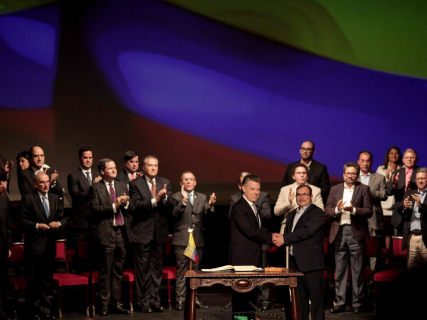










Colombia marks this Tuesday the tenth anniversary of the final signing of the peace agreement between the Government of then-president Juan Manuel Santos and the Revolutionary Armed Forces of Colombia (FARC). That pact sought to end more than half a century of war with the longest-running guerrilla in Latin America, but its implementation has been marked by the indifference of part of the political class, a resurgence in violence, and the rearmament of dissident factions.
Before its final endorsement, the text was rejected by citizens in a plebiscite held a month earlier, which forced a new signing between Santos and the last commander of the guerrillas, Rodrigo Londoño, alias "Timochenko," incorporating proposals from sectors opposed to the initial agreement.
The so-called Acuerdo del Teatro Colón —named after the Bogotá venue where the signing took place— maintained the basic structure of the original pact, but incorporated more than fifty changes. Among them, it was ruled out that the document as a whole would be incorporated into the Constitution, as the first draft had contemplated, except in the sections relating to fundamental rights.
From the start, the agreement had to deal with successive splinters from the FARC, the first even before the preliminary signing in June 2016. The dissidence led by Néstor Vera Fernández, alias "Iván Mordisco," has become one of the main armed actors in the conflict and symbolizes the weaknesses of a pact that has not managed to guarantee the security of a large part of those who laid down their weapons.
Although the process achieved the demobilization of more than 13,000 combatants, the main obstacle to its full reintegration has been precisely their protection. In these ten years, more than 520 former guerrillas have been killed, especially in areas where the State has not been able to fill the gaps left by the FARC. To this list are added social leaders and human rights defenders, against whom violence has been particularly brutal.
Today, several of those territories have become the scene of a fierce struggle between new armed groups seeking to control the lucrative routes of drug trafficking and other illegal economies. This is the case of the Catatumbo region, in the northeast of the country, an old FARC stronghold where the National Liberation Army (ELN) and the Frente 33 of the dissidence of "Iván Mordisco" now face off.
Although in its first years the agreement notably reduced levels of violence, the power vacuum left by the FARC in key corridors of drug trafficking was quickly contested by other armed actors, showing that the conflict, far from ending, fragmented into multiple hotspots.
Political vicissitudes
Although Santos tried to shield the agreement in the legal sphere and provide it with a constitutional framework that supported, among other mechanisms, the Special Jurisdiction for Peace (JEP), tasked with judging all armed actors in the conflict, two years later the arrival of Iván Duque at the Casa de Nariño altered the roadmap.
Duque promoted the so-called "peace with legality," through which he applied the original pact selectively. He tried unsuccessfully to cut back the powers of the JEP and of the peace commissioner, in addition to halting agrarian reform and programs for the substitution of illicit crops. His term was also marked by a sharp increase in the assassinations of demobilized people—more than 300—and of social leaders.
With this approach, the agreement lost political momentum and gradually faded: from a structural transformation project it became a local-scope assistance program in the municipalities hardest hit by the war, based on subsidies and extensions of economic aid to former combatants.
Already in 2022, Gustavo Petro came to power with the promise to reactivate the agreement and, in parallel, reach a similar understanding with the ELN. Analysts point out that this second process ended up eclipsing the first, while security problems worsened, making its implementation difficult.
Petro placed the implementation of the agreement as a matter of State priority, allocated significant budgets, advanced partially in agrarian reform, reinforced the JEP institutionally and reintegration programs, and defended a new drug policy based on the substitution of illicit crops rather than forced eradication.
However, that renewed political legitimacy was eroded by bureaucratic obstacles, by the limitations of the State itself, and above all by the deterioration of security, once the "total peace" strategy was overwhelmed by the lack of willingness of armed groups to continue negotiating.
Achievements and challenges
In addition to the high number of demobilized former combatants, the agreement has made it possible to recover hundreds of bodies thanks to the testimonies of those who laid down their arms and to advance with restorative sentences handed down by the JEP in especially sensitive cases, such as kidnappings by the FARC, extrajudicial executions carried out by security forces in connivance with paramilitaries —the so-called “false positives”— or the sexual violence committed during the conflict.
More than 30,000 victims have testified before the Truth Commission and more than 320,000 have been recognized as such by the JEP. However, a significant part believes that it has not obtained the justice or the reparations expected, understanding that restorative sanctions, rather than prison sentences, are insufficient in the face of the severity of the confessed crimes.
Among the victims’ criticisms of this decade of implementation are the failure of economic reparations, the limited reach of land reform, the incomplete confessions of former commanders of the FARC and the Army, the heavy bureaucracy reflected in endless judicial proceedings, the continued murder of peace signatories, social leaders, and defenders of Human Rights, as well as the forced displacement that persists in areas such as Catatumbo.
Uncertain future
At present, the arrival to power of a declared opponent of the agreement, Abelardo de la Espriella, has called into question a pact that he has described as a refuge for organized crime. His Government has already approved cuts for the JEP that cast doubt on the security of victims and magistrates involved in the macrocases, in addition to abolishing the office of the peace commissioner.
Since the campaign, De la Espriella made clear his offensive against the JEP, especially regarding the processes against military personnel and third-party civilians, as well as against the dialogue and rapprochement policies promoted by the previous Executive of Gustavo Petro toward armed groups.
In just three months in office, the new president has ordered a dozen bombings against positions of the Clan del Golfo, the FARC dissidences, and the ELN—operations that have, for now, left more than 70 dead.
Despite the agreement having a certain constitutional safeguard and the backing of a large part of the international community, its horizon is becoming increasingly uncertain. The combination of agrarian reform and political negotiation —with all its flaws and missteps— that marked the previous legislative term will be replaced by a strategy focused on the State’s punitive hardening and an openly critical reading of the peace text.