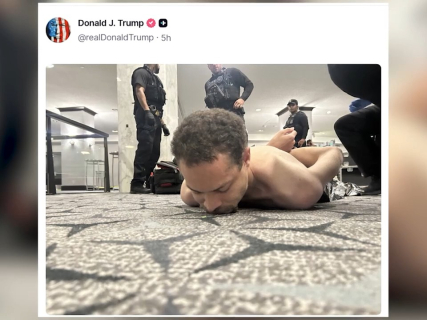
United States federal authorities have revealed new details about the assassination attempt against President Donald Trump during the White House Correspondents' Dinner, an incident that has reopened the debate on security at high-level official events.
The accused, Cole Allen, 31, allegedly prepared the attack weeks in advance, according to the prosecution, which maintains that the suspect researched the event, booked a room at the same hotel where the dinner was being held, and crossed the country from California to Washington D.C. transporting weapons and tactical gear.
An armed selfie minutes before the attack
Among the evidence presented before the federal court of the District of Columbia, an image extracted from the defendant's phone stands out, in which Allen appears taking a selfie in front of his hotel room mirror, barely half an hour before the attempted attack.
In the photograph, the man wears dark clothing and a red tie, and apparently carries several objects: a bag with ammunition, a holster, a sheathed knife, and cutting tools. For the prosecution, this image reinforces the thesis of a premeditated and planned in advance action.
An arsenal seized and detailed planning
After his arrest, authorities seized several firearms, including a 12-gauge shotgun and a pistol, in addition to ammunition, knives, and daggers. The accused faces charges for attempted assassination of the President of the United States, in addition to crimes related to the possession and use of weapons, which could carry a life sentence.
The investigation points to Allen having organized his trip for weeks, including train travel across the country and the logistical preparation of the attack at the event venue itself.
Previous messages and possible planning of the attack
The prosecution has also incorporated into the case emails programmed by the accused before the attack, in which he allegedly said goodbye to family members and expressed his intention to commit the attack, even mentioning that civilians present could be considered “acceptable collateral damage”.
These elements have been used by the prosecution to request their pre-trial detention without bail, considering that there is extreme risk and sufficient evidence of planning.