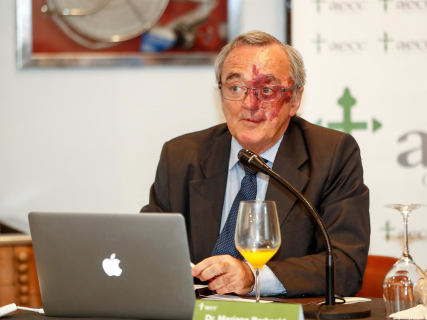
The National Academy of Sciences of the United States (NAS) has formalized the withdrawal of the study led by Spanish researcher Mariano Barbacid on an experimental therapy against pancreatic cancer, published in the journal Proceedings of the National Academy of Sciences (PNAS).
The decision is not based on the scientific results of the work, but on a breach of editorial rules on conflicts of interest, as relevant financial ties with a company linked to the research were not declared.
Undisclosed conflict of interest
According to the magazine, Barbacid and two of her co-authors did not report their relationship with the company Vega Oncotargets, created for the possible commercial exploitation of the developed therapy.
PNAS highlights that this type of situations forces the authors to use a different review process, but the article was processed through a channel that did not correspond in the presence of financial interests, which invalidates the editorial procedure followed.
An unprecedented decision on the article
As a consequence, the journal has opted for the most drastic measure: the complete retraction of the study, instead of a correction or an explanatory note.
The work, published in December 2025, described a "triple therapy" strategy against the KRAS protein that achieved complete remission of pancreatic cancer in mice, which generated a strong international media impact.
The defense of the investigative team
The Barbacid team maintains that the withdrawal responds to a “merely administrative problem” related to the declaration of interests and not to the scientific validity of the results.
According to researcher Carmen Guerra, the omission occurred at the time of sending the article and has already been corrected, stating that the study has been resent to the journal through the proper procedure.
PNAS has wanted to make it clear that the decision does not affect the quality of the work, pointing out that “the value of the research is not in doubt”, although it insists on the need to strictly comply with its transparency rules.
The research team assures that the article has already been resubmitted for its review via the correct route and that they expect its future publication after correcting the declaration of conflicts of interest.