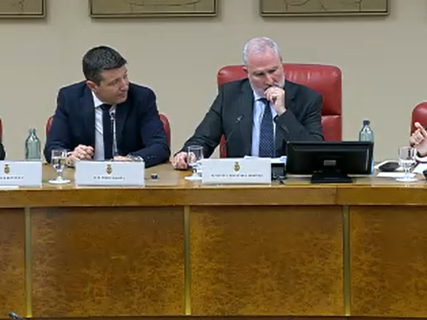

This Monday, the Constitutional Chamber of Congress has brought together two panels of science communicators and energy experts to explain, in a monographic conference -followed by Demócrata-, what were the causes of the energy blackout that, in some parts of our geography, lasted more than 12 hours exactly one year ago.
Organized by the Partido Popular, the six speakers have agreed in pointing out that it is not about attributing responsibility to renewable energies, but to the lack of planning by the Government of Spain. As they have explained, it was a situation of oscillation, with drops and rises in voltage, which had been observed increasingly for five or six years as a consequence of the contribution of photovoltaic sources.
A "snapshot" —these experts emphasize— that remains captured in documents both from before the Red Eléctrica blackout and from the CNMC, the regulatory and supervisory body for the proper functioning of the Electricity Law.
“The electricity sector was very weak”
Throughout more than an hour and a half, the experts have described up to 14 reasons that could explain what happened on April 28, 2025, and how it could have been avoided.
Moderated by journalist Rosana Laviada, the panel included the participation of Manuel Fernández Ordoñez (doctor in Nuclear Physics), Alfredo García (reactor operator and supervisor at the Ascó nuclear power plant) and Javier Revuelta (senior principal at AFRI and expert in energy markets), who were adamant in stating that, on that day, the electrical system presented great weakness.
In his opinion, this situation would have been avoided with greater integration of synchronous energy (1), something that was not possible on that day, given that four nuclear reactors were shut down —only three open out of the seven in Spain—. It was not, they emphasize, a problem of availability, as Beatriz Corredor, president of Redeia, has pointed out, but rather that the planning contemplated that nuclear shutdown.
The CNMC's warning
On February 26, 2025 —explained Alfredo García—, the CNMC published an annual financial report in which it warned Redeia that the integration of renewable energies into the electrical system entailed difficulties in the service (2), with possible reputational impacts derived from the lower availability of reactors.
For Javier Revuelta, as long as the technological development of renewable energies does not reach the necessary storage capacity (3) —something that does not seem imminent—, it will be essential to have more nuclear power plants as backup. “We can't switch to renewables with the push of a button next year,” he said to illustrate the technical complexity of the system.
Fernández Ordoñez maintains that energy, contrary to the "official government narrative," is not free. He differentiates between the wholesale market price and the final price, to which 1.505 billion euros in adjustment services must be added, for example, as a consequence of the current planning, that is, ten times more than four years ago.
For Alfredo García, betting on an energy mix that includes nuclear energy is key both to reducing CO₂ emissions and to containing costs. A statement that, he adds, is reflected in countries like Germany, which has increased its use of gas and coal.
From energy suicide to the reality of renewables
The three panelists agree that it would be an "energy suicide" to close the Almaraz nuclear power plant, considered one of the safest and most advanced in the world. According to their estimates, in a wholesale market, the absence of nuclear energy would raise the price of the megawatt/hour from 65 to 121 euros, with a total additional cost of 18.3 billion euros —pointed out Fernández Ordoñez— and an increase of 10 million tons of CO₂.
In Javier Revuelta's opinion, Red Eléctrica's operation on the day of the blackout was not reckless, but it was based on assumptions that ultimately did not materialize (4). Hence, he adds, the importance of realistically addressing the deployment of renewables and prioritizing the development of energy storage.
Alfredo García added that the audios presented in the Senate's Investigation Commission, far from being mere occasional conversations —as Beatriz Corredor maintains—, reflect real critical situations. “Those of us who work in these centers are not chatting; we talk about problems that should not occur so frequently,” he stated.
At this point, Fernández Ordoñez pointed out that the CNMC has initiated several proceedings against companies, one of them qualified as "very serious" and directed at Red Eléctrica.
Dynamic Voltage Control
Spain —explained Fernández Ordoñez— is an energy island whose inertia is 50% lower than the rest of Europe. Unlike countries like Portugal, which do apply dynamic voltage control (5), Spain does not do so, in his opinion, by decision of the regulator.
He also recalled that, in 2020, Red Eléctrica requested the CNMC (6) to update the voltage control procedure at high levels, which would have made it possible to anticipate the overvoltages prior to the blackout.
Red Eléctrica's Response to Companies
Likewise, he revealed that the electric companies tried to summon REE given the seriousness of the oscillations previously recorded (7), upon detecting a risk of system collapse. However, Red Eléctrica —he stressed— maintained that such a problem did not exist.
In relation to the report by ENTSO-E, Fernández Ordoñez alluded to the parameter that measures short-circuit power, key to evaluating the strength of the grid.
That day —he recounted—, Spain presented a marked asymmetry of firm power between the north and the south. The oscillations that morning further weakened the grid, as did the interconnection operations with France to stabilize the frequency, aspects that, according to his complaint, are not reflected in the ENTSO-E report.
40 seconds without recording?
Furthermore, he questioned that in the more than 500 pages of the report, the short-circuit power is not addressed. "Why did they avoid dealing with this aspect?", he asks. As he explains, the blackout began at 12:32:20 with the first disconnection in Granada, while ENTSO-E places the start of the oscillations at 12:33:16.
This implies, in their opinion, that the first 40 critical seconds are omitted, concluding that 20% more synchronous power would not have changed the outcome. “Why not simulate what happened before and not after?”, he asks, comparing it to the REE report and questioning the impartiality of the process.
“The blame —he concludes— we don’t know who has it; a judge will determine it. But the responsibility exists”.
The effect of the blackout on data centers
Another of the issues addressed in this panel —followed by a second panel moderated by Ramón Roca, director of El Periódico de la Energía— was the impact of the blackout on industry and households. Participants included Esther Jara (director of the Energy Committee of Unesid and head of Energy and Sustainability at Megasa), Armando Layna (founding partner of Spaindc and partner at S4U) and Jesús Gil (general coordinator of Security and Emergencies of the Madrid City Council).
Regarding data centers, Alfredo García warned that the main problem will not be the blackout, but the lack of network, which is slowing down new investments.
Fernández Ordoñez closed this session by pointing out that in Spain there is not enough demand for data centers because, in his opinion, the Government hinders their implementation. He cited as an example a Royal Decree that introduces "Kafkaesque" requirements, such as the obligation to link these centers to their own renewable generation, limit their consumption to certain times or make their installation subject to geographical criteria, in addition to subjecting their authorization to a commission dependent on the Moncloa Economic Office, without the participation of the autonomous communities.
Data centers no longer consume water
Armando Layna underscored that data centers are essential elements for technological development and artificial intelligence and highlighted that “today data centers do not consume water, because we cool in closed circuits”.
The event, inaugurated by Alberto Núñez Feijóo and closed by the Deputy Secretary of Economy, Alberto Nadal, coincided with the release by Red Eléctrica of a video in which the company defends having acted with transparency on the day of the blackout, attributing the causes to multisectoral factors, in line with the Government's position.
Business associations ask for transparency and nuclear power
Meanwhile, the CNMC has described the actions of both Red Eléctrica and Iberdrola as very serious. In parallel, employers' associations such as CEOE and CEIM have demanded explanations.
The president of CEOE, Antonio Garamendi, has questioned what happened a year after the blackout and has warned that "it makes no sense to turn your back on nuclear power".
For his part, Miguel Garrido, president of the Madrid employers' association, criticized that the Government "has not assumed responsibilities, has not offered clear and complete technical explanations and continues with an energy policy that has already proven to be erratic and based on ideological criteria".