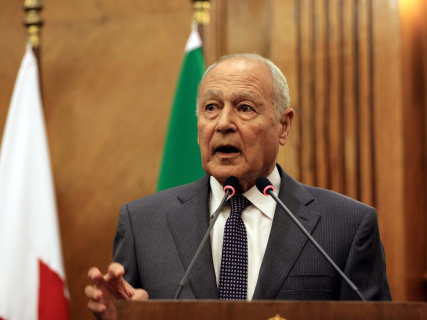

The League of Arab States "has strongly condemned" this Sunday the "brutal Israeli aggression against Lebanon" and its "continued invasion" of the territory, after the capture of the historic Beaufort Castle, in the Nabatiye governorate (southeast), and after the Israeli government announced its intention to "extend" its control in the neighboring country.
"Ahmed Abul Gueit, Secretary General of the League of Arab States, has strongly condemned the brutal Israeli aggression against Lebanon, the continued invasion of Lebanese territory, the destruction of villages and archaeological sites in southern Lebanon, and the attacks and displacement of civilians," reads the statement released by the leader himself on social media.
In the same note, Abul Gueit has described these events as a "flagrant violation of Lebanese sovereignty," as well as "a grave breach of International Law and International Humanitarian Law."
Likewise, the text includes the statements of its official spokesperson, Gamal Roshdi, who has emphasized "the urgent need for this brutal Israeli aggression to cease immediately," considering that "it represents a serious threat to security and stability in the region."
Roshdi "has reaffirmed the solidarity" of the League with "Lebanon and its people" and has conveyed the organization's support to the Lebanese state "to face the consequences of this aggression." In this regard, he has emphasized "the League's support for all measures" promoted by Beirut to "restore security and stability and extend state sovereignty over all its territory."
Among these measures, he has included the call by the Lebanese government to the United Nations Security Council "to work towards an immediate ceasefire, the full withdrawal of Israel from southern Lebanon, and the facilitation of the return of displaced persons to their areas and homes."
In this regard, and according to the words of its spokesperson, the League has urged the Security Council to "assume its responsibilities in this regard" and to "compel Israel to cease fire and fully implement Security Council Resolution 1701," adopted in 2006 and which calls for an end to hostilities between the Lebanese Shiite party-militia Hezbollah and Israel.
Specifically, said resolution demands a permanent ceasefire based on the creation of a buffer zone and foresees the withdrawal of the Israeli Army from southern Lebanon, coinciding with the deployment of the United Nations Interim Force in Lebanon (UNIFIL), responsible for monitoring the cessation of attacks and supporting the Lebanese Armed Forces in their task of regaining control of the region.
This reaction occurs after the capture of the strategic Beaufort Castle, known in Arabic as Qalat al Shaqif, one of the key enclaves of the 1982 Lebanon War, where fighting took place between the Israeli Army and the Palestine Liberation Organization which concluded with an Israeli victory and the establishment of a military position that it would not abandon until the year 2000.
The escalation also comes after Israeli Prime Minister Benjamin Netanyahu ordered an expansion of the offensive in Lebanese territory: "My orders are now to consolidate and extend our control over areas that were under Hezbollah's dominion," he declared, before emphasizing that Israeli military forces are "taking the initiative, operating on all fronts: in Syria, in Gaza, in Lebanon."
In the case of Lebanon, the next objective of the Israeli advance will be the Zahrani River, located 15 kilometers north of the Litani, according to the forced evacuation orders sent this weekend by the Israeli Army to the Lebanese population and the bombings on towns such as Deir Zahrani, located less than a kilometer south of the riverbed that gives the area its name.