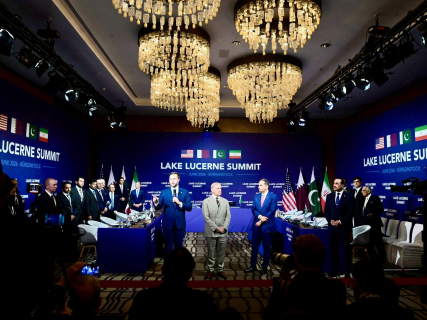


The Iranian delegation participating in the talks with the United States, which began this Sunday in Switzerland, has decided to leave the meeting room in protest of the warnings issued on social media by US President Donald Trump, who has threatened to forcibly take control of the Strait of Hormuz and seize 20% of the crude oil that passes through it.
According to sources close to the negotiation process cited by the Tasnim news agency, linked to the Iranian Revolutionary Guard, Iran's delegates opted to withdraw from the table in the face of Washington's verbal escalation.
"I told them that if they close the strait, they will be left without a country. They won't even be able to return to their fucking country," the US president assured the Fox News channel at a key moment, coinciding with the start of the Bürgenstock diplomatic summit.
Trump has also reiterated his warning that the United States could "perfectly" take control of the Strait of Hormuz by force and even play the role of "toll collector," in the same way that, according to him, Iran has acted during the conflict.
The president has even stated that he could become the "guardian angel of the strait and take 20% of the oil." "We could take control of the strait if necessary. I could raze the country if I wanted to. And if they don't reach an agreement, we will collect the tolls," he warned, further raising tensions amid the diplomatic meeting.
Trump has also held Iran responsible for the resurgence of violence in Lebanon, an element that could jeopardize the future of the talks. The US president has set aside his recent criticism of Israel and has directly pointed the finger at Tehran and its alliance with the Shiite militias of Hezbollah.
"Iran must immediately stop its well-paid representatives in Lebanon from causing trouble. If they don't, we will hit Iran very hard again, just like we did last week, but with more force," warned the US president, in a new show of pressure on the Islamic Republic.
As a first response, the head of the Iranian negotiating team, Mohamad Baqer Qalibaf, stressed that the United States "must be careful with its statements" because "we do not take American threats seriously."
"Don't they realize that if their threats had been effective, we would not have reached today's desperate situation?", Qalibaf stated from Switzerland, where bilateral talks are being held.
The Iranian official added that "our armed forces are prepared to respond in different ways." "The more they talk, the more we act," he concluded, making it clear that Tehran does not intend to yield to pressure.
A member of the Iranian delegation told public television IRIB that "the most important thing" is the implementation of the agreement reached regarding the ceasefire in Lebanon, the reopening of the Strait of Hormuz, and the unfreezing of Iranian assets frozen abroad.
"If it is not applied, especially with regard to Lebanon, one of the main points on which the end of the war must be declared, the following issues will not be addressed," this representative specified, warning that the negotiating agenda will not advance as long as these commitments are not met.