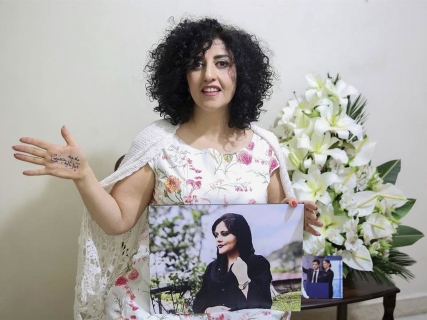

The Iranian human rights defender and Nobel Peace Prize laureate, Narges Mohammadi, was admitted this Sunday to a medical center in Tehran, the capital of Iran, to undergo treatment due to her "multiple illnesses". The transfer occurs after spending ten days hospitalized in the city of Zanyan, in the northwest of the country, while her relatives and doctors "urgently" requested her transfer to the Iranian capital.
The arrival at Pars Hospital, in Tehran, has been possible after the granting of a temporary "suspension" of her sentence in exchange for a "high bail," according to a statement detailed by the Narges Mohammadi Foundation. The entity has specified that the ambulance transfer "has concluded" and that the activist is now at said hospital, where she will receive care "from her own medical team."
"Today, Narges Mohammadi has been discharged from Zanjan Hospital, following an order suspending her sentence to receive medical treatment. She has been transferred by ambulance to Pars Hospital in Tehran, where she has been admitted. This order has been issued in accordance with the evaluation of the Legal Medicine Organization, according to which she needs specialized care outside of prison under the supervision of her own medical team due to multiple illnesses", according to the activist's lawyer, Mostafa Nili.
However, the Foundation warns that this suspension of the sentence "is not enough", since Mohammadi "needs specialized and permanent care", which is why it insists that the Nobel Peace Prize laureate "never return to prison to serve the 18 years remaining of her sentence".
"Now is the time to demand their unconditional release and the withdrawal of all charges," the organization claims, which then underlines that "no human rights and women's rights activist should ever be imprisoned for their peaceful work."
In the same vein, his relatives have expressed their gratitude to the international community for its "unwavering solidarity," in reference to the repeated demands for immediate release. Among them is that of the Spanish Minister of Foreign Affairs, José Manuel Albares, who last Thursday, May 7, summoned the Iranian ambassador to Spain, Reza Zabid, to demand respect for Human Rights in the Islamic Republic and the release of Mohammadi.
Also the Secretary-General of the United Nations, António Guterres, asked the Iranian authorities to guarantee "at a minimum" the urgent medical attention that the activist needs, who had already been hospitalized for a heart problem during the hunger strike she undertook to denounce the conditions of her imprisonment.
It is worth remembering that it was in February of this year when Mohammadi began said strike, following her arrest on December 12 during an event in memory of lawyer Josrou Alikordi, who died weeks earlier under "strange circumstances".
The activist had been provisionally released from prison in December 2024, after the Tehran Prosecutor's Office accepted a request for release for medical reasons. Months earlier, in October, she had to be admitted to a hospital after her family reported that the authorities had been preventing her for more than two months from accessing necessary treatment despite her worsening health.
Mohammadi was initially sentenced to an additional six years in prison for conspiracy and one and a half years for propaganda activities. Later, her lawyer reported in February that she had also been imposed a two-year travel ban and another two years of exile to the city of Jusf, in west-central Iran.