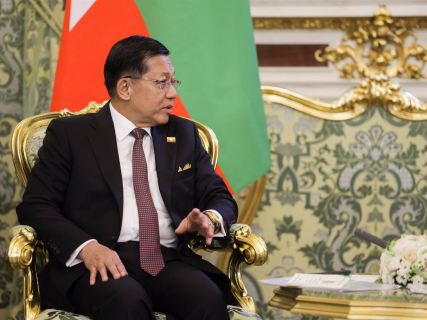

The President of Myanmar, Min Aung Hlaing, who took control following the 2021 military coup, has underlined this Thursday that Naypyidaw will not fully carry out the measures ordered by the International Court of Justice (ICJ) after the country was condemned for the genocide of the Rohingya minority, considering that some provisions are “inappropriate”.
“Myanmar will take the appropriate measures for a responsible country, but it will not comply with demands that it considers inappropriate,” the Myanmar leader said in his first remarks since the historic verdict, without clarifying which specific points from the ruling would fit into that category.
The head of government has insisted that the resolution “has caused major harm to the country’s reputation” and has maintained that the authorities presented “all relevant information, documents and evidence” to support its defense before the ICJ.
“As head of State, I believe that I am responsible for all matters that take place in the country and I will not accept issues that affect the country,” he added during a meeting of the Myanmar Executive, according to a statement released by the Office of the Presidential Information and Press.
The ICJ has ordered Myanmar to end violations of the Convention on the Prevention of Genocide, to investigate and bring to justice suspects of these crimes against the Rohingyas, to guarantee the return of displaced persons, to return seized property, and to compensate for the damage suffered by members of this community.
The spokesperson for Myanmar’s Presidency, Jaing Jaing Soe, had already said last week that the ruling “is not fair” and argued that the authorities acted “in line with International Law,” after the court held the country responsible for a genocide in the context of the military operations launched in 2017 against this Muslim minority in the western state of Rakhine, where around 10,000 people died.
The operations date back to 2016, when several attacks by the Arakan Rohingya Salvation Army (ARSA, for its English acronym) against border posts of the Myanmar Army triggered the military response. In October of that year, the Armed Forces launched a first major offensive in northern Rakhine, which led to allegations by the United Nations of serious violations of Human Rights.
The crisis worsened in August 2017, when the Burmese Army launched a broad military campaign that left thousands dead and caused the massive flight of about 700,000 people to Bangladesh, where more than 1 million stateless Rohingya refugees currently live, spread across more than thirty camps in the district of Cox's Bazar.