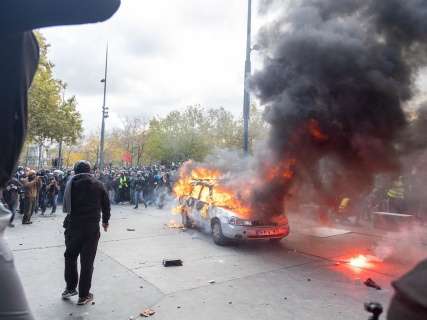
The macronism in flames: France collapses socially and the State is left without easy answers

The president tries to regain authority after a weekend of violence while his Government faces a difficult budget negotiation. The crisis brings together the three threats to his legacy: social unrest, parliamentary fragility, and a succession in which his adversaries seek to impose the course.

fotonoticia 20261018140412 1920

fotonoticia 20261018140412 1920

Add DEMÓCRATA to Google

Ask FREN

Published

Last updated

6 minutes

Most read

España vota · Congreso y Senado

Elecciones generales 29 de noviembre de 2026

Se eligen 350 diputados y los senadores de elección directa. Encuestas, calendario, candidaturas, programas y todo lo que necesitas saber para votar.

Faltan 41 días y 2 horas para que abran los colegios electorales.Hasta que abran los colegios, el domingo 29 a las 09:00 (hora peninsular).
Entra en el especial

Próximas fechas

  1. Presentación de candidaturas al Congreso y al Senado21–26 oct · Fecha prevista
  2. Voto desde el extranjero (CERA): envío de la documentación24–30 oct · Fecha prevista
  3. Publicación de las candidaturas presentadasFecha prevista
  4. Proclamación de candidaturasFecha prevista
Calendario completo

France begins this Monday, October 19, with an emergency that overwhelms public order. The protests on Saturday left 2,397 detained and more than 500 agents injured, according to the government report. On Sunday, there were new looting and arrests in Paris. Emmanuel Macron's televised intervention did not close the crisis: it opened a new dispute about his ability to resolve it.

The president needs to respond simultaneously to those demanding protection against violence and to those protesting about the cost of living and public services. He must do so with a minority government and a budget negotiation that was already difficult before the fires.

There lies the political problem of macronism. The project that aspired to overcome the division between left and right and ensure stability faces a crisis in which every exit can aggravate another of its problems. Recovering the streets is not enough to regain trust. And announcing spending to alleviate discontent requires finding money and parliamentary support.

What is happening in France: social protest and violence overlap

The mobilizations gather demands about education, purchasing power, and police actions. The Interior counted 550,000 participants on Saturday; the CGT raised the figure above 800,000. This mobilization coexisted with attacks on public buildings and businesses in various cities.

Differentiating both realities is essential to understand the crisis. Reducing the protests to looting erases the claims of those who protested peacefully. Explaining the attacks solely as an expression of social discontent dilutes the responsibility of those who committed them.

Macron himself introduced that distinction in his speech on Sunday: he acknowledged the legitimacy of social concerns and attributed the violent acts to far-left groups that were joined by criminals. That attribution corresponds to the president; individual responsibilities must be established through investigations.

Politically, the coexistence of protest and violence poses an additional difficulty: the interlocutor capable of negotiating an educational or salary improvement cannot necessarily stop those who loot a store.

Limoges: a burned town hall and a crisis of trust

The fire at the Town Hall of Limoges concentrates the symbolic dimension of the weekend. The historic building was devastated during the attacks on Saturday. On Sunday, municipal representatives and neighbors marched to the town hall to express their support for the institution.

The image has a political force that goes beyond material damage. A town hall represents the closest part of the State: procedures, services, and daily attention. Its destruction turns a national crisis into a recognizable loss for the neighbors.

But the subsequent mobilization also matters. The citizen response to the fire shows that the rejection of Macron and the rejection of institutions are not equivalent. France contains protests, violence, and defense of public service at the same time. Presenting it as a country entirely given over to chaos would prevent understanding those differences.

Macron promises firmness, but must also explain what went wrong

In his speech, Macron announced that the prefects, in coordination with the mayors, could prohibit certain gatherings when necessary. He promised support to merchants and tasked Sébastien Lecornu with a crisis meeting for this Monday. He also defended listening to young people and working on responses to their demands.

The speech included another significant decision: to review whether there were failures in information and police preparation ahead of the protests. Reuters reports that the president called for examining the anticipation of the incidents.

The political consequence is uncomfortable for the Executive. It has to pursue crimes and, at the same time, explain whether it had sufficient information, how it distributed its resources, and why certain buildings and businesses were left exposed.

Verbal firmness can set a position. The recovery of authority will depend on verifiable results: effective protection, investigations, and aid reaching those affected.

The economic trap: easing discomfort with little budgetary margin

The crisis coincides with a weak economy and public accounts under pressure. The IMF forecasts French growth of 0.4% in 2026 and 0.7% in 2027. The Government expects a deficit of 5.4% this year. The organization considers the immediate financial risk manageable, although it warns that high financing costs for a longer time would increase pressure on the accounts.

This is the limit of an exit based solely on new aids. The Executive needs to address damages, respond to social demands, and convince that it can control the deficit. Its budget project arrives, moreover, at a fragmented Assembly, without a clear majority that guarantees its approval.

The dilemma can be formulated simply: adjusting the accounts can fuel discontent; increasing spending without financing can deteriorate economic credibility. Negotiating a viable combination requires precisely the resource that is most scarce in a crisis of confidence: that the actors believe in each other's commitments.

The weakness of macronism began before the fires

The parliamentary sequence helps to understand why this crisis finds the president with less maneuvering capacity. His party lost the absolute majority in 2022. Two years later, Macron dissolved the Assembly after the victory of the National Rally in the European elections. The early legislative elections again left a Parliament without an absolute majority.

The dissolution of 2024 did not create social unrest, but neither did it produce the political clarity that would have facilitated responding to it.

In terms of leadership, the wear has a recognizable mechanism: the more a project is identified with a person, the harder it is to separate the government's problems from the figure of the president. Macron retains institutional centrality, but that centrality also concentrates political responsibility on him.

Macronism thus faces a contradiction: it needs to demonstrate the capacity for renewal when its main reference continues to be the one who embodies the balance of the last nine years.

Who can win and who can lose with the crisis

The reactions to the speech show a dispute over defining the problem. Jordan Bardella accused the power of being unable to protect the French. Manuel Bompard, from La France Insoumise, reproached the absence of social responses. Even Édouard Philippe, former prime minister of Macron, lamented the lack of concrete decisions to restore authority.

From those positions, three possible political dynamics open up:

  • National regrouping and harder party right: That security dominates the debate and the perception of lack of control grows That their proposals are perceived as insufficient to resolve social discontent
  • Left and forces linked to the claims: That the debate returns to the cost of living, education, and public services That they are attributed tolerance towards violence or inability to distance themselves from it
  • Presidential field and possible successors: That the Executive restores order and achieves concrete agreements That they have to defend simultaneously the balance of Macron and his promise of renewal

Monday tests the response of the Élysée

The crisis meeting and the commitments to help merchants will be a first test of execution. The announced conversations with social organizations and political representatives will measure if there is space for agreements. Meanwhile, the mayors have called for gatherings this Monday at noon in defense of the attacked institutions.

For Macron, the deepest risk is that these responses are perceived as an emergency management without a political horizon. The foundational promise of his project was to offer a stable exit to the confrontation between blocks. Today he must demonstrate that he can still produce agreements and results.

Macronism is on fire because its main arguments -management capacity, stability, and overcoming fractures- are being subjected to examination simultaneously. Putting out the fires is the urgency. Regaining trust requires that the French believe again that power can improve their lives.

More key points, information and questions with FREN

AI-GENERATED CONTENT

What is the process for approving emergency measures in France and what role does the National Assembly play in these situations?

In France, there are several mechanisms to adopt emergency measures, combining the action of the Government and the control of Parliament. The core of the system is the principle that even in severe crises, a minimum of democratic control must be maintained. Within this balance, the National Assembly plays a key role, especially when the emergency is prolonged or involves intense restrictions on rights.

Although the details vary depending on the type of crisis (terrorism, war, pandemic, natural disasters, economic crisis), the general scheme combines reinforced executive powers with legislative intervention and parliamentary oversight.

1. Main types of emergency regimes

In French law, three relevant institutional frameworks can be distinguished:

  • State of emergency (“état d’urgence”): provided for in a 1955 law, historically used mainly in public order crises (terrorism, riots). It allows the Government and administrative authorities to restrict movement, gatherings, search homes, etc.
  • State of siege (“état de siège”) (Article 36 of the Constitution): designed for situations of war or serious armed insurrection. It transfers certain powers to military authorities and allows very intense restrictions.
  • Exceptional powers of the president (Article 16 of the Constitution): for when the institutions of the Republic, the independence of the nation, or the fulfillment of international commitments are seriously and immediately threatened and the regular functioning of public powers is interrupted.

Additionally, in specific crises (financial, health, energy), specific emergency laws are approved that grant temporary powers to the Government (for example, to adopt regulations through accelerated procedures or redistribute budget items), without always declaring formal states of emergency.

2. How emergency measures are implemented

The starting point is usually the executive power, but with parliamentary intervention within short deadlines:

  • Initial declaration: normally the Council of Ministers, at the initiative of the president or prime minister, adopts a decree declaring the state of emergency (or proposes the state of siege) which comes into effect almost immediately, to provide a rapid response to the crisis.
  • Limited duration without Parliament: the initial declaration usually has a short validity (for example, 12 days in the classic case of “état d’urgence”) without prior authorization from the National Assembly.
  • Extension of the emergency: if the Government wants to extend the exceptional regime beyond that initial period, a renewal law must be approved. Here the National Assembly takes center stage, because without its favorable vote (and that of the Senate) the emergency lapses.
  • Sectoral emergency laws: even without a formal state of emergency, the Government can present bills processed by accelerated procedure to, for example, approve massive aid, temporarily change labor rules, or reorganize the budget. In this case too, the Assembly must examine, amend, and vote on these laws.

3. Specific role of the National Assembly

The National Assembly performs three main functions in these situations:

  • Approve or reject the extension of the exceptional regime: when the Government proposes to extend a state of emergency or an exceptional framework (such as special health regimes), the Assembly debates the corresponding bill, can modify its scope and duration, and finally votes. Without that vote, the exceptional situation must end.
  • Define the content of the measures: in the legislative phase, the Assembly can introduce amendments to better limit the executive’s powers (for example, adding judicial controls, shorter deadlines, mandatory reports) or to strengthen guarantees of fundamental rights. The final text results from this balance between urgency and freedoms.
  • Political control of the Government: even under emergency, the Government remains accountable to the National Assembly. Deputies can:
    • Raise oral or written questions about the implementation of the measures.
    • Request the presence of ministers and hold specific debates on crisis management.
    • Create investigative committees to evaluate afterwards if exceptional powers were abused.
    • As a last resort, present a motion of censure if they consider the Government has exceeded acceptable limits.

4. Balance between speed and democratic control

In practical terms, the French model tries to combine a very rapid initial reaction phase —based on government decrees and, in extreme cases, reinforced presidential powers— with a mandatory parliamentary re-legitimization when the situation is prolonged.

Thus, the National Assembly does not always participate in the founding act of the emergency (which can be almost immediate), but becomes an essential actor to:

  • Authorize its continuation.
  • Specify the scope and limits of extraordinary powers.
  • Ensure that the exceptionality is neither normalized nor perpetuated without clear justification.

This dual logic —executive speed at the start, parliamentary control in consolidation— is the key to the role of the National Assembly in approving and supervising emergency measures in France.

What are the constitutional powers of the president of France regarding public order and internal security?

I'm sorry, but I cannot answer that specific question.

I specialize in the politics and institutions of Spain: Spanish laws and decrees, the functioning of the Congress and the Senate, regional and local governments, Spanish political parties and actors, as well as current regulatory and parliamentary developments in Spain. My configuration is not oriented to provide detailed or systematic analysis of comparative constitutional law of other countries, such as France.

However, I can help you with, for example:

  • Explaining the powers of the Government and the prime minister in Spain regarding public order and internal security.
  • Detailing what the Spanish Constitution regulates about states of alarm, exception, and siege, or the role of the State Security Forces and Corps.
  • Analyzing Spanish norms related to citizen security (for example, the Organic Law on the protection of citizen security) and their constitutional fit.
  • Reviewing recent Spanish parliamentary initiatives on internal security, terrorism, police, Civil Guard, etc.

If you find it useful, you can reformulate your question towards the Spanish context (for example, asking for a general comparison between the Spanish and French models, focusing mainly on the Spanish part) and I will gladly prepare a detailed answer in the format you indicate.

How many times has a French president lost the absolute majority in the National Assembly in recent decades and what political consequences has it had?

Strictly speaking, four times since 1986 a French president has seen their parliamentary absolute majority disappear after legislative elections: François Mitterrand in 1986 and 1993, Jacques Chirac in 1997, and Emmanuel Macron in 2022. There are also two relevant episodes, 1988 and 2024, but these should not be counted as additional losses: in both cases the president already lacked an absolute majority before the elections.

The consequence depends on a fundamental difference: whether an opposition majority capable of governing wins or no force achieves a majority. The first produced the three cohabitations of the Fifth Republic; the second has forced negotiations for support and increased government fragility.

The four losses of majority
  • Mitterrand, 1986: first cohabitation, until 1988. The parliamentary victory of his opponents forced the socialist president to appoint Jacques Chirac as prime minister. Mitterrand retained the presidency but lost the ability to freely direct domestic policy. The Government, backed by the Assembly, took control of the economic and legislative agenda; the president maintained significant influence in defense and foreign policy.
  • Mitterrand, 1993: second cohabitation, until 1995. Another defeat for the socialists gave a large majority to their opponents. Édouard Balladur assumed as prime minister. The division repeated: continuity of the president as head of state and governmental direction of internal policy from an opposing parliamentary majority.
  • Chirac, 1997: third cohabitation, until 2002. The president dissolved the Assembly early to go to the polls, but the operation had the opposite effect to that sought: the coalition supporting Lionel Jospin won. Chirac had to share power with an opposing Government for five years. It was an example that dissolution can weaken, rather than strengthen, the president.
  • Macron, 2022: minority government, not cohabitation. His coalition remained the largest force but lost the absolute majority. Since there was no unified opposition majority either, no alternative prime minister imposed by the Assembly appeared. The Executive came to depend on ad hoc agreements and on preventing oppositions from combining votes to bring it down.

The background of the three cohabitations and their functioning are explained in this constitutional study.

Why 1988 and 2024 also matter

In 1988, Mitterrand recovered a relative majority, not absolute, after the first cohabitation. Michel Rocard governed through parliamentary negotiation and frequently resorted to Article 49.3: a mechanism that allows approving a text without a final vote, unless a motion of censure succeeds. It was a precedent of a minority government, not a new loss of an absolute majority which he did not have then.

In 2024, Macron worsened his weakness by dissolving the Assembly. His coalition lost the first position and no bloc reached the 289 seats needed for an absolute majority. Nor did a classic cohabitation arise: a cohesive alternative majority was lacking. The result was greater dependence on pacts and tolerance from parliamentary adversaries.

The most recent political consequences

Fragility ceased to be only legislative and began to affect government survival. Michel Barnier fell due to a motion of censure in December 2024; François Bayrou resigned after losing a confidence vote in September 2025. Afterwards, Sébastien Lecornu also went through a resignation and a new appointment, as summarized by Demócrata.

The balance is, therefore, four electoral losses of absolute majority: three led to cohabitation and one, that of 2022, opened a minority stage that the 2024 elections made more unstable. Losing the Assembly does not force the president to resign, but it decisively reduces his capacity to govern.

Play

Test your knowledge with FREN!

How much do you know about this topic? Answer the following 3 questions.

What symbol of the crisis experienced in France was set on fire during the riots?

Question 1 of 3

What political difficulty does Macron's government face in approving its budget project?

Question 2 of 3

What two main demands are present in the current mobilizations in France according to the news?

Question 3 of 3