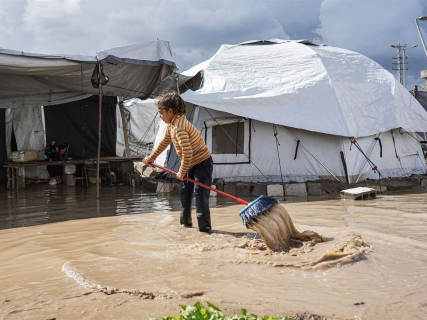

The Humanitarian Team (HCT, for its acronym in English) for the Occupied Palestinian Territory has said that the impact of the latest storms in the Gaza Strip could largely have been avoided and has urged Israel to immediately authorize the entry of winter supplies to protect the civilian population. "There are lives at stake," the body stressed in a statement.
Heavy rains have caused the deaths of minors and adults, have paralyzed basic services, and have left thousands of family shelters flooded, destroyed, or seriously damaged. The HCT, which brings together those responsible for different UN agencies and international and local NGOs, attributes the extent of the damage both to the severity of the storm and to political decisions that hinder humanitarian work.
The team recalled that several months ago it submitted a winter preparedness plan that included the delivery of emergency shelters, warm clothing and blankets, the improvement of health and protection services, drainage works and reinforcement with sacks of sand, as well as equipment to pump water, remove rubble, and neutralize explosive devices. To carry it out, it had already warned then, it was essential to have adequate funding, access to higher ground, and a rapid entry of materials.
In this context, the HCT has emphasized that Israel, in its capacity as an occupying power, is required to guarantee the population’s basic needs. However, it denounces that its restrictions limit both the arrival of essential products and access to large areas of the enclave, including interior areas that are less exposed to flooding.
"PEOPLE CANNOT WAIT"
Among the main obstacles, the organization cites the strict approval controls, the limited operational capacity of border crossings, and unpredictable delivery timelines—factors that are delaying the arrival of key supplies.
Despite the fact that the available financial resources are far less than what is required, more than 150,000 tents purchased by humanitarian partners and member States are still outside Gaza, awaiting authorization to enter. Most are stored in Al Arish, about 50 kilometers from Jan Yunis, in the south of the enclave, while successive storms continue to destroy shelters and increase the urgency of replacing them.
"The winter will last for months. Access to more durable shelters must not be conditioned on political progress when the population's needs are so urgent," the statement highlights, which insists that "people cannot wait."
In this situation, the Humanitarian Team calls on the Israeli authorities to open all available border crossings and speed up the entry of aid in sufficient volumes, in addition to removing obstacles to the repair of drinking water and sanitation networks.
It also requests that all humanitarian personnel be allowed to operate without hindrance, including UN agencies and international and Palestinian NGOs, and that significant commercial activity be promoted that helps sustain the population.
"Winter supplies must reach families immediately to avoid further loss of life and protect their dignity," the note concludes, which also calls on the international community to "use its influence" so that these measures are applied "without delay" and the necessary humanitarian funding is guaranteed.