Consult here the list of the PSOE for Madrid for the elections of 29N: these are the candidates for Congress and the Senate

Pedro Sánchez heads the socialist candidacy for Congress in Madrid, followed by Margarita Robles, Félix Bolaños, and Pilar Sánchez Acera. Antonio Hernando, Leticia Correas, and José Luis García make up the list for the Senate. Check all the names.

fotonoticia 20260807133647 1920

fotonoticia 20260807133647 1920

Add DEMÓCRATA to Google

Ask FREN

Published

3 minutes

Most read

Elecciones 29N · Encuestas

La media de las encuestas

Media a 18 de noviembre de 2026 · 17 institutos

  • PP31,4 %
  • PSOE27,4 %
  • Vox19,0 %
  • Frente Amplio6,1 %
  • ERC2,4 %
  • SALF2,0 %
01020304050ene 2024jul 2024ene 2025jul 2025ene 2026jul 2026

Media del último estudio de cada instituto en 30 días y su evolución semanal desde el 23J. Partidos con al menos un 2 %.

Todas las encuestas

Elecciones generales del 29 de noviembre · Demócrata

The PSOE of Madrid has approved this Wednesday, October 14, its candidacy for the Congress of Deputies and the Senate for the general elections on the upcoming November 29. The list for the Lower House will be headed by the President of the Government, Pedro Sánchez, followed by the Minister of Defense, Margarita Robles, and the Minister of the Presidency, Justice and Relations with the Courts, Félix Bolaños.

The Regional Committee of the Madrid socialists has given the green light to a candidacy of 38 candidates for Congress, which also includes Pilar Sánchez Acera, Fernando Grande-Marlaska, and Rafael Simancas. For the Senate, the formation has included Antonio Hernando, Leticia Correas, and José Luis García.
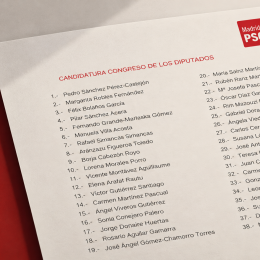
Complete list of PSOE for Congress from Madrid

The socialist candidacy for the Congress of Deputies for the Madrid constituency is made up of the following names, according to the party document:

  1. Pedro Sánchez Pérez-Castejón
  2. Margarita Robles Fernández
  3. Félix Bolaños García
  4. Pilar Sánchez Acera
  5. Fernando Grande-Marlaska Gómez
  6. Manuela Villa Acosta
  7. Rafael Simancas Simancas
  8. Aránzazu Figueroa Toledo
  9. Borja Cabezón Royo
  10. Lorena Morales Porro
  11. Vicente Montávez Aguillaume
  12. Elena Arafat Rautu
  13. Víctor Gutiérrez Santiago
  14. Carmen Martínez Pascual
  15. Ángel Viveros Gutiérrez
  16. Sonia Conejero Palero
  17. Jorge Donaire Huertas
  18. Rosario Aguilar Gamarra
  19. José Ángel Gómez-Chamorro Torres
  20. María Sáinz Martín
  21. Rubén Ranz Martín
  22. María Josefa Pascual Vallejo
  23. Óscar Díaz García
  24. Rim Mazouzi Fritah
  25. Gabriel Dorado Martín
  26. Ángela Viedma Alonso
  27. Carlos Cerón Hernández
  28. Susana López Antequera
  29. José Antonio Domínguez Chacón
  30. Teresa López Chamosa
  31. Juan Carlos García Gutiérrez
  32. Carmen Rodrigo Rojo
  33. Gonzalo Matías de Lara
  34. Leonor Mogío Gabardino
  35. José Antonio Jiménez Walias
  36. Susana Hernández Yáñez
  37. Diego Pinilla Zambrano
  38. Marian Llopis Sandino

The candidacy maintains several members of the Executive in its top positions. Margarita Robles will occupy number two, Félix Bolaños number three, and Fernando Grande-Marlaska number five, while Pilar Sánchez Acera, Secretary of Organization of PSOE-M, is in fourth position.

Among the leaders who repeat is also Rafael Simancas, Secretary of State for Relations with the Courts and Constitutional Affairs, in seventh place. The list also incorporates members of the federal leadership such as Manuela Villa, Borja Cabezón, and Víctor Gutiérrez.

PSOE candidates for the Senate from Madrid

The socialist candidacy for the Senate from Madrid includes Antonio Hernando, Leticia Correas, and José Luis García.

Candidate Position
Antonio Hernando Secretary of State for Telecommunications and Digital Infrastructures
Leticia Correas Deputy Mayor of Navalcarnero and member of the regional executive of PSOE-M
José Luis García Deputy in the Assembly of Madrid and former mayor of San Martín de Valdeiglesias

The PSOE of Madrid approves its lists for the 29N

The approval of the candidacies has occurred after the socialist groups of the Community of Madrid held their assemblies to present proposals.

Among the incorporations are Aránzazu Figueroa, general secretary of the Socialist Youth of Spain, in the eighth position, and Elena Arafat, advisor in the Presidency of the Government, in the twelfth. Also appearing are Lorena Morales, head of Equality of PSOE-M and regional deputy, and Carmen Martínez Pascual, from the socialist group of Fuenlabrada.

The lists approved by the Regional Committee of Madrid are part of the process of preparing candidacies of PSOE for the general elections on November 29, 2026. The organic calendar includes its review by the Federal List Commission on October 16 and the final ratification by the Federal Committee on Saturday the 17th.

More key points, information and questions with FREN

AI-GENERATED CONTENT

What is the status of the parliamentary processing of the PSOE candidacy for Madrid for the general elections?

As of October 14, 2026, the PSOE candidacy for the Madrid constituency in the general elections on November 29 has not yet been registered with the Provincial Electoral Board of Madrid nor definitively proclaimed. The process is in the party's internal phase, prior to the legal-electoral procedure before the electoral boards.

It is useful to distinguish three levels, which are sometimes mixed in public debate:

  • Internal processing within the PSOE (party bodies that decide the list).
  • Electoral processing before the electoral boards (registration and proclamation of candidacies, regulated by the LOREG).
  • Parliamentary scope: currently the Cortes are dissolved, so there is no “parliamentary processing” properly associated with these lists; what exists is electoral processing of candidacies for the Congress and the Senate.
1. Internal situation in the PSOE for Madrid

According to information from Demócrata and other media, the status of the PSOE's internal file is as follows:

  • Lead candidate: Pedro Sánchez will again head the candidacy for Congress for Madrid.
  • Following positions: Félix Bolaños is practically assured continuity around number three on the list, while the number two position has been subject to debate. Initially, the possibility of incorporating Sara Aagesen, Minister for Ecological Transition, was considered, but Aagesen herself has shown reluctance, which has forced Ferraz to seek female alternatives with political weight for that highly symbolic position.
    See, among others, the analysis on the composition of the socialist lists: article in Demócrata.
  • Bodies that must decide:
    • Local groups and provincial structures submit their candidacy proposals.
    • The Federal List Commission examines and may modify these proposals.
    • The PSOE Federal Committee, meeting in Fuenlabrada on Saturday, October 17, is the body called to definitively ratify the internal lists for Congress and Senate before submitting them to the electoral boards (analysis on the final stretch of the lists).

Therefore, as of today, the PSOE candidacy for Madrid is in the final phase of internal composition and ratification, but it is not yet listed as submitted or proclaimed in the electoral scope.

2. Official electoral calendar: registration and proclamation

The “legal” processing of the candidacy before the electoral administration is governed by the Organic Law of the General Electoral Regime (LOREG). According to the calendar published by Demócrata and electoral institutions for the general elections on November 29 (detailed calendar for 29N; INE note), the key dates are:

  • October 21–26: deadline for parties to submit their candidacies for Congress and Senate to the Provincial Electoral Boards. It is during this interval that the PSOE must formally register the list for Madrid.
  • October 28: the Official State Gazette (BOE) will publish the list of submitted candidacies. These are still provisional, pending correction of defects and resolution of challenges.
  • Around November 3: the BOE will publish the candidacies already proclaimed by the Provincial Electoral Boards, once reviewed and corrected. It is at this moment that, if there are no incidents, the PSOE candidacy for Madrid will be legally proclaimed by the Provincial Electoral Board of Madrid.

Only in cases of appeals or specific jurisdictional issues would the Central Electoral Board intervene, which acts as the superior control body, but the ordinary proclamation of candidacies corresponds to the provincial boards.

3. Summary of the current status
  • At the party's internal level: the PSOE list for Madrid is in the closing phase; it is assumed that Pedro Sánchez will lead it, with Bolaños in a prominent position, and the debate centers on number two. The Federal Committee on October 17 must ratify the candidacy before sending it to the electoral administration.
  • At the electoral level (electoral boards): as of October 14, the submission period for candidacies has not yet opened (it begins on the 21st), so the PSOE candidacy for Madrid:
    • Is not yet formally submitted to the Provincial Electoral Board of Madrid.
    • Has not been provisionally or definitively proclaimed by said Board.
    • The Central Electoral Board has not intervened in anything related to its proclamation.

Consequently, if we speak strictly of “parliamentary processing,” it does not yet exist: the General Courts are dissolved and the PSOE candidacies for Madrid are in the prior phase of internal composition and, in the coming weeks, of registration and electoral proclamation before the competent boards.

When and in which BOE will I be able to see the PSOE candidacy for Madrid published once it is proclaimed by the Provincial Electoral Board? What legal differences exist between the proclamation of candidacies by the Provincial Electoral Board and the possible intervention of the Central Electoral Board? How does the current process of preparing the PSOE lists for Madrid compare with the one followed in the 2023 general elections?

What are the powers and functions of the President of the Government according to the Spanish Constitution?

The 1978 Spanish Constitution establishes the President of the Government as the central figure of the Executive Power. He is not a “primus inter pares,” but the true head of the Government, with a clearly predominant position over the other members of the Council of Ministers and a key role in directing domestic and foreign policy.

1. Direction of Government action (art. 97 CE)

The core of his powers appears in Article 97 of the Constitution: the Government directs domestic and foreign policy, the civil and military administration, and the defense of the State, and exercises executive functions and regulatory authority. Within that Government, the president:

  • Sets the general political orientation and coordinates the actions of the entire Executive.
  • Promotes and arbitrates the actions of the ministers, resolving conflicts of competence between departments.
  • Represents the Government both domestically and abroad, especially before the General Courts, other state powers, and international partners.

2. Relations with the General Courts

The Constitution assigns the President of the Government several essential functions in his relationship with Parliament:

  • Political responsibility: the Government, and particularly its president, are jointly responsible before the Congress (art. 108 CE). This is concretized in instruments such as:
    • Vote of confidence (art. 112 CE), which only the president can propose to seek the Chamber's explicit support for his program or a political declaration.
    • Motion of censure (art. 113 CE), whose approval implies the dismissal of the president and the automatic investiture of a new president proposed in the motion.
  • Parliamentary control: the president must appear before the Congress and, if applicable, before the Senate to answer questions, interpellations, and report on Government action. Although the Constitution does not detail each format, the duty of information and control derives from articles 66 and 110 and the parliamentary principle of the system itself.
  • Relationship with the King in legislative matters: the president proposes to the King the dissolution of the Cortes or one of its Chambers and the calling of elections (art. 115 CE), a decision of enormous political significance that always requires his initiative.

3. Appointment, dismissal, and configuration of the Government

The President of the Government occupies a central position in the formation and organization of the Executive:

  • Appointment: he is proposed by the King after consulting the representatives designated by political groups and the President of the Congress (art. 99 CE). It requires the confidence of the Congress through the investiture session.
  • Appointment and dismissal of ministers: once invested, the president proposes to the King the appointment and dismissal of the other members of the Government (art. 100 CE). This gives him effective control over the composition of the cabinet.
  • Dismissal of the Government: the Government ceases, among other cases, due to resignation or death of the president, loss of a vote of confidence, approval of a motion of censure, or holding of general elections (art. 101 CE).

4. Functions in the Council of Ministers and regulations

Within the Council of Ministers, the president:

  • Convenes and presides over its meetings.
  • Sets the agenda and prioritizes the matters to be addressed.
  • Directs deliberations and seeks cohesion and unity of Government criteria.

Although regulatory authority corresponds to the Government as a whole, the president is the main political responsible for the approval of royal decrees and the submission to the Cortes of draft laws and, if applicable, the use of instruments such as royal decree-laws, always within constitutional requirements.

5. Role in the institutional system

In summary, the Constitution positions the President of the Government as:

  • Head of the Executive, who defines and directs general policy.
  • Mainly responsible before the Congress, subject to its permanent confidence.
  • Privileged interlocutor of the King in adopting key decisions such as government formation or dissolution of the Chambers.
  • Coordinator of the State Administration, both civil and military, and a central figure in defense matters.

All this shapes a figure with broad political powers, but always framed within a parliamentary system in which his legitimacy and permanence depend on the confidence of the majority of the Congress of Deputies.

What results did the PSOE obtain in the Madrid constituency in the last general elections?

In the last general elections held in Spain, on July 23, 2023, the PSOE obtained the following official results in the Madrid constituency for the Congress of Deputies:

  • Votes obtained: 1,004,599
  • Percentage of vote: 27.84 %
  • Seats won: 10 deputies

These data correspond to the final count, once the external vote (CERA) has been incorporated and the official tally completed. The reference can be verified in the summary of results by constituency available in public sources such as the Madrid electoral constituency page on Wikipedia, which in turn refers to the official publication in the Official State Gazette.

Meaning of these results for the PSOE in Madrid

The key figure is that the Socialist Party achieves just over one in every four ballots cast in the Madrid constituency, with close to 28 % of valid votes. In terms of parliamentary representation, this vote share translates into 10 seats in the Congress of Deputies for Madrid.

The relationship between vote percentage and seats reflects the functioning of the Spanish electoral system:

  • Deputies are distributed province by province, not based on a single national percentage.
  • In each constituency, the D’Hondt method is applied to the votes of each list to assign the last seats that are “in dispute.”
  • Competition between left and right forces, as well as vote fragmentation among different parties, greatly influences how many seats each party converts from the same percentage.

In the case of Madrid, the PSOE competes with a very strong right-wing bloc and with other relevant lists on its left. That with 27.84 % it has reached 10 deputies indicates that, although it is not the leading force in the province, it maintains significant electoral weight and a solid presence in the Madrid delegation of the Congress.

Context within the national result

Placed in the context of Spain as a whole, the July 23, 2023 elections represented for the PSOE one of its best recent results in vote percentage at the national level, with just over 31 % and 121 seats in Congress. Madrid is one of the most decisive constituencies for that overall distribution for three reasons:

  • It contributes a very high number of seats to Congress, among the highest in the country.
  • It is a territory where polarization between blocs is intense, meaning small vote changes can alter several seats.
  • It is also a place of great political and media visibility, so results there are always read as a barometer of the political moment.

From this perspective, the 1,004,599 votes obtained by the PSOE in the Madrid constituency and the 10 deputies won contributed significantly to the party's national total and its ability to challenge the Popular Party's political initiative in Congress.

In summary, in the last general elections (July 23, 2023) the PSOE in Madrid:

  • Surpassed one million votes in the constituency.
  • Reached almost 28 % electoral support.
  • Translated into representation, secured ten seats in Congress from this province.

With these data, it can be stated that Madrid remains a strategic constituency for the PSOE: it is not only an important source of seats but also a key indicator of its relative strength on the national political stage.

How do these PSOE results in Madrid compare with those obtained in previous general elections in the same constituency? Which other parties obtained representation for Madrid in the 2023 general elections and with what percentages? How did the results in Madrid influence the balance of power between left and right blocs in the Congress resulting from July 23?

Play

Test your knowledge with FREN!

How much do you know about this topic? Answer the following 3 questions.

Who holds the first position on the PSOE Madrid list for the Congress of Deputies for the November 29 elections?

Question 1 of 3

Which body must review the list approved by the PSOE Madrid Regional Committee before its final ratification?

Question 2 of 3

How many candidates are included in the PSOE Madrid candidacy for the Congress of Deputies?

Question 3 of 3