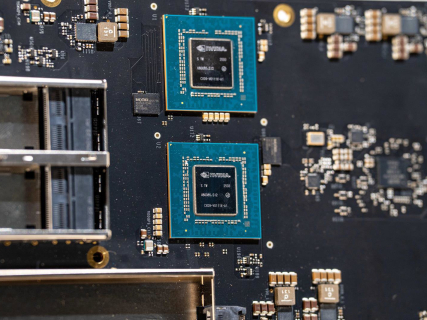

The Administration of Donald Trump has chosen to impose new obstacles to the shipment of chips and artificial intelligence (AI) intelligence servers to Chinese companies, at a time of ongoing progress in investigations into the export of semiconductors linked to the alleged espionage case that has involved his former chief executive officer, Jensen Huang.
A provisional rule issued on Monday by the Department of Commerce requires that operators of data centers located in Singapore, Malaysia, Thailand, Indonesia and Brazil apply for a specific license from the U.S. Government before they can export advanced AI chips from Nvidia and other U.S. manufacturers to customers based in those countries, according to the Department’s own document.
"The rule is intended to ensure that existing restrictions on access to sensitive U.S. technology cannot be circumvented through remote computing arrangements in which data centers located in third countries participate," the statement issued by the Office of Industry and Security (BIS, for its English-language acronym), which is under the Department of Commerce, says, adding that it has been "drafted by the Department of the Treasury and the National Security Council, and under their guidance."
With this move, Washington, which presents itself as the "world leader in advanced computer technology and superintelligence," says it seeks "the global adoption of U.S. technology for legitimate commercial purposes, while ensuring at the same time that sensitive technologies are not used in ways that threaten the national security of the United States."
The draft regulation has come to light just a few days after Jensen Huang’s resignation as CEO of Nvidia, following his acknowledgment that he maintained a relationship with Alice Huang, a former executive of the company Megaspeed International—headquartered in Singapore—identified in the United States as a possible Chinese spy. Megaspeed is being investigated in U.S. territory for alleged violations of export control rules, although the company has denied having committed any irregularity, while Alice Huang currently remains in China.
The Department of Commerce has made this initiative public just when President Donald Trump and other senior officials of the Administration are embarking on a tour of Asia to attend several regional summits in which, among other matters, the scope of the United States’ controls on the export of advanced technology will be addressed.