

A wave of protests and unrest is sweeping across different corners of the world in recent times. They are not isolated demonstrations, but rather draw on a common element, which has been simmering for some time, and has ended up exploding. Although with different angles, the underlying pillars on which the demands rest have a lot to do with it, as a study commissioned by the Global Fund for a New Economy (GFNE) and carried out by Convergent Opinion shows. It gathers the responses of 9,688 people in Great Britain, France, Germany, Spain, Brazil and Argentina.
Between 47% and 50% believe that the protests recorded in different parts of the world respond to a shared underlying cause, rather than being isolated national conflicts. In Brazil and Argentina, by contrast, there are between three and four percentage points more people who perceive them as separate issues.

And the corollary is that the cost of living appears among the top two priorities that citizens want their respective governments to address in all the countries analyzed. It ranks first in Great Britain, at 69%; France, at 62%, and Germany, at 53%. In all cases, it surpasses immigration as a concern, even in British territory, where the latter is cited by 43%.
This perception is not limited to a political orientation: left- and right-wing voters show an almost identical propensity to recognize a shared cause. Jan Eichhorn, director of Research at d|part and a professor at the University of Edinburgh, highlights how similar the reasons for discontent are across countries: "From London to Madrid and to Berlin, people describe the same suffocation over the cost of living, points to the same failure of those in power and expects a better response from the State," he explains.
Support for the protests
When asked about responsibility for the problems, governments and politicians appear first in all six countries. The responses that point to them range between 35% and 56%.
The measures considered most useful vary: social housing stands out in Spain and Germany; limits on price increases, in France; public education, in Brazil, and increases to the minimum wage, in Argentina.
For Oscar Berglund, professor of Public Policy Studies at the University of Bristol and a specialist in social movements, "this survey shows that, although there are national differences, people around the world are fed up with stagnant wages and the increase in the prices of essential goods such as housing, food and energy".
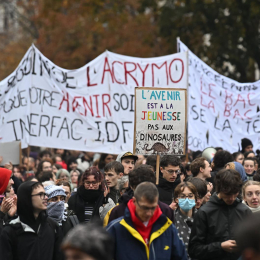
The goals of the protests are supported by more than half of those surveyed in each of the six countries. France records the highest percentage, with 68%, followed by Germany (60%), Argentina (59%), Spain (57%), Brazil (56%), and Great Britain (52%).
Featured story
More than 106,000 people return to the streets on the fifth Saturday of social protests in France
2 minutes
Acceptance of the demands does not necessarily mean agreeing with the forms of mobilization. In France, 55% support the goals, but not the methods; in Germany, that position reaches 51%, and in Spain, 44%.
The survey also asks about disruptions to everyday life. In all countries, there are more people who consider brief interruptions acceptable when they serve to make governments listen to the protesters — between 48% and 59% — than those who believe that protests should never disrupt daily activity — between 34% and 46%. In Great Britain, only 13% accept prolonged disruptions.
Veronika Dinter, spokesperson for GenZ regelt, a movement linked to several youth protests in Germany, summarizes her organization’s unrest in two words: "We’re furious". Dinter refers to social cuts, the state of schools and universities, labor demands, and military spending. The organization announced a strike for November 20 together with young people from different European countries.
A global tax on large fortunes
The proposal to establish an annual global minimum tax of 2% on the approximately 3,000 people whose wealth exceeds 1 billion dollars obtains a favorable majority in all six countries. The support percentage ranges between 57% and 65%, while those who oppose it represent between 7% and 12%.
The measure also receives approval among right-wing voters: at least half of their voters support it in each of the countries included in the study. In Germany, the percentage reaches 64%, and in France, 65%.
In Berglund’s words, "it is interesting to see the growing cross-cutting support for a wealth tax as a way to address inequality. Social movements very rarely have the support of the majority while they are happening, but they are vindicated in the collective memory years later. These are, in fact, very high figures of support for the protests".
Alex Cobham, executive director of Tax Justice Network, argues that, "in Europe and beyond, extreme wealth is suffocating economies, impoverishing people and weakening democracies. But we have a historic opportunity to tax and curb extreme wealth through a new UN tax convention that already has the backing of the majority of countries".
For his part, Gabriel Zucman, director of the International Tax Observatory, also refers to the international acceptance of the measure and describes it as one of the most popular public policy proposals "in the whole world". In his view, delaying its implementation may deepen distrust in governments and favor the advance of far-right authoritarianism.
Trust in governments does not reach a majority
The survey detects a lack of majority trust in the actors who could drive the changes being demanded. Current national governments are identified as the option in which the most trust is placed, with percentages ranging from 12% to 37%, depending on the country.
France and Germany present a particular feature: the main opposition parties generate more trust than their respective governments. In France, 24% point to Rally National, compared with 12% who choose the Executive. In Germany, Alternative for Germany obtains 23%, compared with the Government’s 14%. The left-wing formations, considered together, are close to those results: La France Insoumise, the Socialist Party and The Ecologists add up to 21% in France, while La Izquierda and Los Verdes reach 18% in Germany.
In Spain, the PSOE and Sumar coalition government leads the responses, with 32%, ahead of the People’s Party (20%) and Vox (17%). In Great Britain, the Executive obtains 23% and Reform UK, 19%. Governments also take first place in Brazil, with 37%, and in Argentina, with 35%.
The distribution among the younger people departs from the general trend in France and Germany. Among people aged 18 to 24, La Izquierda gets 29% in Germany, compared with 18% for Alternative for Germany; in France, La France Insoumise reaches 34%, compared with 21% for National Rally. In Spain, the difference is smaller: Vox registers 26% among that age group and the Government, 29%.