

The 29N approaches inexorably and, with its sights set on the electoral horizon, DEMÓCRATA has started a series of interviews in which one of the formations with the most force in the Basque Country could not be missing: EH Bildu. Its candidate, Oskar Matute, who debuts as number one, argues that although the polls smile on them, success could not be spoken of if it is not achieved to stop a Government made up of PP and Vox.
In this calm conversation with DEMÓCRATA, Matute analyzes the electoral scenario, the political line his group has followed during the current legislature, and what edges will guide his action next: policies to win rights and reinforce freedoms for workers. He also avoids talking about a pulse with the PNV, assures that "Euskal Herria looks more like EH Bildu than any other political formation" and lays out his vision regarding housing policies, migration, and the business fabric, among other issues.
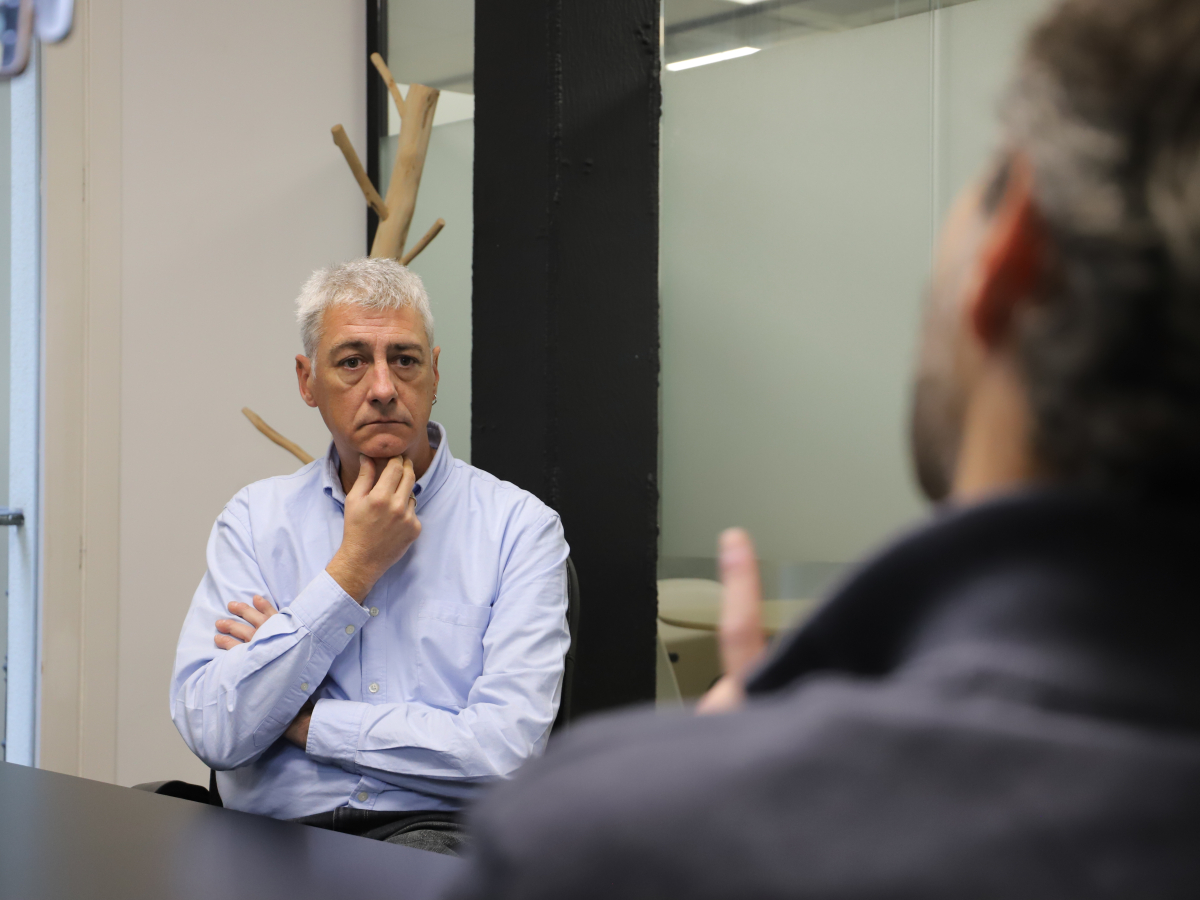
QUESTION: EH Bildu is one of the parties with the clearest outlook in the 29N elections. All the polls give them an upward trend. What forecast do they offer? Will results improve? What would be a good result?
ANSWER: What we would like is for our success to contribute to an overall success. Having a particular success that then cannot become a government different from the one PP and Vox aspire to have, our electoral rivals in this contest, would be of little use because we do not believe that what is at stake is a mere alternation of power.
We believe there is a clash of models. One that wants to take us to involution and authoritarian times, and another, with many imperfections, but that sets out a path of deepening rights and freedoms. We take a clear side there and we say so openly: with our votes there will be no doubt or hesitation when it comes to preventing a PP-Vox government. We do that free of charge et amore.
The polls do not condition us, even though they are very good. We draw on an illusion that exists in Basque society in favor of a left-wing sovereigntist force that defends Euskal Herria, but which is also capable of helping to prevent the rise of the extreme right and far-right parties to the Government.
P: He talks about two opposing models. In your view, what would be the cost of a government formed by PP and Vox? Can you cite some specific rights in which it could be rolled back?
R: Yes, because they state it openly. They question and talk about reviewing the pension system. It is also an attack on Basque society because, as in all cases, there is a substantial group of people who obtain their current income through their pensions and contributions, as a result of their prior work experience.
We also believe that they are going to attack fundamental pillars of our self-government, such as the economic agreement and the quota. They say so. They point out that they want to move toward a unification of the healthcare system, that is, to end our own Healthcare model, which is certainly improvable, but is one of the jewels in the construction of Basque self-government. They also say that they are going to put an end to what they call 'linguistic taifas', in this case, our language, Basque; a direct attack on our identity and on our culture.
And I could go on with practically everything else, because they are proposing a program of regression, taking us back to dark scenarios. They do it when they question the Abortion Law, the rights of the LGTBIQ+ collective... Everything. There is nothing good to hold on to in what PP-Vox proposes.
P: Regarding the other model he talks about. What assessment do you make of Sánchez’s legislature? You have been one of his most reliable partners. What have you left out? Ley Mordaza, the Industry Law…
R: Well, I think we haven’t left things out, but rather they haven’t come about because it was necessary to build a majority of the right to prevent them from being carried out. Therefore, it is difficult for me to point to just one issue. There have been many lines of progress that could have been developed, such as those contemplated in the General State Budgets, which have not been brought out and could have included items for specific places in Euskal Herria.
We have made an all-out defense of social shields, a clear defense of what had to do with the Public Power’s response to the emergency of access to housing, and we have always tried to carry out policies that provide guarantees and rights. This is how our line of pressure and influence has been, because politics has to solve problems, not be an element that makes people’s lives harder. It cannot be forgotten in politics that from your decisions also depends people’s ability to live better, and unfortunately, that the right does a lot.
P: Before moving on to more programmatic issues, I want to ask you how the train tragedy in Urda affects the campaign and, of course, Óscar Puente’s resignation.
R: We are in a campaign, an election period, which is pretty much like a roller coaster, with constant changes of script, jolts… You were talking about Urda, and it’s true, but before we were talking about the Maricarmen decree and, earlier, about other issues. And next week something new will emerge.
I don’t exactly know how much the train accident can influence what happens in the elections. I wouldn’t dare to point out how much emotional pain will persist. It impacts because of the harshness and brutality of the accident, but the campaign should serve so that nobody hides behind any specific fact to cover up their programmatic shortcomings. We are very clear about what we want to do, and we would like the rest to put their demands or objectives on the table, not to do electoralism, which is painful for the victims and their families.
P: When the time comes, you’ve talked about free voting, but what would you ask of the PSOE if they agreed to the investiture? What commitments and what guarantees? Because some partners have complained that things were agreed upon, but they haven’t been laid down.
R: It’s not that we were the most loyal partner or not; rather, we have been steadfast and coherent. There have been many political formations that, swayed by what they understood to be public opinion, interpreted it as a kind of stage setting that made them keep dissonant notes: one day they become super demanding, and the next, they agree to the pact.
We have a line of work that no external factor conditions—only our own assessments, reflections, and decisions. From that position, with common sense, what we propose and will propose will be policies that improve and dignify people’s lives and that serve to deepen our self-government.
That’s what we’re going to be moving through in this legislature as well. We will always be in the pursuit of expanding rights and freedoms, of greater areas of protection for workers and for the most vulnerable sectors.
P: You take up the baton from Mertxe Aizpurua. What can change in your bench, or what nuances can you bring?
R: I hope there are no changes because I think none are needed. Mertxe Aizpurua has been an excellent spokesperson for EH Bildu and what I aspire to is to continue the path she was drawing. EH Bildu is not a project built around figures; it is a collective project where some people occupy spaces of representation, greater or lesser, but the reflection is always the result of collective intelligence that determines the way we intervene and the profiles or accents of our interventions.
P: How do you see the scenario with respect to the PNV and the electoral struggle they maintain in the Basque Country?
R: For a long time we have been saying that Euskal Herria looks more like EH Bildu than like any other political formation, and that is what is being seen. Our growth is always continuous and gradual, not subject to peaks or ridges, because it consolidates its base. It is built from a vocation for a people’s unity project that connects with Basque society, mobilized—a society that fights for its rights and does so on different levels, from the street, in institutions, and in those places where we can be capable of winning rights and strengthening freedoms.
That is where we position ourselves, and we do not waste time on the rivalry that the PNV wants to maintain with us. That is not the debate that people raise; it is not the question they ask when casting a ballot. The debate is about where we stand in the face of regression or democracy, between civilization or rights and freedoms or authoritarian regression and barbarism. And we have it very clear, so I do not want to lose too much time feeding controversies with the PNV or with any other. I have always said that the more voices there are in the hemicycle that defend Euskal Herria, the better.
P: You always try to focus your speech on the rights of the working class, on concrete policies. However, day after day, as they say, they pull out the 'ETA wild card' for you. Feijóo himself told you that a few weeks ago. How do they receive it? Do you think that 'wild card' will stop being used?
R: I don’t know how much it strengthens them to have to invoke continuously an organization that 15 years ago decided to abandon its armed activity and that Basque society celebrates that we live in this new phase. Basque society also understands well what the role of each political actor was so that what was a wish pursued for decades became reality. Personally, we are not very concerned about what they say about us because the one we have to answer to is our people, who know in a clear and straightforward way who we are, what we did, what we do, and what we are going to do.
Mr. Feijóo can cover up his argumentative shortcomings with whatever he wants, but you can’t ask for pears from an elm tree.
P: Housing is the great problem of our time. An issue that has been raised in recent weeks, with Maricarmen as a symbol, emergency decrees, sit-ins, a general strike… What do you propose to solve it? What are your proposals?
R: If someone really wants to sort out the drama that the difficulty of accessing housing represents for millions of people—something that appears in legal texts as important as the Constitution—then they will have to defend public intervention, and we do.
We defend public intervention to ensure that the right to housing is above the possibility of speculation or the profit that some have from the homes they own. From there, many things have to be done, in many places and for a long time. Because a one-way effort in an institution with powers in rental matters, such as the State through the Urban Leases Law, does not do any good if later the autonomous communities decide not to apply the law and to abandon their functions so that the market continues to dominate everything.
We have already seen that the market, when it comes to housing and in almost everything, does not meet criteria of justice, equity, safeguarding of basic rights, and protection for the most vulnerable people. The market follows its only God, which is money.
P: A lot of people who voted for the parliamentary arithmetic that sustains this Government, to you, to ERC, to Sumar, to the PSOE…, are asking themselves: they’ve been in office for eight years and the problem, far from being solved, has gotten worse. What would you tell these people?
R: A street that is active and mobilized, a society that is capable of placing this debate at the center of political action and of pushing those who even today still have more willingness to listen to the big investors and the powerful than to citizens—that is the key. We supported the strike of last November 11, a good opportunity to bring political parties back in front of the mirror.
The reality of the ability to intervene in the housing market also has to do with the distribution of powers. This Government can be criticized for many things and I have done so on many occasions, for timidity, for lack of ambition or boldness out of fear of those hidden powers that do not stand for election; but you have to understand what the map of powers is. The State can do what it can do in matters of rentals and everything derived from it with the price cap, etc., but what has to do with the construction of housing, which is like the great panacea, are the autonomous communities that have exclusive powers. And also the city councils, which own the land where that reality can be built.
I believe that a mobilized society has to be able to challenge all those who, being able to do much more, have decided not to, so that a few continue to enrich themselves with the needs of a majority.
P: All this speech that lays out rights and freedoms, the strengthening of public services—how does it coexist with business activity and investment?
R: We believe that the State, public power, has to intervene in all sectors of the economy. Economics and politics are not opposing realities; they are intertwined and, therefore, from politics we have to be able to regulate, to standardize markets so that they meet the real needs of people and not the speculative wishes of those who are at the top of the pyramid.
When we defend the working class, we do it from a very clear perspective: wealth is generated by workers. And that doesn’t mean that we have too many employers; what we lack are good practices in the business world. We lack collaborative experiences. We have roots in experiences like cooperatives, which build a different way of being in the economy and in the company. We can analyze whether, with the imperfections it may have, that is more convenient than a market in which the boards of directors—filled by those who are filled and who are usually from X parties, never from EH Bildu—have to be capable of determining layoffs, the price of things when they are having record profits… What has most shocked me in this legislature is seeing how the major energy companies and banks boasted about obtaining record profits that were never passed on to citizens. It’s fairly reasonable that whoever has more should pay more, not that they have at their disposal an entire legal architecture to evade their responsibility. Because they are businessmen, but also citizens who claim to be very patriotic. If they love their country so much, then besides showing off the wristband, they should contribute to making it more dignified and livable for everyone.
P: Speaking precisely about workers. What do you think of the Government’s proposal to raise the SMI by 5.3%? A problem is coming to the surface: the minimum wage is getting closer and closer to the middle.
R: We are in favor of the rises that may occur. Unfortunately there is a great deal of people who are tied to that economic threshold because that is what those who employ them decide. If it were up to us, the increases would be much higher; but we also say clearly that that SMI would have to be a common floor that can be implemented by those communities that have the vocation to do so. We have proposed, without any intention of harming the rights of any worker in the Spanish State, that there should be an adequate SMI for each reality, because the cost of living is not the same in every place. In the case of Euskal Herria we defend that there should be our own minimum wage or tailored to our own reality.
P: The right has long been fueling the immigration debate, but we have a very recent milestone like Ceuta. Do you think this is the moment for the left to also address this issue?
R: Several considerations. The left has not stopped having a position in this debate, another thing is that it has been more or less capable of reversing that clearly intentionally crafted media wave.
I do not believe that what the left has to do is to buy into the discourse framework of the far right. That is not it, honestly, that is not where the far right is for sure.
Thirdly, we cannot and must not separate the migratory phenomenon from a global context that explains the reality that may exist around the phenomenon of migration.
And lastly, it is a rather cynical discourse to associate migration with crime but then they need migrants to do the jobs for them.
We are looking for spaces of freedom for all people. Sovereignist left, decades ago, coined a phrase that still holds today: Basque or Basque woman is every person who lives or works in Euskal Herrría. From that position we build a space for integration that goes on welcoming multicultural touches that now may seem novel, as surely those who joined it were 100 years ago, but we have to do it with an integrating perspective that allows us to build friendly societies for everyone and every one. And evidently, a friendly society has to be safe, where what has been your identity can endure. That has nothing to do with the delusions that some put on the table, even people who claim to be on the left.
P: Sánchez intends to use his international positions as electoral leverage. He has positioned himself as the arch-enemy of Trump and Netanyahu, allied with Lula, and has maintained a pro-Palestine position... But he has also set aside, for example, Western Sahara. What assessment does he make of those positions in this legislature?
R: The international context is defined by a reactionary international that not only is content with devastating the planet through its reckless bet on a voracious capitalism that attacks the climate and life, but also accelerates it with multiple conflicts.
We are talking about the Sahara, but the genocide of Palestine concerns all of us. We could talk about Iran, about Ukraine, about the craziness that Trump sometimes lets slip when he talks about Greenland. This is not a horizon that allows us to have hopes, and therefore, standing up to a genocidaire like Netanyahu or a lunatic like Trump is an ethical obligation.
We are very clear that they can be beaten, like Lula in Brazil or the severe setback to Trump in the midterms. We would like, also thanks to the push and the collaboration of the sovereignist and Basque independence left, that on November 29 we would be able to make them bite the dust again.
P: To close, a question that is somewhat more personal. What has changed in Óskar Matute from the time he entered politics until he became a candidate?
R: My hair—this is obvious (he laughs). I have tried to ensure that I do not change the place from which I do politics. I do not consider myself a politician: I am a political activist. We are doing politics from the place where we have been asked to do it. When it is time to do it in the street, we will do it with the same intensity and enthusiasm. I do not live between the four walls of Congress or surrounded by cameras; I have a life, like everyone else, that I try to make as pleasant and enjoyable as possible for those who share it with me within normality. I do not aspire to live backstage my whole life, and my tastes are quite modest.