
Frente Amplio has missed its goal of establishing itself as a key force in the elections of 29N to support the progressive Government, by ending up with a total of 13 deputies if the seats obtained are added to those from the Valencian coalition led by Compromís.
In this way, the space inherited by Sumar loses 18 seats compared with four years ago, marks the worst record of the alternative left to the PSOE in one and a half decades, and retreats to levels similar to those of IU in 2011, when it had 11 deputies and nearly 1.7 million votes.
Thus, a political cycle begun in 2015 after 15M is considered closed, moving from expectations of reaching Government to irrelevance as an opposition force. At the same time, state-level parties enter a critical phase, with historic lows in representation in the face of the push of sovereignist and regionalist formations.
With 95% counted, the candidacy led by Ada Colau adds 1,355,246 votes, 5.08% of the total, to which 380,988 ballots (1.4% of votes cast) obtained by the Compromís-Frente Valenciano coalition are added. Taken together, they fall 1.3 million votes short of Sumar’s brand in 2023, when it exceeded three million (12.3% of the total count) that translated into 31 seats.
Therefore, the electoral performance of Frente Amplio is very poor compared with its goal of reaching at least 10% of the vote, a threshold that, according to its own calculations, could guarantee a group of around twenty deputies with the ability to influence governability. Finally, Frente Amplio has failed in its attempt to be the decisive factor in preventing PP and Vox from reaching the Moncloa.
On the territorial front, the debacle is clear: Frente Amplio is left without representation in a traditional stronghold such as Andalucía and only manages to win seats in Barcelona (3), Balearic Islands (1), Zaragoza (1), Valencia (2) and Madrid, which becomes its main stronghold with a total of five deputies.
In Alicante, the coalition between Compromís, Frente Amplio and Podemos obtains a seat that goes to the purple leader María Teresa Pérez. In the Balearic archipelago and in Zaragoza, the seats correspond to its allies of Ara Més and Chunta Aragonesista (CHA).
IU collapses and signs its worst-ever level of representation
On 29N, it certifies the crisis of the left at the state level, which is reduced to only two MPs between IU and Movimiento Sumar, a very marked setback compared with the 16 seats that both parties added together four years ago within the Sumar coalition. If the representatives that corresponded to Podemos in 2023 in that joint candidacy are added, the figure then rose to 21 seats.
The blow is especially harsh for the organization led by Antonio Maíllo, which only retains the seat of Toni Valero for Madrid, while it fights "in extremis" to try to wrest a seat in Asturias. All this despite having submitted head-of-list candidates in 29 constituencies. The debacle is sealed with the complete loss of representation in its historic stronghold of Andalucía.
IU thus signs its lowest-ever number of seats, below even the two MPs achieved in 2008 and in the first elections of 2015, before its coming together with Podemos in the repeat election of that same year.
Movimiento Sumar is left with a single seat and Más Madrid grows
Movimiento Sumar goes from running a parliamentary group with ten representatives to having only one seat, that of its co-coordinator and spokesperson in the previous legislature, Verónica Barbero.
As a result, the state-level left is relegated to a very secondary role in the future parliamentary group, clearly behind its territorial partners in Más Madrid, Comuns, Compromís, Chunta and Ara Més.
Chunta and Ara Més manage to retain their respective seats and the only force that improves results is Más Madrid, which goes from two to three MPs on the list headed by Emilio Delgado and, together with the party of Ada Colau, positions itself as one of the formations with the greatest representation.
Collapse in Andalucía and advance of the sovereignist left
By territory, the biggest setback for Frente Amplio occurs in Andalucía, the community that distributes the most seats (60), where it is left with no MPs and does not manage to maintain Sumar’s legacy, which in 2023 obtained six seats.
The strong emergence of Adelante Andalucía, which with an autonomist discourse consolidates itself as a reference point for the left beyond the PSOE, ends up sidelining forces of a state-level slant.
The result is especially painful for IU, which sees that in its region with the greatest territorial presence it continues to lose ground against the ballot paper of the formation promoted by anti-capitalist leader Teresa Rodríguez.
Compared with 2023, the candidacy linked to Sumar also fails to gain representation in Murcia, Vizcaya, Tarragona, Girona, Pontevedra, Coruña and Asturias.
In the Basque Country, Galicia and Catalonia, it again falls behind the push of the sovereignist left, with ERC, Bildu and BNG clearly surpassing Frente Amplio. If in 2023 Sumar and the Comuns managed to be the main reference for the alternative left in number of seats, now ERC leads with 10 deputies against the three that Colau obtains in Barcelona (in 2023 Sumar achieved seven across all of Catalonia).
In the Valencian Community, the coalition headed by Compromís together with Frente Amplio and Podemos also falls short of expectations and adds three deputies, one less than in 2023. The two seats for Valencia go to the Valencian formation and the third, for Alicante, goes to the leader of Podemos, María Teresa Pérez.
No comeback despite the campaign and the four-way debate
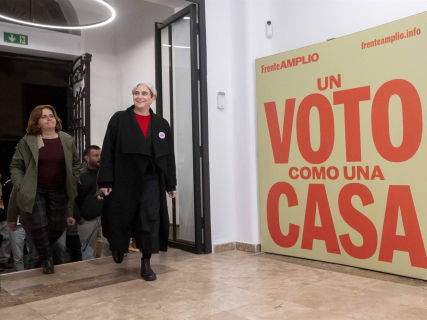
The ballot boxes have dispelled the good feelings with which Frente Amplio closed the campaign and have dashed the expectations of a “historic comeback” fueled by Colau’s good performance in the four-way “debate.” The electoral team believed that a standout performance in that format would serve to activate the left-wing electorate in their favor.
It has also failed to capitalize on the results of its work in the Government or to stop the useful vote toward the PSOE, one of the central pillars of its campaign message. Finally, it falls far short of the 10% of votes it had set as its main goal and of ensuring representation in about a dozen electoral districts.