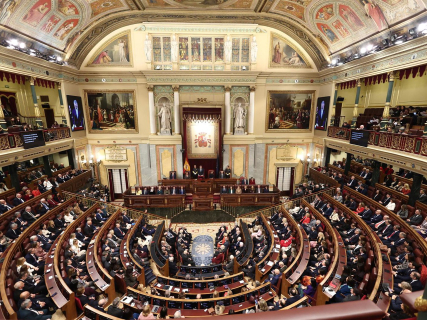

Congress has given new impetus to the modification of its Regulations with the aim of making it easier for minority parties to have their own parliamentary group. The proposal, promoted by ERC, Junts, Podemos, Compromís, and the BNG, overcame the committee stage this Friday, with the rejection of the PP and Vox.
The processing of this reform began at the end of May, when the Plenary Session accepted its debate with the support of the PSOE. In June, the alternative texts registered by the 'popular' party and Vox were rejected, and next Tuesday the bill will be discussed in the Regulations Committee.
According to the timetable managed by the PSOE and its allies, the intention is for the reform to be definitively approved in the Plenary Session scheduled for July 23. In this way, it would be ready to be applied in the new Congress resulting from the next general elections, as parliamentary sources have indicated to Europa Press.
One of the technical amendments incorporated this Friday in the committee stage specifies that the reform will only come into effect in the next legislature, so that current deputies will not be able to benefit from the changes introduced.
Minority parties aim to modify Article 23 of the 1982 Regulations, which now requires 15 seats or, failing that, at least five deputies and 5% of the votes in the entire State, or 15% in all constituencies where they have run.
With the new wording, Pedro Sánchez's parliamentary partners propose to lower the state vote threshold required to form their own group from 5% to 3%, and to reduce the percentage required in the provinces where they present candidates from 15% to 10%.
Advantages of having your own group
At the beginning of the current legislature, neither ERC nor Junts met the conditions set by the 1982 Regulations and had to resort to borrowing deputies from the PSOE and Sumar to form a group. The Congress's Board authorized it thanks to the majority formed by the PSOE and Sumar, who in turn took control of the Chamber's governing body with the votes of the Catalan independentists.
Having your own group entails significant political, economic, and resource benefits. It guarantees a distinct voice in all debates, at least one representative in the committees, in the Permanent Deputation and in the Spokespersons' Board, as well as a question in each control session of the Government. On the economic level, it allows access to greater subsidies and aid for 'mailing'.
In their alternative texts, PP and Vox defended maintaining the current percentages intact to avoid the usual temporary loan of deputies by large parties to small formations so that they can form a group, a practice they describe as a "fraud of law" tolerated by different Boards of Congress throughout several legislatures.
The amendments by PP and Vox that do not prosper
In their partial amendments, both groups took the opportunity to try to introduce other regulatory changes, but their proposals were rejected by the majority of PSOE and Sumar in the Rules Committee, alleging that they affected articles unrelated to the regulation of parliamentary groups.
The same fate befell an initiative by Vox that sought to oblige separatist formations to renounce defending their positions as a condition for having a parliamentary group and that, in case of non-compliance with these commitments, the Board could agree to their dissolution.
This amendment was rejected for being in "a blatant and evident contradiction with the Constitution" since, according to the doctrine of the Constitutional Court, "the model derived from the Constitution is not that of a militant democracy".
The rest of the amendments did pass the initial filter, but none have been incorporated into the report of the committee and remain alive for discussion in committee. In this context, the PP proposes to end the principle of equity between parliamentary groups in force since 1982 and replace it with a criterion of proportionality, so that subsidies, speaking times, and material resources are allocated based on the number of deputies in each group.
The 'popular' also propose reforming the current article 27 so that, when a group other than the Mixed Group "is reduced during the course of the legislature to less than the minimum required for its constitution", it is automatically dissolved and its members join the Mixed Group. Today, dissolution is only foreseen if the group falls "to a number below half of the minimum required".
Furthermore, the PP advocates for the suppression of the figure of the associate deputy, barely used, which allows those who do not join any group at the beginning of the legislature to subsequently join an already constituted one to avoid ending up in the Mixed Group.
Vox, for its part, wants to eliminate the regulatory provision that allows changing parliamentary groups, except to the Mixed Group, during the first five days of each session period, with the idea of curbing temporary seat assignments. Santiago Abascal's party also maintains another amendment to prevent parties that have run in the elections within the same coalition from forming their own group.
ERC and Bildu join Junts' amendment
In the committee meeting, Junts introduced an 'in voce' amendment to the text that further flexibilizes the conditions for constituting a parliamentary group, according to parliamentary sources confirmed to Europa Press.
Currently, the regulations require reaching at least 10% of the votes in the constituencies where one runs to be able to form a group. The proposal from Carles Puigdemont's party is that this percentage only needs to be met in those constituencies where representation is obtained.
The amendment was also signed by ERC and Bildu and received the support of all groups except PP and Vox. The latter protested that the change was introduced orally "without notice, out of time, and with the endorsement of the Congress's senior legal advisor," whom they accused of having become an "ally of separatism."
According to denunciations within Vox's parliamentary group, this modification effectively allows the government's partners to maintain their group status "even if they suffer the collapse that the polls anticipate."