Last votes for the RETA catwalk: What is left to decide?

The Congress examines this Thursday the amendments approved by the Senate to the reform before its final approval and subsequent entry into force.

2 minutes

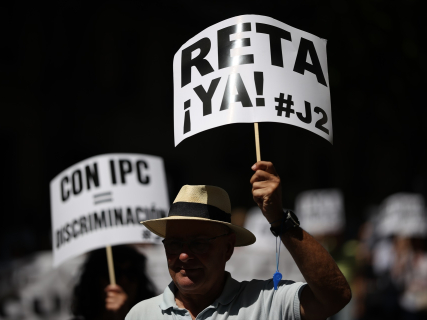
EuropaPress 7544308 persona porta pancarta lema reta ya manifestacion exigir reta pasarela

EuropaPress 7544308 persona porta pancarta lema reta ya manifestacion exigir reta pasarela

Add DEMÓCRATA to Google

Ask FREN

Published

Last updated

2 minutes

Most read

The reform to guarantee a public pension to alternative mutualists who want to transfer their contributions to Social Security is close to coming into force.

The bill will be definitively approved this Thursday, with the voting of its final changes in Congress. After this procedure, the regulation will be ready for publication in the Official State Gazette (BOE) and its subsequent entry into force.

What is being voted on?

The initiative has already been approved by Congress and the Senate, but since changes were introduced in the Senate, these have to be voted on again in Congress. The Lower House has the final word in the legislative process.

All amendments are those approved by the PP, which has an absolute majority in the Upper House.

What is at stake?

The exclusion of retirees. The Upper House reinstated the exclusion of mutualists who had already retired and, therefore, had any type of pension, public or from the mutual, except for the widow's pension.

When there will be regulations. The regulation that must determine the access conditions to the bridge, if Congress reaffirms the Senate amendment, must be approved within three months. The initiative obliges the Executive to determine in this decree the access criteria to the bridge, after Congress eliminated any entry barriers.

The 1 to 1 issue. For the purposes of calculating the regulatory base of the pension – its amount, determined by the contribution career at the time of retirement – the Senate consolidated the computation of each complete month contributed to the mutuality when it was a mandatory system for regulated professions (until approximately 1995) as a complete month and registered in Social Security (regardless of the contributions made compared to the contributions that would have been required).

Boost for the elderly. For those born before 1975, each complete month contributed to the mutuality will be counted as a complete month registered in the RETA. This is a proposal agreed upon by PSOE and Sumar that was eliminated in the last votes in Congress. Now the Senate recovers it.

No turning back. The text returning from the Senate now specifies that the framing in Social Security for mutualists who decide to join the bridge is mandatory and irreversible.

Also if there was a change. Another amendment that must be voted on ensures the bridge for regulated professionals who have been registered in more than one mutuality.

The range returns. This regulation must also determine the coefficient to be applied to the contributions transferred by the mutualists when calculating the contribution career and, therefore, how much pension corresponds to them.

The Government managed to set it at 0.77, Congress erased any reference, and now the Senate recovers the range that the PSOE initially proposed: it will be between 0.67 and 0.87, if the amendment succeeds. This coefficient is justified to discount the contingencies of Social Security to which the mutualists have not been entitled for being in an alternative system.

More key points, information and questions with FREN

AI-GENERATED CONTENT

What is the current parliamentary processing status of the bill on the RETA gateway and what are the next steps until it comes into force?

According to the available parliamentary information, there is currently no bill in the Cortes Generales whose object is the so-called “RETA gateway” (transition between General Regime, RETA, or alternative mutual societies) nor does that expression appear in the titles of active legislative initiatives. Therefore, it is not possible to indicate a specific “processing status” for that bill, because it is not registered as such in the Congress or the Senate. Most likely, we are facing a political proposal or a government commitment not yet materialized in a legal text, or an initiative processed under a different name. Below I explain how it could be situated in the procedure when it formally exists and what the steps would be until it comes into force.

On the non-existence of a “RETA gateway bill” in process

The search for “RETA gateway” in legislative initiatives of the Congress and the Senate does not return any bill or draft law related to Social Security or the self-employed regime.

Various initiatives about “gateways” do appear, but they refer to physical infrastructures (pedestrian bridges, maritime, etc.), unrelated to Social Security. For example, in the Senate there is the initiative with identifier (15)810/001181, titled “Certification of the agreement adopted by the Plenary of the Vejer de la Frontera City Council (…) to demand (…) the construction of the pedestrian bridge over the Salado river connecting El Palmar and Conil de la Frontera (Cádiz)”, already concluded, whose record can be consulted on the Senate website at this Senate link.

There are also numerous administrative announcements about bridges on the website of the Ministry for the Ecological Transition and the Demographic Challenge (MITECO), such as:

And, regarding “demographic challenge” or “digital rural challenge”, there are also regulations in the BOE such as Order TED/180/2021 (MITECO Archival System) and Order TED/1326/2023 (program “Digital Rural Challenge”), also unrelated to RETA. That is: there are formal coincidences with the word “gateway” or “challenge”, but none correspond to a gateway between Social Security regimes.

Consequently, as of today, no further information is available in the consulted sources that allows identifying and tracking a specific bill on the “RETA gateway”.

Steps a future bill on the RETA gateway would follow

If in the future a bill on the RETA gateway is effectively registered in the Congress, it would follow this general scheme:

1. Registration and consideration in the Congress
  • Presentation by a parliamentary group or a minimum of 15 deputies.
  • Qualification and admission for processing by the Congress Board.
  • Consideration in Plenary: debate on whether the Congress accepts to process the bill. If rejected, the initiative lapses.
2. Legislative processing in the Congress
  • Opening of amendment period (to the whole and to the articles).
  • Referral to the competent Committee (likely Labor/Social Security), which appoints a working group to draft a report.
  • The Committee approves a report on the text.
  • Debate and vote in the Plenary of the Congress (unless full legislative competence is with the Committee).
3. Processing in the Senate
  • Referral of the approved text to the Senate.
  • Possibility of amendments and veto by the Upper House.
  • If there are amendments or veto, the text returns to the Congress, which can accept, reject amendments or override the veto with the required majorities.
4. Sanction, promulgation, and entry into force
  • Once the final text is approved by the Cortes, it proceeds to sanction and promulgation by the King.
  • The law is published in the BOE and comes into force on the date indicated in its final provision (if not otherwise stated, 20 days after publication, the so-called vacatio legis).

Only when there is an identified text (with a file number like 122/000XXX or 121/000XXX) can we precisely locate in which of these phases the specific RETA gateway regulation is and estimate timelines for its entry into force.

Has any concrete political commitment been announced by the Government or groups to regulate the RETA gateway, even if no initiative has yet been registered? When the bill on the RETA gateway is registered, how can I locate its file number and follow its processing step by step? What practical differences would there be between regulating the RETA gateway through a parliamentary group bill or through a Government draft law?

What are the legal powers of the Congress of Deputies in approving bills with amendments from the Senate?

The Congress of Deputies has the final say on bills when they return from the Senate with amendments. The Constitution (art. 90) grants the Senate a suspensive power of review and veto only, while the Congress Rules detail how those changes are debated and voted on. In practice, the Congress can accept or reject all or some amendments by simple majority, and even override a Senate veto with reinforced majorities. The final decision of the Congress determines the text that proceeds to sanction and promulgation by the King.

Basic legal framework

The Congress's powers in this phase are supported by two normative blocks:

  • Spanish Constitution, particularly article 90, which regulates the passage of projects (and, in practice, bills) between Congress and Senate. The full text of the Constitution can be consulted in the BOE publication.
  • Rules of the Congress of Deputies, approved by Resolution of February 24, 1982, and successively reformed, accessible on the Congress website in the Congress Rules. Articles 120 to 123 are especially relevant.

Although article 90 CE speaks of “draft laws”, the Rules foresee that bills follow the same procedural path once approved by the Congress and sent to the Senate; therefore, the rules for return with amendments or veto are substantially the same.

Phases of processing upon return from the Senate

According to the Rules, once the Congress has approved the text:

  • Referral to the Senate: article 120 establishes that, once the project or bill is approved, the Presidency of the Congress sends it to the Presidency of the Senate with all its background.
  • Senate action: according to article 90 CE, the Senate has an ordinary period of two months to:
    • Oppose a veto (which must be approved by absolute majority).
    • Introduce amendments to the text approved by the Congress.
  • Return to Congress: if there is a veto or amendments, the text returns to the Congress for “new consideration” by the Plenary (article 121 of the Rules).

This final phase concentrates the Congress's decisive powers: debating the veto, debating and voting on Senate amendments, and setting the final text.

Required majorities and margin of decision

Senate veto

Article 122 of the Rules develops the scheme of article 90 CE:

  • If the Senate has opposed a veto, the debate in the Congress is adjusted to that of “totality”.
  • The text initially approved by the Congress is put to a vote:
    • If ratified by absolute majority of the members of the Chamber, the veto is lifted.
    • If that majority is not obtained, after two months from the veto imposition, it is voted again; in this second vote a simple majority of votes cast suffices to lift the veto.
    • If that simple majority is also not reached, the project or bill is rejected.

In terms of “insistence”, this means the Congress can insist on its own text despite the Senate veto, with reinforced majorities (first absolute, then simple after two months).

Senate amendments

Regarding amendments, article 123 of the Rules is clear:

  • Senate amendments “shall be subject to debate and vote”.
  • Only those obtaining a simple majority of votes cast are incorporated into the Congress text.

From a material point of view, the Congress has three options on each Senate amendment:

  • Accept it (simple majority): it is integrated into the final text.
  • Reject it: the text remains as approved by the Congress.
  • Accept some amendments and reject others, configuring a mixed final text.

This capacity to selectively accept or reject is, in practice, the faculty to “insist” on the Congress's own text article by article, against the Senate's modification proposals.

Legal effects of the Congress decision

According to article 90 CE, the project or bill “cannot be submitted to the King for sanction” until the Congress has pronounced:

  • By lifting the veto, if any.
  • By deciding on the Senate amendments, accepting or not by simple majority.

Once this phase is completed:

  • If the Congress accepts some or all amendments, the final text results from integrating those amendments into the Congress version.
  • If the Congress rejects all amendments, the final text is exactly what the Congress approved before sending it to the Senate.
  • If the Senate veto is not lifted with the required majorities, the bill is definitively rejected, and is not sent to the King.

In all cases where the veto is overcome (or there is no veto) and amendments have been voted on, the text approved by the Congress becomes law after royal sanction and promulgation (art. 91 CE, integrated in the same normative sequence as art. 90 in the Constitution). Thus, the Senate acts as a revising chamber, but the decisive and final competence on the content of bills corresponds to the Congress.

How is this same scheme of Senate veto and amendments specifically applied to organic laws? What procedural differences exist between Government draft laws and parliamentary group bills when they return from the Senate with amendments? In what recent practical cases has the Congress rejected Senate amendments and insisted on its own text?

What conditions does current legislation establish for the transfer of contributions from alternative mutual societies to Social Security?

Current Spanish regulations do not generally provide for a direct transfer of contributions or accumulated economic rights in alternative social welfare mutual societies (of professional associations) to the public Social Security system. What the legislation regulates are the registration (choosing between RETA or alternative mutual society), enrollment/withdrawal, and certain information coordination and effects, but not the transfer of the mutual society's capital to the Social Security “fund”. There is regulation on mobilization of rights between private welfare products, but not towards the public regime.

1. Basic legal regime of social welfare mutual societies

Social welfare mutual societies are mainly regulated in the Rules approved by Royal Decree 1430/2002. This regulation defines mutual societies as private non-profit insurance entities that exercise a voluntary and complementary insurance modality to the mandatory Social Security system; and, in certain cases, as alternatives to the Special Regime for Self-Employed Workers (RETA).

The regulation details the nature of contributions, economic rights of members (interest, reimbursement of contributions, participation in assets upon dissolution, etc.) and the regime of entries and exits. However, in the available text there is no mechanism that allows ordering the mutual society to transfer its funds or economic rights to Social Security. Exits are internally articulated (reimbursements, benefits, liquidation), not by transfer to the public system.

2. Alternative mutual societies to RETA and registration option

The figure of alternative mutual societies to the Social Security of the self-employed is specified in the Resolution of July 24, 2007 of the Directorate General of Social Security Regulation, which sets delimitation criteria of these entities as alternatives to RETA registration.

This resolution clarifies that certain professional associations can opt for:

  • Mandatory registration in RETA, contributing to the public system; or
  • Alternative inclusion in the social welfare mutual society of their professional association, when it meets legal requirements.

The resolution even foresees that some professionals who were in RETA may withdraw if they have an adequate alternative mutual society and opt for it. However, it expressly establishes that such withdrawal from RETA “will not give rise to any refund of the paid contributions”, and nowhere contemplates that contributions made to the mutual society are transferred to the public system. Each system keeps its resources and generates its own benefits.

3. References in the General Social Security Law

The General Social Security Law, consolidated text approved by Royal Legislative Decree 8/2015, mentions alternative social welfare mutual societies in several provisions (for example, regarding the obligation to provide information to the Social Security Administration, effects on situations assimilated to registration, incompatibilities with unemployment benefits, etc.).

In the accessible parts of the text, the following is noted:

  • Obligation of alternative mutual societies to supply data to Social Security.
  • Reference to activities registered in an alternative mutual society for certain benefits and compatibilities.

But again, there is no provision for transfer of economic rights or actuarial reserves from those mutual societies to the public system, only coordination of information and consequences for access to public benefits.

4. Mobilization of rights between private instruments

Where detailed regulation of “transfers” does exist is in the field of pension plans and funds and other private products. Royal Decree 681/2014 modifies, among others, the Regulation of pension plans and funds to allow the mobility of consolidated rights between different plans, funds, and welfare insurance.

However, this mobility occurs between private instruments (pension plans, collective insurance, etc.) and not towards Social Security. The consulted regulations do not enable the capital accumulated in an alternative mutual society to be converted into “contributions” or pension rights within the public regime.

5. Practical conclusion

With the available regulatory information, the conditions are essentially as follows:

  • The legislation does not establish a general mechanism for transferring contributions or economic rights from alternative mutual societies to Social Security.
  • The link between both systems is articulated via registration (choosing RETA or alternative mutual society), information obligations, and effects on benefits, but not by transfer of funds.
  • Contributions to the mutual society generate rights within the entity itself (benefits, reimbursements, rights over the mutual fund), according to the Mutual Societies Regulation and statutes.
  • To improve the public pension, one must contribute to the Social Security system (registration in the corresponding regime or special agreement), while rights accumulated in the mutual society may, if applicable, be mobilized towards other private welfare products, but not transformed into Social Security contributions.

No further information is available in the consulted sources recognizing a different path for transferring contributions from alternative mutual societies to the public system.

In which specific cases does the General Social Security Law consider contributions or activity covered by an alternative mutual society? What requirements and limits does the regulation establish to mobilize rights from a professional mutual society to a pension plan or other private product? If I have been years in an alternative mutual society and move to RETA, how are my public and private retirement benefits coordinated?

Play

Test your knowledge with FREN!

How much do you know about this topic? Answer the following 3 questions.

Who has the final say on the definitive approval of the reform for the RETA gateway?

Question 1 of 3

What requirement must the regulation governing access to the RETA gateway meet?

Question 2 of 3

Which group of mutualists was excluded, according to the Senate amendment, from accessing the RETA gateway?

Question 3 of 3

Hola, soy Fren. ¿Cómo te ayudo?