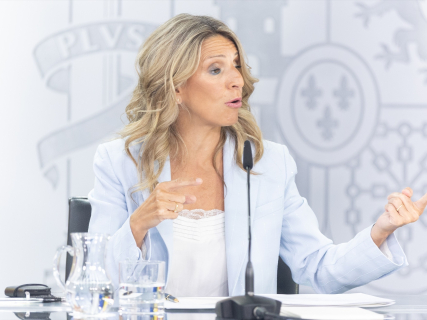

The candidacy of Yolanda Díaz to lead the International Labour Organization opens a much narrower and more complex electoral race than the size of the organization might suggest. The decision does not correspond to a vote by all the member countries of the ILO nor to the United Nations General Assembly.
The next director-general will be elected by the 56 titular members of the Governing Body of the organization: 28 representatives of governments, 14 of workers, and 14 of employers. That is to say, the vice president will have to build a majority among three groups with very different interests and sensitivities.
Her main rival is the current director-general, the Togolese Gilbert F. Houngbo, who has already formalized his candidacy for a second term with the backing of his country. The election will be held on November 16 by secret ballot. The winner will begin their term on October 1, 2027.
Who can submit a candidacy?
Candidacies can be registered by any of the member states of the ILO or by a titular or deputy member of its Governing Body. Spain therefore acts as the formal promoter of Díaz's candidacy.
The deadline remains open until August 31. This means that the electoral slate is not necessarily closed yet and that new candidates could be added in the coming weeks.
The Spanish proposal must be accompanied by the required documentation, such as the nomination letter, the candidate's resume, and a statement outlining her project for the organization.
A public examination and another behind closed doors
The institutional campaign will have a first key date on September 23. That day, the candidates will participate in a public interactive event organized by the ILO to explain their proposals and answer questions.
The session will serve to confront their plans on issues such as the expansion of artificial intelligence, labor rights, work on digital platforms, equality, global production chains, and the delicate financial situation of the organization.
The second examination will be much less visible. On November 9, a week before the vote, the candidates will appear in private sessions before the members of the Governing Body. There they will try to directly convince those who have the right to vote.
The final election will also be held behind closed doors.
How many votes does Díaz need?
To be elected, a candidacy must obtain more than half of the votes of the members of the Council entitled to participate. With the 56 full positions filled, the majority usually stands at 29 votes.
The voting is secret and as many rounds as necessary can be held. When there are several candidates, the candidate with the least support is eliminated, so their votes must be redistributed among the survivors.
The tight election of 2022 shows the importance of each ballot. Houngbo obtained 30 votes, just one more than the necessary majority, after two rounds of voting.
The unions, the most favorable starting point
The most favorable bloc for Díaz is, in principle, that of the workers. The vice president is a labor lawyer, has been leading the Ministry of Labor since 2020, and has placed social dialogue and the expansion of labor rights at the center of her political career.
The Government presents as its main credentials the labor reforms approved during its mandate, the increases in the minimum wage and the reduction of temporary contracts. Pedro Sánchez has also emphasized that she would be the first woman and the first Spanish representative at the head of the organization.
The main Spanish trade union organizations have positively assessed the possibility of her candidacy, although this does not guarantee automatic support from the 14 international representatives of workers. The Council includes trade unionists from different regions, political cultures, and labor priorities.
Even obtaining the 14 union votes, Díaz would need at least another 15 from governments and employers to reach the majority.
The business bloc, the most difficult terrain
The main obstacle is likely to be among the 14 representatives of employers. Some of the measures advocated by Díaz—from increases in the minimum wage to the reduction of working hours or the regulation of platforms—have generated conflicts with Spanish business organizations.
CEOE had already warned, before the confirmation of the candidacy, against the possibility of using the election to reformulate political agendas within the ILO. Sources familiar with the organization consider it unlikely that Díaz will obtain majority support in the business group.
However, the bloc does not have to vote completely uniformly. The ILO is precisely based on the search for tripartite agreements and a candidacy can capture individual support through commitments on institutional stability, legal security, or business sustainability.
The 28 governments will hold the key
The real battle will take place among the representatives of the governments. They are half of the electorate and constitute the only bloc with sufficient capacity to tilt the election on their own.
Díaz needs to turn her Spanish candidacy into a candidacy with European support and, at the same time, avoid being perceived solely as a proposal from the European left. The Government will try to project it as a candidate capable of also representing the Global South, according to the message disseminated by the Vice President herself.
To achieve this, it will be necessary to negotiate vote by vote with European, Latin American, African, and Asian governments. Public support can serve as a political signal, but it does not guarantee the outcome because the ballot is secret.
Díaz's rival has the advantage of the position
Houngbo starts with an obvious advantage: he has been leading the ILO since October 2022, knows its internal bodies, and has experience in various United Nations institutions. He was also the first African elected to lead the organization, an element that may favor the continuity of regional and diplomatic support.
Díaz's candidacy must frame the election as a dilemma between continuity and change. Her discourse is based on the need to strengthen labor rights and recover the political centrality of the ILO at a time marked by artificial intelligence, the weakening of multilateralism, and financial difficulties.
Houngbo, for his part, can defend the experience gained during his first term and present himself as an option for stability amid a budget crisis.
What real chances does Yolanda Díaz have?
The candidacy is competitive, but it does not start with a guaranteed majority. Her path to victory would involve three simultaneous moves: securing very broad support among the representatives of the workers, gathering around half of the governmental votes, and capturing some business votes or compensating for possible union losses with more support from governments.
Her main strength is to offer a recognizable political candidacy, with ministerial experience and a defined labor agenda. She can also benefit from the debate about the need for a woman to lead the organization for the first time.
Her main weakness is the difficulty in presenting herself as a consensus figure before the business bloc and conservative governments. This is compounded by Houngbo's institutional advantage and the current director's ability to mobilize support built over years within the ILO.
The election, therefore, will not be decided solely by the candidates' track records. It will depend on the Spanish Government's diplomatic capacity to weave a transversal coalition. In a vote of only 56 people and with a secret ballot, two or three changes of position can decide who will lead international labor policy for the next five years.