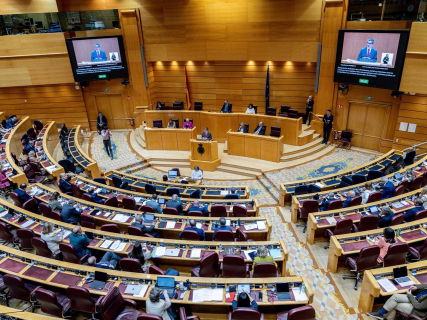

The Senate Transport Commission will study this Tuesday the AP-9 law, which proposes the transfer of the management and ownership of the highway to Galicia. The PP will take advantage of its absolute majority in the Upper House to push through several amendments with which it intends to recover the "spirit" of the text approved at the time by the Parliament of Galicia.
The legislative initiative was born in the Galician Chamber, but remained blocked until, a few weeks ago, the agreement between PSOE, BNG, and Sumar allowed it to be reactivated, incorporating not only the management but also the ownership of the road in favor of the Xunta de Galicia.
As a result of that pact, the new articles were transformed into an organic law proposal. This Tuesday, the Transport Commission will meet to incorporate the modifications proposed by the PP into the draft of the norm.
The focus of the conflict is that the Xunta de Galicia and the PP consider that the new wording deviates from the literal text of the law agreed upon in the Galician Parliament. For this reason, the popular party tried to correct it through amendments in Congress, which were rejected. Thus, the PP on one side and the PSOE and BNG on the other mutually accuse each other of "betraying" the Galicians with their respective positions.
Despite this, the PP has an absolute majority in the Senate and will push through these same amendments during the processing in the Upper House, although the project will have to return to Congress afterwards, which will have the final say on the changes introduced.
WHAT DOES THE AGREEMENT BETWEEN PSOE, SUMAR AND BNG SAY?
Although initially the socialists had registered an amendment that excluded the transfer of ownership, the finally agreed text establishes as the purpose of the law "the transfer to the Autonomous Community of Galicia of the ownership of the AP-9 and the powers over the legal regime of the concession, as well as the functions and services of the AP-9 highway to the Autonomous Community of Galicia".
To execute this objective, it is foreseen that the General State Administration and the Xunta will submit a proposal for an agreement to the Joint Transfer Commission that details the conditions and limits of the transfer of powers that the State currently exercises over the Autopista del Atlántico, an agreement that must be approved by royal decree.
That proposal will have to specify the rules for the transfer of several functions, starting with the authorization for the commissioning of new sections, the adaptations or reforms of existing ones, and the approval of links and auxiliary roads of the highway.
It must also determine how the supervision and inspection of the correct functioning of the infrastructure will be articulated, in accordance with the general road regulations and the concession specifications; as well as the sanctioning power in the face of possible breaches by the concessionaire company in the operation of the AP-9.
Likewise, the agreement will have to establish the conditions for any modification that affects the economic-financial regime of the concession, "particularly regarding the establishment, updating and suppression of tariffs and tolls, as well as the application of discount programs, including the authorization of those that are voluntary at the request of the concessionaire"; and for the elaboration and approval of new agreements or addenda to those already in force.
ECONOMIC REPERCUSSIONS
The agreed text also establishes that the General State Administration will maintain, vis-à-vis the concessionaire company of the AP-9 highway, the obligations with economic and financial impact derived from the application of the current concession that have originated from modifications adopted during the period in which the State has held the competence, and always within the economic limits in force on the date the transfer is approved.
In coherence with this, the consequences of the decisions taken by the state administration before the transfer will continue to fall on it. The transfer agreement must establish "the obligation to approve the ordinary or extraordinary tariff revisions that said modifications have established, in order to ensure that these economic limits are respected."
WHEN WILL THE XUNTA ASSUME THE COSTS?
For its part, the Xunta will assume, vis-à-vis the concessionaire company of the AP-9 highway, "all obligations with economic and financial repercussions as a consequence of the modifications to the economic-financial regime of the concession that it promotes once the transfer is effective."
The text also clarifies that modifications to the economic-financial regime of the concession that the autonomous community wishes to promote may not alter the economic commitments already foreseen and that "any decision that entails an increase in said commitments must be fully assumed by the community in the amount that this increase entails".