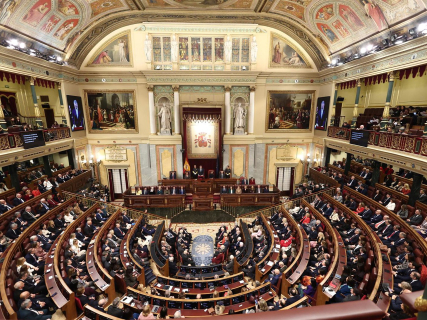

The Plenary of Congress is expected to give the green light this Thursday, in an extraordinary session, to the modification of its Regulations with the aim of facilitating that minority parties can have their own parliamentary group. The initiative, promoted by ERC, Junts, Podemos, Compromís, and the BNG, will be applied in the next legislature and faces strong opposition from PP and Vox.
The minority forces propose to amend Article 23 of the 1982 Regulations, which currently requires having 15 seats to form a group or, alternatively, to exceed five deputies and reach 5% of the votes nationwide or 15% in all constituencies where a candidacy has been presented.
With the reform, Pedro Sánchez's parliamentary partners seek to lower the necessary state voting percentage to constitute a group from 5% to 3%, and reduce the threshold in those provinces where they obtain representation from 15% to 10%. The idea is that parties with less territorial implantation have more options to have their own voice in the Chamber.
In the meeting of the working group, an amendment proposed "in voce" by Junts was also accepted, which further softens the conditions for creating a parliamentary group. If it is currently required to reach at least 10% of the votes in all constituencies where they run, the proposal from Carles Puigdemont's party limits that requirement only to the provinces where a seat is ultimately achieved.
Political and economic advantages of having a group
At the beginning of the current legislature, neither ERC nor Junts met the requirements set in the 1982 Regulations and were forced to resort to loans from PSOE and Sumar deputies to be able to form a group. The Congress Bureau gave its approval thanks to the majority that PSOE and Sumar hold, which in turn took control of the governing body of the Chamber with the votes of the Catalan independentist parties.
Having a group brings significant political, economic, and resource benefits. Those who achieve it ensure presence and a differentiated voice in all debates, at least one representative in parliamentary committees, in the Permanent Deputation, and in the Board of Spokespersons, as well as one question in each session of control to the Government. From an economic point of view, it means accessing greater subsidies and assistance for "mailing".
Debate on proportionality and the dissolution of groups
During the processing in committee, an amendment from the PP that aimed to end the principle of equity among parliamentary groups in force since 1982 was rejected. The "popular" defended applying a criterion of proportionality so that subsidies, speaking times, and material means would be distributed according to the number of deputies that make up each group.
The PP also proposes, and will bring it back this Thursday to the Plenary, to modify the current article 27 so that, when the number of members of a group other than the Mixed "is reduced during the course of the legislature to less than the minimum required for its constitution," that group is automatically dissolved and its deputies move to the Mixed. At this moment, the Regulation only provides for dissolution if the group falls "to a number lower than half of the minimum required."
Likewise, the committee rejected the PP's proposal to eliminate the figure of the associated deputy, provided for in the Regulation although barely used. This figure allows those who do not affiliate with any group at the beginning of the legislature to later associate with an already constituted one to avoid integrating into the Mixed.
The proposals from Vox against group changes
Vox, for its part, will again defend in the Plenary the amendment that was rejected in committee to eliminate the provision of the Regulation that allows changing from one parliamentary group to another, except to the Mixed, during the first five days of each session period. With this modification, the formation of Santiago Abascal aims to end the temporary transfers of deputies between groups.
In addition, Vox will insist on its proposal to prevent those parties that have presented themselves in the elections integrated into the same coalition from forming a parliamentary group in Congress, with the aim of limiting the internal fragmentation of the Chamber.