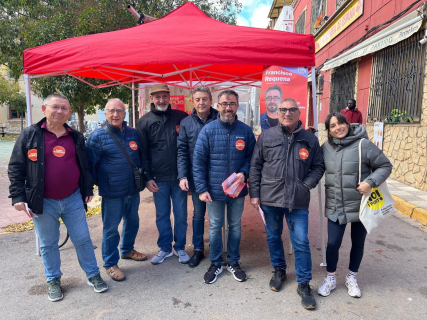

Juan Blanco and Francisco Requena, candidates of Frente Amplio for the Congress and for the Senate of Progreso to the Senate for the province of Albacete, respectively, have put on the table a package of measures to safeguard children’s rights and raise the quality of life in municipalities in the rural environment.
As Frente Amplio has stated in a press release, their proposals prioritize social protection, guaranteed access to public services, and greater investment in towns.
Coinciding with the International Day of the Child, Blanco has underscored that caring for and protecting the youngest is a task that concerns society as a whole.
"Boys and girls are not only the future, they are also the present", he said, calling for political decisions that make their rights effective.
Among the specific initiatives, Blanco has again raised the creation of a universal support for childrearing of 200 euros per month, a proposal which he has recalled his political space has defended throughout the legislature without managing to see it move forward.
He added that the Partido Socialista now includes this measure in its electoral program, after having rejected its processing in recent years, and has expressed confidence that it can be approved as soon as possible.
The Frente Amplio proposal, which in the province of Albacete is promoted by Izquierda Unida, provides for aid of 200 euros per month for each dependent minor under 18 years of age, with automatic granting and a gradual rollout over the course of the legislature.
The group links this benefit to the goal of ending child poverty and accompanies it with measures to protect vulnerable households against power, water, and gas shutoffs.
The candidate for Congress has also argued for making education from 0 to 3 years effective and for ensuring dental care and access to glasses for minors. "That is paramount, above all for the most disadvantaged families", he emphasized.
Likewise, he has asked to expand parental leave at birth up to 20 weeks for each of the prospective parents.
These proposals are integrated into Frente Amplio’s commitment to a network of free public education from 0 years old through university, with public places at no cost in the 0 to 3 years segment.
In the healthcare sphere, the organization proposes extending dental care coverage and guaranteeing free glasses and contact lenses for all ages.
Blanco has also wanted to dedicate specific attention to migrant childhood arriving without adult reference persons. “It is our responsibility and we have to look after them and take care of them,” he said, recalling the obligation to offer protection to those who find themselves in a situation of special vulnerability.
Guadalajara: criticism of the urban management by the PP and Vox
In Guadalajara, Frente Amplio appeared this Saturday before the media to focus the debate on the everyday problems affecting the city.
To that end, the candidate for the Senate for Guadalajara, Mar González, has given the floor to the person who, she has highlighted, best knows the municipal reality and defends it in the Plenary Session: the spokesperson and only councilor of Aike in the Guadalajara City Council, Susana Martínez, who was already a council member between 2015 and 2019.
Susana Martínez has warned that the joint management of the Partido Popular and Vox, under the mayoralty of Ana Guarinos, “is going to turn Guadalajara into a less livable, less sustainable and less green city.” A concern that, she has recalled, is central to her municipal group, Aike, in which the Partido Verde has been taking part for years, according to what Frente Amplio reported in a press release.
As a first example, the councilor has pointed to the project of the axis of Cardenal González de Mendoza and the surroundings of the Santuario de la Antigua, an intervention of more than 10 million euros financed at 85% with European funds FEDER, against which Aike has filed an appeal with the Central Administrative Court of the Ministry of Finance and has driven a petition-signature collection campaign.
“It is an unusable concrete platform that does nothing to improve either mobility or the permeability of the neighborhoods, it does not provide new services and it also involves the felling of 121 trees,” Martínez denounced, insisting that the project “does not meet the objectives of these European aid programs” and is being carried out “without an environmental impact report, an issue that in an investment of this kind we cannot overlook.”
As a second case, Susana Martínez has questioned the authorization of a gas station attached to a block of housing, in the area around the bridge over the river Henares, one of the city’s most representative monuments and, at the same time, one of its main entrances and exits.
"This is what will remain after four years of mismanagement by the Partido Popular and Vox, a management that does not think about the general interest of the city, but about very particular issues," he/she stated, adding that "the construction of a gas station has been authorized almost in the living room of the neighbors, in the vicinity of a monument that we have to preserve, and at one of the entrances and exits of the city, where there are also mobility issues that we have to analyze".
"These are two examples of a management that does not think about making cities more livable and that leaves these legacies in a city like Guadalajara," he/she concluded.
Ciudad Real: housing and public services at the center of the debate
In Ciudad Real, the candidate for the Congress of Deputies for Frente Amplio in the province, Juana Caro, moved this Saturday to Tomelloso to take part in an information table set up on the promenade next to the Plaza de Toros, within the electoral campaign ahead of the general elections on November 29.
Throughout the morning, residents of Tomelloso have come by the information point to learn firsthand the proposals of the candidacy, talk with the Frente Amplio representative, and convey their concerns to her, in a day marked by the exchange of ideas and direct engagement with citizens.
The candidate devoted much of her interventions to addressing some of the main concerns of working families, such as difficulties in accessing housing, defending public healthcare, and the need to ensure a high-quality and accessible public education in all municipalities of the province of Ciudad Real.
On housing matters, Caro detailed Frente Amplio initiatives to facilitate access to a decent home, with special attention to the young population and to families who have problems affording rental and purchase prices.
"It cannot be that having a decent home has become a constant concern for so many families. We need policies that guarantee that our young people can develop their life project without having to spend most of their salary paying rent.
Housing has to be a right within reach of all people," the candidate said.
Likewise, Caro has highlighted the need to strengthen public services as a tool to ensure equal opportunities, regardless of the municipality in which one lives.
Along these lines, he has focused on public healthcare and education, two areas that Frente Amplio places among its programmatic priorities and that it considers essential to sustain social and territorial cohesion in the province.