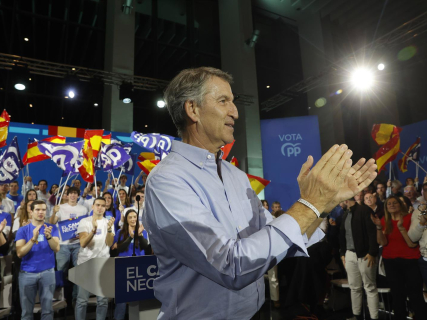
The PP rises by eight seats and extends its advantage over the PSOE to six points, according to Data10's daily tracking

Data10’s poll for OKDIARIO, published after the election face-off, gives 137 seats to the PP, 106 to the PSOE, and 62 to Vox. Feijóo would attract support coming from the PSOE, Vox, and abstention, according to the pollster’s estimates

fotonoticia 20261119185228 1920

fotonoticia 20261119185228 1920

Add DEMÓCRATA to Google

Ask FREN

Published

Last updated

3 minutes

Most read

Elecciones 29N · Encuestas

La media de las encuestas

Media a 20 de noviembre de 2026 · 19 institutos

  • PP30,8 %
  • PSOE27,9 %
  • Vox19,0 %
  • Frente Amplio6,3 %
  • ERC2,5 %
01020304050ene 2024jul 2024ene 2025jul 2025ene 2026jul 2026

Media del último estudio de cada instituto en 30 días y su evolución semanal desde el 23J. Partidos con al menos un 2 %.

Todas las encuestas

Elecciones generales del 29 de noviembre · Demócrata

The PP rises by eight seats from the previous day and obtains 137 MPs in the Data10 tracking for OKDIARIO published this Friday, November 20, after the face-to-face between Pedro Sánchez and Alberto Núñez Feijóo. The conservatives raise their vote estimate to 32.5%, while the PSOE falls to 26.5% and Vox to 18.8%. PP and Vox would add up to 199 seats, 23 more than the absolute majority.

GENERAL ELECTIONS 29N · DATA10 · NOVEMBER 20 2026

The PP wins eight deputies in a single day

137PP seats
199PP + Vox seats
51.3%Joint vote PP + Vox

Evolution of voting intention · Verified measurements of November 19 and 20

35%30%25%20%15%Nov. 19Nov. 20
PPPSOEVoxFrente Amplio
Party Nov. 19 Nov. 20 Seats Nov. 20
PP 31.5% 32.5% 137
PSOE 26.9% 26.5% 106
Vox 19.4% 18.8% 62
Frente Amplio* 6.5% 6.8% 12
Others 15.7% 15.4% 33

*Frente Amplio includes the territorial coalitions indicated by Data10. Source: Data10 for OKDIARIO, November 20. Data for November 19: previous handover. These are poll estimates, not election results.

The PP wins eight seats and extends its lead over the PSOE to six points

With 32.5% of the vote, the conservatives improve by one point compared with the tracking of November 19 and go from 129 to 137 deputies. The distance with the PSOE, which drops four tenths to 26.5%, increases to six points. The socialists would lose six seats compared with the previous day and would end up with 106.

The update is published after the televised debate between Feijóo and Sánchez. According to Data10, the PP would capture 70,000 voters coming from the PSOE, 120,000 from Vox, and 150,000 from abstention. These figures are estimates from the poll and do not by themselves allow checking which part of the movement is due to the face-to-face.

Vox loses four deputies, but PP and Vox keep 199

Santiago Abascal’s party concedes six tenths, from 19.4% to 18.8%, and goes from 66 to 62 deputies. The rise of the PP compensates for that loss: the sum of both parties goes from 195 seats in the November 19 handover to 199 in the day’s handover of 20.

In vote share, the two candidacies gather 51.3%, compared with 50.9% the previous day. The absolute majority of Congress requires 176 deputies.

Frente Amplio rises to twelve seats

The Frente Amplio estimate, together with the territorial coalitions grouped in this category by Data10, improves to 6.8% and twelve deputies. The previous day, the survey attributed 6.5% and nine representatives to it. The rest of the candidacies would gather 15.4% of the vote and 33 seats.

The distribution published adds up to the 350 seats in Congress: 137 for the PP, 106 for the PSOE, 62 for Vox, twelve for Frente Amplio, and 33 for other forces. The next handover will allow checking whether the variations observed after the debate are maintained in the daily series.

More key points, information and questions with FREN

AI-GENERATED CONTENT

What legislative steps and parliamentary procedures are necessary after a general election for the formation of a new government in Spain?

After a general election, forming a Government requires constituting the Chambers, investing the president, and appointing the ministers. It is not necessary to approve a specific law: it is a constitutional and parliamentary procedure, accompanied by political negotiations. The decisive decision corresponds to the Congress, which grants or denies its confidence to the candidate.

1. Final results and accreditation

After the electoral count, the general scrutiny is carried out, the corresponding claims are resolved, and the elected representatives are proclaimed, in accordance with articles 103 to 108 of the Organic Law of the General Electoral Regime. Electoral appeals may be filed. In the Congress, deputies must present their credentials, declare their activities, and swear or promise to uphold the Constitution to fully acquire their parliamentary status.

2. Constitution of the Chambers

The Congress and Senate hold their respective constitutive sessions and elect their governing bodies. In the Congress, the session takes place on the day indicated in the electoral call decree and begins under an Age Table: the oldest deputy, assisted by the two youngest.

The definitive Table is then elected: Presidency, four vice presidencies, and four secretariats. To preside over the Congress, an absolute majority is required in the first vote; if no one achieves it, the two candidates with the most votes compete, and the one with more votes wins. After the oath or promise, the Chamber is declared constituted. Parliamentary groups are formed within the following five working days. These rules appear in articles 1 to 4, 24, and 37 of the Congress Regulations.

3. Negotiation and candidate proposal

Parties negotiate support, abstentions, or coalition agreements. These are political decisions: there is no obligation to sign a pact or to form a coalition Government.

According to article 99 of the Constitution, the King consults the representatives designated by the political groups with parliamentary representation and proposes a candidate through the Presidency of the Congress. The Constitution does not impose that it must automatically be the leader of the most voted candidacy. It also does not establish a specific deadline between the elections and the first investiture vote.

4. Debate and investiture votes

Upon receiving the proposal, the Presidency of the Congress convenes the Plenary. The candidate presents, without time limit, the Government program they intend to form and requests the confidence of the Chamber. Then the parliamentary groups intervene, with turns for response and reply.

  • First vote: requires an absolute majority, that is, more than half of the members of the Congress.
  • Second vote: if that majority is not achieved, it is held 48 hours later. A simple majority suffices: more favorable votes than opposing ones.

The votes are public by roll call: each deputy expresses their vote. The procedure is developed in articles 85 and 170 to 172 of the Regulations. The Senate does not participate in this decision.

5. If no candidacy succeeds

Successive proposals may be processed by the same procedure. The decisive deadline is two months from the first investiture vote, not from the elections nor from the constitution of the Congress.

If no candidacy obtains confidence within that period, article 99.5 of the Constitution obliges the dissolution of both Chambers and the calling of new elections. The Presidency of the Congress submits the decree to the King's signature and countersigns it.

6. Appointment and taking office

Once confidence is obtained, the Presidency of the Congress communicates the result to the King for the appointment of the president of the Government. At the proposal of the latter, the King appoints the ministers, according to article 100 of the Constitution. After the appointments and taking office, the new Executive is constituted; ministers do not require individual parliamentary investiture.

What are the functions and competencies of the president of the PP in the parliamentary and political sphere according to Spanish legislation?

The president of the Popular Party (PP) is not a figure regulated as such in the Constitution or parliamentary regulations, but an internal party position. Their functions and competencies derive from two levels: (1) the strictly party sphere, defined by the PP statutes, and (2) the institutional functions assumed when, in addition to being party leader, they hold a parliamentary seat or other public offices (deputy, senator, possible candidate for the Presidency of the Government, etc.), which are governed by legislation and parliamentary regulations.

1. Nature of the position: party leader, not a State body

From a legal-constitutional point of view, the president of the PP:

  • Is not a State body nor part of the General Courts.
  • Is not mentioned in the Constitution nor in the Organic Law of the General Electoral Regime (LOREG).
  • Does not have "own powers" over Parliament conferred by law: their institutional faculties depend on the public offices they hold (deputy, senator, etc.) and the internal organization of the PP parliamentary group.

Therefore, their "political" competencies mainly come from the electoral strength of the PP and the internal authority recognized by the party statutes and its governing bodies.

2. Internal and political functions within the PP

According to the general logic of party statutes (including the PP, pursuant to art. 6 of the Constitution and the Organic Law of Political Parties), the president of the PP mainly exercises internal political leadership functions:

  • Defining the party's general political line, in coordination with the Executive Committee and the National Board of Directors.
  • Representation of the party before other formations, institutions, social organizations, and media.
  • Electoral strategic direction: leadership of campaigns, proposal (or validation) of lead candidates for the Congress, Senate, and other institutions.
  • Coordination with the PP parliamentary groups in Congress, Senate, and regional parliaments to set positions on votes, initiatives, and debates.
  • Convening and presiding (as provided by the statutes) the main governing bodies: executive committees, boards of directors, etc.

All these functions are organic-political in nature, not strictly parliamentary, and are based on the organizational autonomy of parties recognized by the Constitution.

3. Parliamentary projection when a deputy or senator

When the president of the PP is also a parliamentarian (the usual case), their competencies in the Courts are governed by the Constitution and the Regulations of the Congress or Senate. In this sphere, their functions do not derive from "being president of the PP," but from the specific offices they hold:

  • As a rank-and-file deputy or senator, they have the same powers as any other member:
    • Present initiatives (bills, non-legislative motions, questions, requests for appearances, etc.) through the Parliamentary Group.
    • Intervene in plenaries and committees according to the turns set by the Regulations and the Popular Group.
    • Vote in plenary and committee sessions.
  • As president of the Popular Parliamentary Group (if they assume that role, which is not automatic), they exercise key influence in:
    • The appointment of spokespeople and deputy spokespeople.
    • Setting the group's position on each initiative.
    • Distribution of speaking times among the group's deputies.
  • As possible "leader of the opposition" (political figure, not legal), they usually:
    • Intervene in the most relevant debates (investiture, motions of censure, general policy debates).
    • Lead criticism of the Government and articulate programmatic alternatives.

All these actions take place within the framework set by the Chamber's Regulations and the internal rules of the Popular Parliamentary Group, not by a specific legal statute of the "president of the PP."

4. Political competencies in the parliamentary system

In a parliamentary system like Spain's, the president of the main opposition party or the majority party also has a relevant political role, although not legally defined:

  • Interlocution with the Head of State in phases such as the designation of a candidate for the Presidency of the Government, through the King's consultations with parliamentary group representatives.
  • Negotiation of investiture, budgetary, or legislative pacts with other parties, if the PP is the governing party or aspires to be.
  • Ability to set the public agenda through political proposals and speeches that guide the work of the Popular Group in the chambers.
  • Direction of the strategy towards the Government (support, opposition, negotiation) which then translates into concrete initiatives in the Congress and Senate.

5. Legal limits

Although the president of the PP concentrates strong political power, their actions are subject to limits:

  • Respect for the Constitution and laws: they cannot, by themselves, appoint or dismiss public authorities, dissolve chambers, or approve norms; these are functions of the King, the Government, and the Courts under constitutional terms.
  • Respect for parliamentary autonomy: the internal organization of the chambers corresponds to their Tables, Boards of Spokespersons, and Plenaries; the president of the PP only influences through the Popular Group.
  • Respect for the party's internal democracy: their powers are exercised according to the statutes approved by the PP congresses and may be reviewed or limited by the party's collegiate bodies.

In summary, the functions of the president of the PP in the parliamentary and political sphere are based on their party leadership and the institutional offices they hold, rather than on a specific legal regulation of that title.

What practical differences exist between the president of the PP and the spokesperson of the Popular Group in the Congress regarding their parliamentary functions? How does the president of the PP coordinate with the party's regional parliamentary groups and what leeway do these have to set their own positions? What role does the president of the PP play in investiture processes and in negotiating government pacts at the state level?

What legal requirements must be met for a political party to achieve an absolute majority in the Congress of Deputies?

For a political party to obtain an absolute majority in the Congress of Deputies, it must secure, on its own, at least 176 of the 350 seats. This electoral result should not be confused with gathering 176 favorable votes in a vote: these may come from several parties through parliamentary agreements.

1. The decisive requirement: more than half of the seats

The absolute majority is calculated over the total members of the Chamber, not only those attending a session or participating in a vote. Half of 350 is 175; therefore, the minimum needed to surpass it is 176.

Being the party with the most seats is not enough. A formation with 150 deputies may be the largest force in Congress but does not have its own absolute majority. The majority of seats should also not be confused with a percentage of citizen votes: what matters for this majority is how many seats the formation finally obtains in the Chamber.

2. Electoral results and exercise of office

The own majority depends on the deputies elected and proclaimed by the electoral administration. Then, to fully acquire the status of deputy, article 20 of the Congress Regulations requires jointly fulfilling these requirements:

  • Present the credential issued by the corresponding electoral body to the General Secretariat.
  • Complete the declaration of activities provided in electoral legislation.
  • Take an oath or promise to uphold the Constitution at the first plenary session attended.

These requirements correspond to each deputy: they do not constitute an additional authorization granted to the party to recognize an absolute majority. The Regulations also govern the constitutive session, in which the list of elected members is read and the Congress is constituted.

3. Own majority and majority through agreements

It is advisable to distinguish two situations:

  • Own absolute majority: a formation has 176 deputies or more.
  • Absolute majority in a vote: a proposal receives at least 176 favorable votes, even if they come from different groups.

For example, a formation with 160 deputies and another with 16 can sum the necessary support for a decision requiring an absolute majority. That does not make the first the holder of 176 seats nor guarantees that such support will be repeated in all votes. Additionally, article 79 of the Regulations establishes that the vote is personal and non-delegable.

4. What an absolute majority vote requires

When this majority is required, it is not enough to obtain more favorable votes than opposing ones: 176 supports must be reached. Abstentions and absences do not provide affirmative votes nor reduce that threshold by themselves. Thus, 175 votes in favor, 100 against, and 75 abstentions do not reach the absolute majority.

The quorum must also be respected, that is, the minimum attendance to validly adopt agreements. Article 78 requires that the Chamber be duly convened and have the attendance of the majority of its members.

5. What this majority is for

In the investiture, the vote to grant confidence to the candidate for president of the Government, an absolute majority is required in the first vote. If not obtained, another is held 48 hours later and a simple majority suffices: more favorable votes than opposing ones, according to article 171 of the Regulations.

For organic laws, article 131 requires an absolute majority in a final vote on the entire text. Therefore, having 176 seats facilitates gathering the necessary support but does not replace the vote nor exempts compliance with the parliamentary procedure.

Play

Test your knowledge with FREN!

How much do you know about this topic? Answer the following 3 questions.

How many seats would the PP obtain according to the Data10 survey published on November 20, 2026?

Question 1 of 3

What percentage of votes would PP and Vox jointly sum according to the estimate?

Question 2 of 3

How many deputies are needed to obtain an absolute majority in the Congress of Deputies?

Question 3 of 3