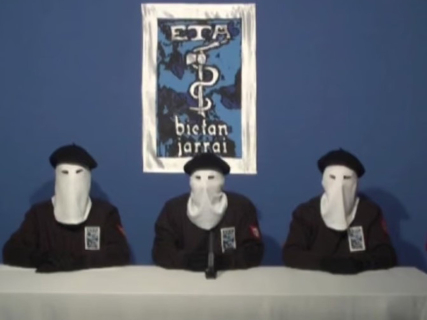

This Thursday, July 23, marks five decades since the disappearance of the leader of ETA political-military (pm) Eduardo Moreno Bergareche, known as 'Pertur'. Half a century later, the case remains surrounded by mysteries, including the location of the body of that young ideologue of 25 years who advocated for the end of armed struggle after Franco's death and who promoted the germ of Euskadiko Ezkerra, now integrated into the PSE.
The last time 'Pertur' was seen alive was on July 23, 1976, in San Juan de Luz, a French town near the Spanish border. At 09:40 hours, he was traveling in a vehicle with the etarras Francisco Múgica Garmendia, alias 'Pakito', and Miguel Ángel Apalategi Aierbe, 'Apala'.
Both were part of the most radical sector of ETA and were framed in the so-called 'Bereziak', some 'special commands' of ETA political-military supporters of maintaining violence and with no intention of abandoning terrorist activity.
According to the police investigation, that morning 'Pertur' was scheduled to attend an appointment at the Café Consolation in San Juan de Luz, which he never reached. The account of 'Pakito', collected in a ruling from the National Court, states that he and 'Apala' "coincidentally" ran into 'Pertur', who asked them to drive him to the French side of Behobia, near Hendaya.
As the disappearance occurred in French territory, it was the French authorities who took over the investigations, but the inquiries "went nowhere," summarizes Gaizka Fernández, historian and researcher at the Memorial Center for the Victims of Terrorism, in statements to Europa Press.
Fernández has dedicated practically his entire career to clarifying the case of 'Pertur' and, in the last year, has focused on police and French documentation that has been little explored until now, material with which he has prepared the article "Eduardo Moreno Bergaretxe (Pertur). The ideologue who changed the course of ETA."
An account of ETA with "spurious origin" and political ends
Among the conclusions of his work, the historian argues that the version disseminated by ETA about a supposed operation by the public order forces (FOP) regarding the disappearance of 'Pertur' has a "spurious" origin. "If they blamed the FOP, it was solely to take advantage of the opportunity and gain political returns," Fernández states in his study.
According to the explanation, and relying on the testimony of one of the spokesmen for ETA at that time, Joseba Knörr, although three days after the disappearance the band was already pointing to the FOP, in reality the security forces "lacked data on what happened and the circumstances that surrounded his disappearance."
Knörr also recalls that, in those first moments, the organization itself did not contemplate the possible involvement of the special command 'Bereziak' in the disappearance.
Against the thesis of the participation of state agents, Gaizka Fernández's work points out that the security services knew that Pertur defended an internal current in ETA that advocated opening an exclusively political stage, leaving aside armed action.
"Neutralizing him was counterproductive," the historian notes, who emphasizes that even the head of the Central Documentation Service (SECED) —now the National Intelligence Center (CNI)— in the Basque Country, Ángel Ugarte Fernández de Lara, stated in an investigation by the National Court (AN) opened in 2008 that 'Pertur' "was not followed at all."
Ugarte also stated before the judge that "'he had no doubt'" about ETA's responsibility, since his disappearance "harmed the interests of the State" because "he was in favor of the theory of bifurcation" to separate armed activities from political ones within the organization.
The AN ended up archiving the case in 2012 after concluding that there were "not enough indications" to charge specific individuals for these events.
The testimony about 'Apala' and the lead from the sea
Fernández's text also includes the account of a former member of ETApm who fought in the civil war in El Salvador and coincided with 'Apala' in Nicaragua, where he confessed to him: "'Pertur is at the bottom of the sea and no one will ever find him'." According to the work, the witness "told it both to Lourdes Auzmendi [Pertur's partner] and to Iñaki Martínez [member of Euskadiko Ezkerra]."
The historian clarifies that this is just an indication, but it fits with other elements. Among them, a report from the French Naval Station of Bidasoa that recorded the disappearance of an inflatable boat in the port of Hendaye between July 24 and 26.
The document notes that even "in circles close to ETA, it was rumored that the boat could have been used by Pertur's kidnappers since, on previous occasions, they themselves have used this type of vessel for their attempts to penetrate Spain."
The Triple A and the false attributions of the far right
On the other hand, Fernández describes the atmosphere of "confusion" that existed in those years due to the claims made by certain far-right leaders regarding attacks or disappearances, a phenomenon that also affected the case of 'Pertur', despite the fact that they "lacked foundation."
"Former far-right leaders have acknowledged that between 1976 and 1977 Isidro Carmona [ultra leader] used those initials, which he had copied from an Argentine organization, to attribute to them all the attacks he learned about with the ultimate goal of defrauding media outlets," the historian recounts.
Thus, Fernández emphasizes that this case "was affected by a common phenomenon during the late Franco regime and the Transition: that individuals who had nothing to do with the attacks claimed them in the name of makeshift initials, like the Triple A."
"Every time they heard news of an attack, they would call the media and say 'we are the Triple A'. In fact, other attacks like that of the Atocha lawyers are also attributed to them as AAA," he adds.
Half a century later, the family continues to wait for the truth
Fifty years later, Pertur's family and circle continue to demand to know what happened and where his body is. "The only hope they have is that someone speaks," summarizes Fernández. This Saturday, his relatives have organized several events in Irún to "keep his memory alive" and demand that the truth be known, as they explain in a statement.
The investigator insists that there are still significant gaps because access to CESED documentation remains blocked. "I have been able to consult documentation from the army's secret service, but not from CESED," he laments.
Fernández points out that it is not even clear "whether the current CNI has that documentation or not" because "those sources cannot be consulted," unlike what happens in other European countries like France, Italy, or Germany, where it is indeed possible to access those files. In his view, opening them would not only help clarify the case of Pertur but also many other events from the "late Francoism" and the Transition.
The one from 'Pertur' is part of the 314 unresolved cases left by the criminal activity of the terrorist group, which ended its campaign of violence in 2011 after more than 800 murders.