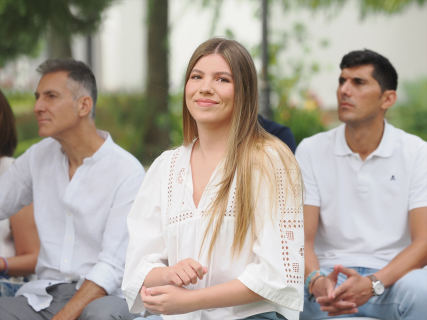
Infanta Sofía debuts with her first public speech supported by Princess Leonor

The youngest daughter of Kings Felipe VI and Letizia has delivered her first speech at an official event during the presentation of the "Docentes Referentes" awards from the Ibercaja Foundation, on a day marked by the surprise presence of Princess Leonor.

2 minutes

EuropaPress 7653089 infanta sofia visita actividades educativas monasterio cogullada julio 2026

EuropaPress 7653089 infanta sofia visita actividades educativas monasterio cogullada julio 2026

Add DEMÓCRATA to Google

Ask FREN

Published

Last updated

2 minutes

Most read

Infanta Sofía took a further step in her institutional agenda this Wednesday by delivering, for the first time, a public speech. The youngest daughter of Kings Felipe VI and Letizia starred in Zaragoza in the most important event of her official career to date, on the occasion of the delivery of the first edition of the "Docentes Referentes" awards from the Ibercaja Foundation, of which she is honorary president on the occasion of the entity's 150th anniversary.

The infanta's institutional debut was marked by an unexpected surprise. Princess Leonor, whose presence was not on the official agenda, attended the Monastery of Cogullada to accompany her sister on a particularly significant day, once again showcasing the close relationship between the two.

Before the ceremony, the two sisters toured several educational workshops with the 25 finalist teachers of this initiative, which recognizes projects related to educational leadership, inclusion, sustainability, research, and health promotion in classrooms. During the visit, they shared conversations and gestures of complicity that did not go unnoticed.

Infanta Sofía's Debut

At just 19 years old, Infanta Sofía has taken on one of her most significant institutional commitments since she began representing the Crown. Her address to the attendees marks her debut as a speaker at a public event and demonstrates the progressive increase in her presence on the official agenda of the Royal Household.

Although Princess Leonor continues to be the main representative of the institution as heir to the throne, the infanta's participation in such events reflects Zarzuela's desire to grant her an increasingly visible role within her representative functions.

An Unexpected Appearance by Leonor

The presence of the Princess of Asturias was the big surprise of the day. Without intervening during the event, Leonor wanted to accompany her sister at a particularly symbolic moment, reinforcing the image of unity of the Royal Family on a key day for the infanta.

The King's two daughters also coordinated their outfits. Sofía opted for a white blouse with cut-out details and light blue wide-leg trousers, while Leonor chose white trousers and a romantic-inspired navy blue blouse, completing an image of complicity both on and off stage.

More key points, information and questions with FREN

AI-GENERATED CONTENT

What institutional competencies does Infanta Sofía have according to Spanish legislation?

Infanta Sofía, as the younger daughter of King Felipe VI, is legally an Infanta of Spain with the style of Royal Highness, but Spanish legislation does not grant her any institutional competencies of her own. The Constitution only distinguishes between the King, the heir (Prince or Princess of Asturias), the Regency, and the possible guardianship of a minor King, without providing specific functions for the infantas. Her position is regulated in terms of titles, styles, honors, and protocol precedence, and only exceptionally could she exercise functions as regent or guardian if constitutional conditions were met.

Key rules defining her status

1. Spanish Constitution: succession, regency, and guardianship

The basic framework is in Title II of the Spanish Constitution:

  • Arts. 56 and 62: establish the role of the King as Head of State and list his functions (sanctioning laws, proposing the president, calling elections, supreme command of the Armed Forces, etc.). These functions do not extend to the infantas.
  • Art. 57: regulates the succession to the Crown. The heir holds the dignity of Prince or Princess of Asturias from birth or from the moment of the call. Infanta Sofía is not the heir while Princess Leonor is alive, so the Constitution does not assign her any specific title or function.
  • The same art. 57 provides that abdications and renunciations and doubts about succession are resolved by organic law, which led to Organic Law 3/2014 (abdication of Juan Carlos I), which also does not introduce competencies for infantas.
  • Art. 59: regulates the Regency. When the King is a minor or incapacitated, the regency corresponds to the father or mother or, failing that, to the closest adult relative next in line to the Crown. This means that, in hypothetical scenarios (for example, if Leonor were a minor Queen or incapacitated), an infanta who is the successor relative could become regent if she is of age.
  • Art. 60: regulates the guardianship of a minor King, which may also correspond to close relatives designated by will or by the Cortes. Again, this is an abstract possibility for any family member, not an ordinary competency.

Therefore, the Constitution only offers Infanta Sofía a potential role in the line of succession, regency, or guardianship under certain circumstances, but does not grant her political, executive, or representative functions of her own.

2. Royal Decree 1368/1987: dignity of Infante of Spain

The formal status of Infanta Sofía is defined by Royal Decree 1368/1987, on titles, styles, and honors of the Royal Family:

  • It establishes that the children of the King who do not have the status of Prince or Princess of Asturias are Infantes of Spain and receive the style of Royal Highness.
  • The children of the Prince or Princess of Asturias will also be infantas. No decision-making power or constitutional functions are assigned to infantas, only protocol and honorary status.
  • Outside what is provided for the King, heir, and regents, no person may be titled Infante of Spain or receive its styles and honors, emphasizing that it is a strictly regulated title.

For Infanta Sofía, this means that the law only defines her condition as Infanta and her style of Royal Highness, but does not confer any independent institutional power.

3. Order of precedence and representation

Royal Decree 2099/1983, which approves the General Order of Precedence of the State, places members of the Royal Family at the top of the protocol hierarchy:

  • In official acts in Madrid and autonomous communities, the order is: King or Queen, Queen consort or consort of the Queen, Prince or Princess of Asturias, and then the Infantes of Spain.
  • The decree indicates that whoever holds “expressly the representation of His Majesty the King” may act with a determined precedence. That is, the King's representation in acts can be delegated, but this depends on the King's own decision, not an automatic right of the infantas.

Therefore, Infanta Sofía has a high protocol position in State acts, but only acts institutionally when the King decides, in terms of symbolic representation.

What can and cannot Infanta Sofía do according to the law?

Based on all the above, the legal framework can be summarized as follows:

  • She has no constitutional competencies of her own: she does not sanction laws, does not endorse acts, does not integrate State bodies, nor has a political function defined by the Constitution or organic law.
  • Main role: symbolic and protocolary: as Infanta of Spain and Royal Highness, she participates in official acts of the Crown and State with the precedence set by the order, but without decision-making capacity.
  • Possible functions by delegation: the King may entrust her to attend or preside over certain acts on his behalf. This representation is of a customary and protocolary nature, not an autonomous legal power.
  • Possible extraordinary functions: in very specific scenarios (regency or guardianship of a minor or incapacitated King) she could exercise functions as regent or guardian if at that time she were the adult relative called by the Constitution. These are, in any case, exceptional cases.

In summary, Spanish legislation configures Infanta Sofía as a member of the Royal Family with title, style, and precedence, but without a specific institutional role beyond what the King may entrust her in the representative sphere and the possible functions that the line of succession might assign her in extraordinary situations.

What is Infanta Sofía's previous academic and professional background?

Infanta Sofía de Borbón y Ortiz has followed a clearly internationalized academic path but still without conventional professional experience, since, by decision of the Royal Household, her future is oriented towards institutional representation and not a paid job. Born in Madrid in 2007, she attended preschool, primary, and secondary education in Spanish schools and completed the International Baccalaureate in Wales before starting, in 2025, university studies in Political Science and International Relations in Europe. Sources agree that she is a polyglot young woman, with complementary training in STEM activities, music, and sports, and that her presence on the official agenda has increased since she reached the age of majority. There is no evidence of a "professional" career outside her functions linked to the Crown.

Basic biographical data

Infanta Sofía was born on April 29, 2007 at the Ruber International Hospital in Madrid, as the younger daughter of King Felipe VI and Queen Letizia and second in the line of succession after Princess Leonor, according to the Wikipedia entry and various biographical profiles such as those from Diez Minutos, Antena 3, or informative pieces on social media from the Royal Household and specialized media, such as Monarquía España or 20 Minutos.

Formal academic trajectory

Preschool and school stage in Madrid

Various sources agree that her education began at the Royal Guard Preschool, in the El Pardo Palace, where children of personnel linked to the institution also attend, as recorded in the biography on Wikipedia and summaries shared on social media such as the ¡HOLA! video. Later, on September 13, 2010, she began Primary at the Santa María de los Rosales School (Aravaca, Madrid), where she completed Primary and Secondary Education.

The profile of the infanta published by ABC, "Infanta Sofía reaches the age of majority and begins to decide her own path", details that she followed the same steps as Leonor at this stage: nursery in El Pardo and the entire cycle of preschool, primary, and secondary at Santa María de los Rosales.

International Baccalaureate in Wales

In 2023, the infanta moved to UWC Atlantic College (Wales, United Kingdom) to pursue the International Baccalaureate, just like her sister. According to the cited ABC article and the Wikipedia entry, she completed the program between 2023 and 2025 and graduated in May 2025. The ABC text highlights that in April 2025 she turned 18 "away from home," in Wales, while attending her final year of IB.

University studies in Political Science

After the International Baccalaureate, Zarzuela ruled out that the infanta would start military training and confirmed that she would go directly to university, according to ABC. The university path is concretized in her enrollment at Forward College, a private center linked to the University of London, where she studies a degree in Political Science and International Relations. This is recorded in the piece by the newspaper Demócrata about Leonor's university choice, which specifies that "the younger daughter of the Kings studies Political Science and International Relations at Forward College, a private center linked to the University of London with campuses in Lisbon, Paris, and Berlin" (article about UC3M).

The same itinerary is detailed when Demócrata reports on the meeting of Infanta Sofía with President Marcelo Rebelo de Sousa in Lisbon: it indicates that she was attending her first year in Lisbon and that the program will be completed in Paris and Berlin in subsequent courses.

Languages and complementary training

Journalistic and biographical sources agree in describing her as a polyglot, although they differ in the number and detail of languages. ABC states that she speaks English, Arabic, and French, in addition to Spanish (ABC profile), while other informative summaries also attribute to her knowledge of co-official languages and other languages thanks to her international education, as covered by pieces from Diez Minutos, La Vanguardia, or informative videos on social media such as ¡HOLA!, Instagram, or TikTok. In any case, there is consensus that she combines Spanish with a high level of English and good command of at least French and Arabic.

Regarding complementary training, the ABC article indicates that the kings guided her, along with Leonor, towards extracurricular activities linked to STEM careers, such as robotics, which Sofía especially enjoyed. Other informative pieces, like the report from 20 Minutos, highlight that she plays the violin, has taken theater classes, and leans towards sciences and new technologies, in addition to being fond of sports.

Public activities and pre-professional "experience"

She has no conventional work experience and, in fact, the Royal Household established that she will not be able to perform paid work, unlike her aunts, according to ABC. Her "pre-professional trajectory" is linked to her progressive incorporation into the institutional agenda.

In 2024, she took on her first official solo act with the presentation of the awards for the photographic contest "Objective Heritage," a task cited by ABC. Later, already as a university student in Lisbon, she met with the President of Portugal at the Belém Palace, according to Demócrata's report on the meeting with Marcelo Rebelo de Sousa. She has also been integrating into solemn State acts: for example, her debut at the October 12 reception at the Royal Palace in 2025 or her presence at events with international projection, such as the 2025 Women's Euro Cup final alongside Leonor, covered by Demócrata in this chronicle, or the upcoming participation in the reception for Pope Leo XIV at the Royal Palace mentioned in this news.

As institutional recognition after reaching the age of majority, the Government awarded her the Grand Cross of Isabella the Catholic, according to ABC's information in this article. All this fits with the idea, reiterated in the chronicles of Diez Minutos and La Vanguardia, that her university training in Political Science is aimed at strengthening her capacity to support the Crown institutionally rather than pursuing a classic professional career.

Other informative and biographical materials about her figure can be found in Royal Household publications on Facebook, in videos like this summary on YouTube, or in other general context profiles – for example, about the International Baccalaureate – such as the El País report "The International Baccalaureate, a model to cultivate the passion for learning and critical thinking".

To what extent will Infanta Sofía be able to combine her studies at Forward College with a more intense institutional agenda in the coming years? What are the main differences between Sofía's education and that of Princess Leonor in the military and university fields? How does the figure of Infanta Sofía fit into the Spanish political debate about the monarchy and institutional representation?

What is the current composition of the Spanish Royal Family and their official functions?

The Spanish Royal Family, strictly since 2014, is composed of six people: King Felipe VI, Queen Letizia, Princess of Asturias Leonor, Infanta Sofía, and the emeritus kings Juan Carlos I and Sofía. Only Felipe VI is Head of State and holder of the Crown; the rest perform representation and support functions, without their own constitutional powers. The Royal Household has been limiting its core to this reduced structure, differentiating it from the "family of the King," where infantas Elena and Cristina and other relatives are placed. In practice, the institutional agenda is led by the Kings and, increasingly, by Princess Leonor and Infanta Sofía, while the role of the emeriti is basically honorary.

Official composition of the Royal Family

1. Felipe VI, King of Spain

Felipe VI is the Head of State and holder of the Crown. He represents Spain abroad, sanctions and promulgates laws, calls elections and referendums, proposes the investiture of the President of the Government, and exercises supreme command of the Armed Forces. His function is essentially arbitral and moderating, following the Constitution.

The intense agenda described by the newspaper Demócrata demonstrates this central role: in 2025 the Royal Family held 240 audiences, 104 acts abroad, and 455 activities in total, with strong weight in institutions, international relations, culture, solidarity, and defense, according to the 2025 report. Among his usual functions is the reception of credential letters from ambassadors, as another Demócrata chronicle records about an event at the Royal Palace with several new diplomatic representatives (credential reception).

2. Letizia Ortiz, Queen consort

Queen Letizia has no constitutional competencies of her own, but she is a key piece in the representation of the Crown. She accompanies the King in most official acts, presides over activities in social, cultural, health, and educational fields, and reinforces the public projection of the institution. Her constant presence is seen in the official agenda of the Royal Household, where she appears alongside the King in acts such as the colloquium for the 50 years of parliamentary monarchy in Congress (Congress colloquium) or visits of heads of state and the Pope, documented in the public agenda (June 6, June 7, June 9, June 4, June 5).

3. Leonor de Borbón, Princess of Asturias

Princess Leonor is the heir to the Throne and holds the title of Princess of Asturias, as well as other historic titles associated with the successor (such as Princess of Girona or of Viana, visible in acts covered by Demócrata about visits to Navarre and the Princess of Asturias Awards: Christmas Message analysis). Her main function today is her preparation: she has completed military training as future captain general of the Armed Forces and, according to the Demócrata news, will start a degree in Political Science at the Carlos III University of Madrid (announcement of her studies; also analyzed in report on the education of the kings).

Institutionally, Leonor already participates in high-profile acts: October 12 parades, anniversaries of the parliamentary monarchy, or activities of the Princess of Asturias Foundation, and appears in the annual registry of institutional gifts of the Royal Household, where 21 individual gifts are recorded in 2025 (2025 gift list).

4. Infanta Sofía

Infanta Sofía is the second in the line of succession. She has no governing function, but the internal rules adopted by Felipe VI in 2014 establish that, unlike her aunts Elena and Cristina, she cannot have paid employment, which fully links her to the representation tasks of the Crown. A comprehensive profile by ABC emphasizes that her role will be to support her father and sister, progressively joining the official agenda and already performing solo acts.

The Infanta appears alongside her parents and sister in numerous institutional commitments, such as the recent visit of the Pope or the delivery of Royal Air and Space Academy Employment Dispatches scheduled for today, July 8, 2026 (Royal Household agenda). She also participates in symbolic events such as the October 12 parade, where Demócrata's chronicle highlights the role of the Kings' daughters in the public image of the institution (Hispanic Day 2025).

5. Juan Carlos I, King emeritus

After his abdication in 2014, Juan Carlos I retains the title of king emeritus, but has no constitutional functions. He is not part of the daily agenda of the Crown and his presence in official acts is very limited and politically marked, as seen in the coverage of the 50 years of parliamentary monarchy: in the celebrations in Congress and the Royal Palace, analyzed by Demócrata, his institutional absence is emphasized (50 years of monarchy and proclamation analysis), although he does participate in private meetings.

6. Queen Sofía, Queen emerita

Queen Sofía, as queen emerita, also does not exercise Head of State functions, but maintains her own agenda in social, cultural, and humanitarian fields. Demócrata records, for example, her role in religious and memorial acts linked to the Pope's visit and family and mourning events, such as the death of her sister Irene of Greece (death report). Her service career was recognized with the awarding of the Golden Fleece in a ceremony where the King highlighted her "a whole life of exemplary service" (Golden Fleece event).

Royal Family vs. "family of the King"

The collected sources — including explanatory materials such as those from Wikipedia, Okdiario, or general genealogical analyses published by media like Infobae and casarealdeespana.es) — agree that outside the Royal Family are infantas Elena and Cristina, their children, and other relatives. They are considered "family of the King," without their own institutional agenda or direct assignment from the Royal Household, although they may appear in occasional family events.

Public control, transparency, and headquarters

The activity of the Royal Family is subject to indirect parliamentary scrutiny through the Royal Household budget, approved by the Cortes. The transparency policy includes the annual publication of the list of institutional gifts, as seen in the record of 429 gifts in 2025 disseminated by Demócrata. Additionally, most of the work is coordinated from the Zarzuela Palace, while the Royal Palace of Madrid is reserved for solemn State acts, whose institutional function is explained in reports such as the one from eldiario.es about the Royal Palace.

Other relevant links

To complete the institutional and legal context of the Crown and its relations with other State powers, the following can be consulted: the Moncloa note on Congress and succession to the Crown (Moncloa note); the explanation of the specific immunity of members of the Royal Family in Demócrata (article on immunities); the official website of the Household of H.M. the King (Royal Household); and more general analyses of its social, economic, and symbolic role, such as those from Echeverría Abogados, this academic dossier, or explanatory entries on social media like this historical compilation.

What practical differences are there between the institutional activity of Princess Leonor and Infanta Sofía nowadays? How is the Royal Household financed and what parliamentary control exists over the Royal Family's budget? What political and institutional role did Juan Carlos I have in the Transition and how is it evaluated today by Congress and the parties?

Play

Test your knowledge with FREN!

How much do you know about this topic? Answer the following 3 questions.

What was the occasion when Infanta Sofía gave her first public speech?

Question 1 of 3

Who surprised with their presence at the event accompanying Infanta Sofía?

Question 2 of 3

Where did the event take place in which Infanta Sofía debuted as a speaker?

Question 3 of 3

Hola, soy Fren. ¿Cómo te ayudo?