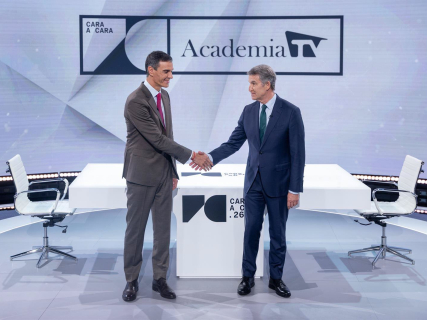

Several Moroccan media outlets have reported this Friday the face-to-face held the night before between the President of the Government and PSOE candidate, Pedro Sánchez, and the PP leader, Alberto Núñez Feijóo, putting the focus on the way in which Morocco was mentioned and on how the 'populars' candidate positioned the Alevi kingdom as the “villain”.
"Morocco is invited in the electoral debate between Sánchez and Feijóo", the portal 'Yabiladi' titles it, one of the most followed digital outlets in the neighboring country. The outlet highlights that Feijóo reproached the head of the Executive for his dependence on Rabat and underscores, in particular, the exchange of accusations between the two regarding the massive entry of migrants recorded last July in Ceuta, without going too deeply into the underlying political analysis.
Instead, the also digital 'le360' adopts a much more critical tone in its chronicle of the face-to-face between the two main candidates, centering its reproaches on the PP leader. "Feijóo turns Morocco into the villain of his face-to-face with Sánchez", this outlet headlines, considered very close to Palacio.
"Alberto Núñez Feijóo turned Morocco into the obsession of his attack on Sánchez and into the scapegoat of the Ceuta crisis. He mentioned it six times, compared with Sánchez’s three, mixed the Sahara with the entries, and insinuated a debt that he was unable to prove. With nine days until the polls, Feijóo is increasingly moving toward Vox’s discourse, with which he does not rule out reaching an agreement to govern", journalist Faiza Rhoul summarizes in her piece.
Although it acknowledges that the tone used by Feijóo "did not reach that of Vox", it points out that "the framework seemed familiar to him", because he spoke of the "invasion" of Ceuta and also of "a supposed Moroccan operation against Spain". Even so, it concluded the debate without providing "a single proof of the Moroccan operation that he insinuated and without explaining what he proposes for the Sahara or for cooperation with Rabat".
"His obsession with Morocco portrayed a strategy that needs an external enemy because it does not have a serious policy for the relationship with the neighbor", 'le360' wraps up, which has been following in detail Feijóo’s interventions about the links with Morocco, especially those related to the 2030 Football World Cup and the venue of the final.
Meanwhile, the portal 'Hespress' is publishing this Friday an analysis of the elections of November 29 and their possible impact on the Alaouite kingdom under the title "Elections in Spain: why a victory for the right should not worry Rabat".
In this article, Abdelhamid Benkhattab, Professor of Political Science at the Faculty of Law Agdal-Rabat, argues that the extremes, both on the left, referring to Podemos and Sumar, and on the right, referring to Vox, lack real capacity to condition foreign policy and "determine Spanish policy toward Morocco". "They also do not necessarily worsen Spanish-Moroccan relations," he adds.
Regarding a possible coalition Executive between PP and Vox, this specialist considers that Feijóo's people are not obliged to take on Vox's toughest stance toward Morocco, and frames the popular party's campaign statements about the neighboring country within a strategy aimed at attracting a specific segment of the electorate.
"The PP is immersed in a political and discursive game regarding Morocco in order to satisfy the Spanish far right and unite part of its electorate," Benkhattab assesses, who rules out a lasting deterioration in bilateral relations. "Once the Government is installed and after one or two months of exercising power, things will return to normal," he predicts.
As for Sánchez and his options for continuing in La Moncloa, the expert consulted by 'Hespress' refuses to write him off. "He is a phoenix; every time it is said that he is finished, he always returns to the Spanish political scene," he stresses, emphasizing that his chances hinge on "his alliances with the Basque and Catalan independence parties".