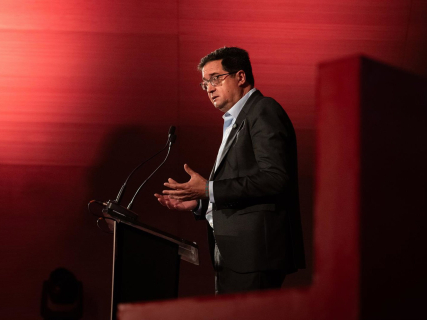

The minister for Digital Transformation and Public Function, Óscar López, has reiterated this Friday that he does not retract his criticism of judges "from A to Z", on the same day that the president of the Supreme Court and the General Council of the Judiciary, Isabel Perelló, has rejected allusions from the Government to possible "malfeasance" by some magistrates.
In an appearance on the television channel 'La Sexta', Óscar López insisted that he stands by the assessments he has made in recent days about judicial decisions that he considers "unjust", including, in his opinion, the one that affected the former State Attorney General, Álvaro García Ortiz.
When questioned about the specific identity of these judges, the also general secretary of the PSOE in the Community of Madrid avoided naming anyone in particular and limited himself to emphasizing that he says what he "wants to say, always".
The votes and the limits of political action
In parallel, the president of the Supreme Court, Isabel Perelló, has lashed out this Friday against accusations of "malfeasance" attributed to the Government and has stressed that votes "do not legitimize any action". In her opinion, "veiled and not so veiled" campaigns that damage the image of the Spanish judiciary pose a threat to the Rule of Law.
Perelló stressed that judicial independence constitutes an "essential feature" of the legal status of judges and described it as "lamentable" to have to reiterate this idea in the current context.
"Any attempt at interference in judicial independence, wherever it comes from, poses a threat to the Rule of Law and calls into question the legal and political foundations of our democratic society," stated the president of the High Court.
The magistrate defended the plurality of viewpoints, disagreement, and criticism, which "when it is constructive and respectful" contributes to "improving" the system.
"All judicial decisions, all of them, can and should be the subject of debate, of criticism, but there is a qualitative leap when this criticism is aimed at questioning the professional honesty of the judge. This is what is not admissible," she added.