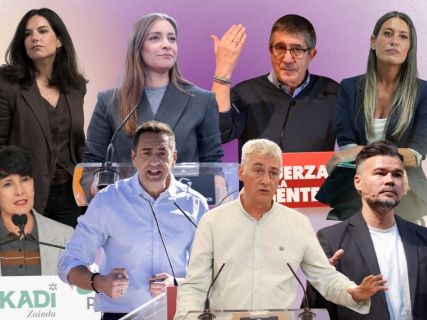









Poll | Who is winning the RTVE spokesperson debate? Vote here

Ester Muñoz, Patxi López, Pepa Millán, Emilio Delgado, Gabriel Rufián, Míriam Nogueras, Oskar Matute and Maribel Vaquero face each other in the debate at eight of RTVE. Participate in the DEMÓCRATA poll and choose who is being the most convincing

WhatsApp Image 2026 11 23 at 16.18.18

WhatsApp Image 2026 11 23 at 16.18.18

Add DEMÓCRATA to Google

Ask FREN

Published

Last updated

1 minute

Most read

Poder Digital · Carrera digital

La carrera digital de los candidatos

El Poder Digital de cada candidato a la Presidencia, de 0 a 100, desde junio · cambio en las últimas 4 semanas

30405060708090100julagoseptoctnovSánchez 93,8Montero 86,3Alvise 82,2Rufián 80,8Feijóo 79,1Abascal 78,4Colau 76,5Nogueras 58,0Valido 39,0
  1. 1Sánchez93,8▼ -0,2
  2. 2Montero86,3▼ -1,7
  3. 3Alvise82,2▼ -1,8
  4. 4Rufián80,8▼ -1,2
  5. 5Feijóo79,1▲ +0,1
  6. 6Abascal78,4▼ -4,6
  7. 7Colau76,5▲ +4,5
  8. 8Nogueras58,0▼ -5,0
  9. 9Valido39,0▼ -7,0

Pendientes de que su partido anuncie el candidato: Adelante, BNG, EH Bildu, EAJ-PNV y UPN.

Ver la carrera completa

Mide presencia e influencia en redes, no intención de voto.

Who is winning the RTVE electoral debate? Six days before the general elections of November 29, eight spokespersons from the main parliamentary forces confront their proposals in the last big debate, eight days into the campaign. At DEMÓCRATA we want to know what our readers think: who is being the most convincing?

The event, held this Monday, November 23, at the Prado del Rey studios, brings together Ester Muñoz (PP), Patxi López (PSOE), Pepa Millán (Vox), Emilio Delgado (Frente Amplio), Gabriel Rufián (ERC), Míriam Nogueras (Junts), Oskar Matute (EH Bildu) and Maribel Vaquero (PNV), moderated by journalist Xabier Fortes.

Vote in our poll and choose the spokesperson who, in your judgment, is defending his or her proposals best. The vote collects the preferences of readers who decide to participate and has no scientific character and does not intend to reflect the opinion of all voters.

A debate of eight in the final stretch of the November 29 elections

For 90 minutes, the representatives of the eight parties confront their positions on some of the main issues of the campaign. The format agreed by RTVE divides the event into three blocks: housing and the state of welfare; economy, employment and infrastructure; and sociopolitical climate and pacts.

The meeting makes it possible to hear the forces that could be involved in parliamentary negotiations after November 29, especially in a Congress in which agreements between parties will play a decisive role in the investiture of the next President of the Government.

Who is being the best spokesperson in the debate?

The DEMÓCRATA poll allows readers to assess the interventions of the eight participants and choose the one they consider most convincing, regardless of their electoral preferences.

The voting will remain open during the debate so that readers can participate as the exchange of arguments between political representatives progresses.

More key points, information and questions with FREN

AI-GENERATED CONTENT

What are the parliamentary procedures following the general elections for government formation?

After general elections, the formation of the Government goes through three stages: organizing the new Chambers, holding the investiture in the Congress, and making appointments. The elections do not directly designate the president of the Government: he needs the confidence of the Congress; the Senate does not participate in that vote.

1. Constitution of the Chambers

The Congress holds its constitutive session on the day and at the time established in the royal decree calling the election. Initially, the oldest deputy present presides, assisted by the two youngest.

The Board of the Congress is elected, its governing body: a Presidency, four Vice Presidencies, and four Secretariats. To elect the Presidency, an absolute majority is required in the first vote; if no one achieves it, the two most voted candidacies compete and the one with more votes wins. Then, the deputies swear or promise to uphold the Constitution and the Congress is declared constituted. The Senate organizes its own constitution but does not grant confidence to the Government.

2. Parliamentary groups and spokespersons

Within five working days following the constitutive session, the written constitutions of the parliamentary groups are submitted. Those who do not join any group go to the Mixed Group. The spokespersons form the Board of Spokespersons, chaired by the Presidency of the Congress, which participates in organizing parliamentary work.

These are organizational procedures of the Chamber, not votes on who will govern. Their main rules are found in articles 23 to 25 and 39 of the Regulations.

3. Proposal of candidate

The king consults the representatives designated by the political groups with parliamentary representation and proposes a candidate for the Presidency of the Government through the Presidency of the Congress. This convenes the investiture Plenary, that is, the session in which it is debated and voted whether to grant confidence to the candidate.

The proposal and the call are different actions: it is the king's responsibility to propose and the Presidency of the Congress to convene the debate. The central framework is article 99 of the Constitution and article 170 of the Regulations.

4. Debate and investiture votes

The session begins with the reading of the proposal. The candidate presents, without time limit, the program of the Government he intends to form and requests confidence. Then, the groups that request it intervene, for thirty minutes each, with the possibility of response and reply.

  • First vote: requires an absolute majority of the members of Congress, that is, more than half of the total.
  • Second vote: if the first fails, it is held forty-eight hours later. A simple majority suffices: more favorable votes than opposing.

The votes are public by roll call: each deputy expresses their position. Before the second vote, the candidate may intervene for ten minutes and each group for five. They are regulated by articles 85 and 171 of the Regulations.

5. If no candidacy succeeds

If both votes fail, new proposals may be processed by the same procedure. The decisive period is two months from the first investiture vote, not from the elections nor from the constitution of the Congress.

If during that period no candidacy obtains confidence, both Chambers are dissolved and elections are called. The Presidency of the Congress submits the decree for the king's signature and communicates it to the Senate, according to article 172 of the Regulations.

6. Appointment and formation of the Government

Once confidence is granted, the Presidency of the Congress communicates it to the king for the appointment of the president of the Government. He chooses the other members of the Executive, who are appointed by the king at his proposal: they do not need an individual investiture. Thus, the process culminates, according to articles 99 and 100 of the Constitution.

The parliamentary development can be consulted in the Regulations of the Congress.

What functions and powers does a parliamentary spokesperson have in Spain?

A parliamentary spokesperson represents their group and expresses its position before the Chamber. Their role combines powers recognized by the Regulations with tasks of coordination and political negotiation, but does not allow them to substitute Parliament's decisions nor vote on behalf of their colleagues.

There is no identical catalog for all of Spain: each Chamber has its own Regulations. To specify the powers, the main example is the Regulations of the Congress; its rules should not be automatically transferred to the Senate or to the autonomous parliaments.

Representation and organization of the group

In the Congress, when a group is constituted, it is communicated who exercises its spokespersonship and who can substitute them. The spokesperson acts as the group's interlocutor before the Presidency and other groups. It is useful to distinguish three responsibilities:

  • Group spokesperson: exercises their general representation and communicates their positions and initiatives in the regulatory terms.
  • Deputy spokespersons: support or substitute the holder according to designations and internal distribution of functions. They do not automatically have all the powers by that denomination.
  • Spokespersons in committees: assume the group's representation in a specific matter. They should not be confused with the Presidency of the committee, which directs its sessions.

Participation in the Board of Spokespersons

This is one of their most important institutional functions. In the Congress, the group spokespersons make up the Board of Spokespersons, chaired by the Presidency of the Chamber. Its decisions are adopted by weighted vote: the weight of each group depends on its number of deputies, not on how many people attend.

The Board intervenes in the organization of parliamentary work. In particular, the agenda of the Plenary — the matters to be debated — is set by the Presidency in agreement with it. In other matters, such as the general programming of work, the Board must be heard, without that necessarily meaning its approval is needed.

Debates and initiatives

The spokesperson can defend the group's position, but does not monopolize its interventions: different deputies can intervene on its behalf. Nor can they speak whenever they want; they must obtain the floor from the Presidency and respect the applicable turns and times.

Additionally, the Regulations of the Congress attribute specific actions to them:

  • Sign a bill presented by their group, without needing to gather additional individual signatures.
  • Sign the amendment writings of their deputies, or have their substitute do so, for knowledge purposes; that signature does not equate to political authorization required by the provision.
  • Express acceptance of certain incorporations to the group.
  • Request the closure of a discussion, whose decision corresponds to the Presidency in agreement with the Board.

Political negotiation and limits

The spokespersonship serves as an interlocution to negotiate parliamentary positions and agreements. That negotiation must be distinguished from a decision-making competence: an agreement among spokespersons does not substitute the signatures, procedures, majorities, or votes that correspond.

By itself, a spokesperson cannot approve laws, admit initiatives, freely convene sessions, nor impose the agenda. The Board decides on the admission and processing of writings; the Presidency directs the debates; the Plenary and committees adopt their agreements. Furthermore, each deputy's vote is personal and non-delegable.

In short, three levels must be separated: what the Regulations of each Chamber allow, what the group internally entrusts to its spokesperson, and the political influence that this achieves through negotiation.

What has been Ester Muñoz's political trajectory before becoming the PP spokesperson?

Before becoming spokesperson of the Popular Group in the Congress in July 2025, Ester Muñoz had worked in the national leadership of the PP, been a senator for León, and held responsibilities in the Junta of Castilla and León. Later she assumed the provincial presidency of the party, returned to the Cortes as a deputy, and joined Alberto Núñez Feijóo's team as deputy secretary of Health and Education.

The beginnings: New Generations and Génova

Muñoz joined the PP in 2003, at 18 years old, and began her activity in New Generations. Her training was legal: she graduated in Law from the University of León in 2009 and later completed a master's degree in Private International Law in Murcia.

In May 2011 she began working at the national headquarters of the PP. In February 2012 she became chief of staff to Carlos Floriano, then deputy secretary of Organization and Electoral. It was, therefore, a stage of internal work in the party structure, prior to her elected positions. That year she also tried to promote a candidacy to preside over New Generations of Castilla and León, although she finally withdrew and supported Daniel Sualdea, according to the Demócrata profile.

2015-2019: senator for León

Her first seat came in the general elections of December 2015, when she was elected senator for León. She renewed the seat in June 2016. During her time in the Upper Chamber, she was spokesperson of the PP in the Incompatibilities and Justice commissions, and participated in debates on budgets, nationality, and historical memory.

In February 2019 she sparked controversy by criticizing the historical memory budget with a reference to "digging up some bones." Later she apologized and explained she was referring to Franco's remains. In the April 2019 elections, she failed to renew her seat and was left out of the candidacy for November, as reported by Demócrata.

2019-2023: regional stage and provincial leadership

After leaving the Senate, she joined in September 2019 as advisor to Alfonso Fernández Mañueco, president of the Junta of Castilla and León. In October 2021 she became territorial delegate of the Junta in León, a responsibility she held until her return to the national Parliament in 2023.

At the same time, in November 2022 she was elected president of the PP of León. Thus, before returning to Madrid, she had accumulated experience both in the regional Administration and leading the provincial organization of the party, according to the Demócrata chronology.

2023-2025: Congress and national leadership

In July 2023 she obtained a seat in the Congress for León. In November, Feijóo appointed her deputy secretary of Health and Education. In the Lower Chamber, she was second vice president of the Commission of Education, Vocational Training, and Sports and PP's rapporteur on the law for care of people with ALS. Her parliamentary responsibilities can be consulted at the Congress of Deputies.

Before the appointment, she already appeared before the media after leadership meetings and took on prominent interventions. On July 2, 2025, Feijóo announced she would replace Miguel Tellado, who moved to the General Secretariat. Her arrival at the spokespersonship thus culminated a path through the party organization, the Senate, the regional Administration, and the Congress, as reported by Demócrata about the replacement.

Play

Test your knowledge with FREN!

How much do you know about this topic? Answer the following 3 questions.

Into how many thematic blocks was the RTVE electoral debate structured?

Question 1 of 3

Who moderated the eight-person electoral debate held at RTVE?

Question 2 of 3

What characteristic does the DEMÓCRATA survey about the debate have?

Question 3 of 3