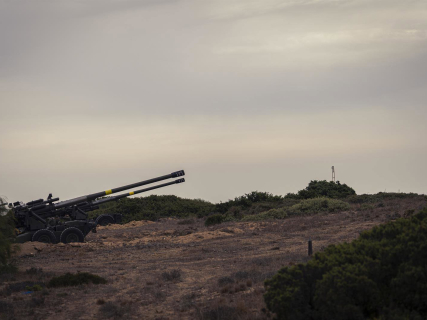

The Coastal Artillery Regiment number 4 (Racta 4), in permanent coordination with the Maritime Operational Command (MOM), has set in motion the deployment of a Coastal Artillery Defense Unit (Udacta) in the area of the Strait of Gibraltar, with the aim of reinforcing surveillance, control, and protection activities in this enclave of great strategic value.
As the Navy has stated in a communiqué, this device, integrated into Presence, Surveillance and Deterrence operations (OPVD), has made it possible to enhance interoperability and the integration of Coastal Artillery capabilities with the Navy, driving the exchange of information and coordination of the different operational actions.
To carry out this deployment, more than a hundred personnel were moved to both sides of the Strait, along with their sensors, transmission systems, and different artillery pieces, forming a specific device for this scenario.
Among the main missions assigned to the Udacta is the surveillance of maritime traffic through the detection, tracking, and identification of ships and vessels, as well as the collection of information about those activities that may be of interest for maritime security in the area.
At the same time, a section of the Infantry Regiment "Asturias" number 31, based at "El Goloso" in Madrid, assumed responsibility for providing security and ensuring the self-protection of the deployed force throughout the exercise. With this activity, Racta 4 consolidates its capacity to support surveillance and defense of the coastline and reinforces its role in protecting a space of special geostrategic importance such as the Strait of Gibraltar, the Navy has said.
The Coastal Artillery Regiment number 4 (Racta 4) constitutes the only unit of the Spanish Army specifically structured, equipped, and trained to generate Coastal Artillery Defense units, with the ability to carry out surveillance, control, and defense of the coastline missions anywhere in national territory, the Navy has recalled.
On the other hand, the Maritime Operational Command (MOM) forms part of the operational structure of the Armed Forces and is subordinated to the Chief of the Defence General Staff. At its level, it is responsible for the planning, command, and monitoring of presence, surveillance, and deterrence operations in the maritime spaces of sovereignty, responsibility, and national interest. It is under the command of the Admiral of Maritime Action (Almart), Vice Admiral Vicente Cuquerella Gamboa, and is headquartered in Cartagena.
Integrated into the MOM, different ships of the Navy carry out, under the operational control of the Command of Operations, Presence, Surveillance and Deterrence Operations (OPVD), considered an effective tool to maintain surveillance of the spaces of sovereignty and interest. These operations make it possible to improve knowledge of the maritime environment, contribute to its comprehensive protection — in coordination with other State institutions — as well as to detect possible threats in advance and facilitate an immediate and proportionate response in the event of a crisis.