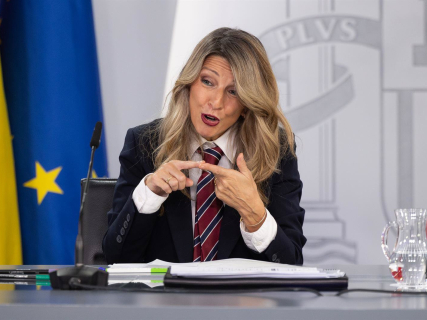










Each parent will have 20 weeks of paid leave for the birth and care of children with the extension that the Council of Ministers will approve this Tuesday, the last one before the general elections on 29N. As announced by the Second Deputy Prime Minister and Minister of Labour and Social Economy, Yolanda Díaz, the reform will also increase up to 34 weeks the leave for single-parent families.
Through a royal decree-law, the Executive will add an additional week to the leave that parents can enjoy during the first year of the child’s life or during the twelve months following their adoption or fostering. To those 18 weeks will be added the two that can already be used until the child turns eight years old.
The leave will be individual, non-transferable, and paid at 100% of the regulatory base. With this extension, the Government will fulfill one of the commitments included in the coalition agreement between the PSOE and Sumar.
The rule must be submitted for ratification at the Permanent Committee of the Congress of Deputies, since the Cortes Generales are dissolved due to the electoral call.
How the 20 weeks of leave for birth will be allocated
With the new extension, parents will have 18 weeks during the first year of the child’s life and another two that they can reserve to attend to their care needs until the age of eight.
Until now, legislation establishes that the first six weeks are mandatory and must be enjoyed without interruption and full-time immediately after the birth, adoption, or fostering.
The rest of the leave corresponding to the first year may be distributed in weekly periods, consecutive or interrupted, and enjoyed full-time or part-time, subject to agreement with the company when applicable.
Single-parent families will have 34 weeks
The extension will also benefit single-parent families, who until now had 32 weeks of paid leave and will have two additional ones with the reform announced by Díaz.
In this way, they will be able to enjoy 34 weeks of paid leave for the birth and care of children.
Details regarding the entry into force of the extension and its possible retroactive application remain pending until the royal decree-law is published in the Official State Gazette (BOE).
The evolution of maternity and paternity leave
Since January 2021, both parents enjoy leave of equal duration, after a process of progressive alignment of the former maternity and paternity leave that began in 2019.
In July 2025, the Government approved a new extension through Royal Decree-law 9/2025, which included an additional week during the first year of the child’s life and two more paid leave for care up to the age of eight.
According to the latest data published by the Ministry of Inclusion, Social Security and Migrations, Social Security has processed 374,638 benefits for birth and childcare during the first nine months of 2026, 5.2% more than in the same period of the previous year, with spending of 3,564.8 million euros.