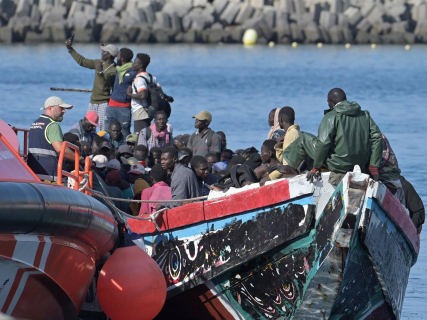

The progressive shift southward of the departure points on the coasts of West Africa toward the Canary Islands, together with the persistent migratory pressure in the region and the usual good weather for sailing at this time of year, indicates that even riskier crossings are to be expected in the coming months, according to a warning by the International Organization for Migration (IOM).
The high concentration of recent arrivals to the archipelago via the so-called West Africa Atlantic route "can plausibly be explained by the interaction between persistent migratory pressures and favorable conditions for departures," a spokesperson for this UN agency told Europa Press.
According to the IOM’s own forecasts, in October weak winds were expected off Senegal, Gambia and Guinea Bissau—countries to which the departure points of vessels bound for the Canary Islands have been moved in recent times, compared with the following months. "In general, scarce wind favors lower waves, which potentially creates opportunities for people who are already considering or are prepared to cross so that they can depart in a relatively short period of time," this spokesperson details.
According to the latest data from the Ministry of the Interior, by November 15, 24,346 migrants had reached the Canary coasts, representing an increase of 65.9% compared with the same period of 2025, distributed across a total of 30 vessels.
The IOM confirms that, although in the first half of the year arrivals to the archipelago decreased, in the second half there is a rebound, especially since September, and it recalls that traditionally the last quarter tends to concentrate more landings—although in 2025 it was an exception. "Unlike what happens in the Mediterranean, winds and weather conditions in the coastal countries of West Africa are generally more favorable in the winter months," the spokesperson points out.
Longer and more dangerous crossings
In this context, the UN agency expects that in the coming months "weather conditions will worsen and crossings will become more dangerous", to which is added that the points of departure "have been steadily shifting further south to Guinea, Guinea-Bissau and Gambia in response to the intensification of border controls in the previous countries of origin", in reference to Morocco, Mauritania and, more recently, Senegal, from where many vessels traditionally departed.
"Taken together, these dynamics could contribute to a less visible migration system in the Atlantic in the coming months, characterized by longer journeys, greater immobility in transit locations and a higher risk of incidents not detected at sea", warns the spokesperson, referring to both possible shipwrecks and boats that fail to reach the Canary Islands and are left adrift on the high seas.
People trying to reach the archipelago from the African coasts now face "longer distances to reach the Canary Islands and more time at sea", which "increases their exposure to dangerous conditions and the risk that boats are left adrift, which makes journeys even more dangerous than they already were", emphasizes the IOM representative.
Therefore, the agency insists on the urgency of protecting migrants along the entire journey and on the need to "expand access to safe and regular routes to migrate".
Cooperation along the entire route
In the same vein, it stresses that "to save lives, there needs to be greater cooperation among countries of origin, transit and destination, not only action at the point of arrival", referring to the Canary Islands, where the capacity to accommodate has been put under strain by the volume of arrivals in the past few weeks.
Besides addressing the causes that drive irregular migration, mainly by providing livelihoods and opportunities in countries of origin, the IOM maintains that those who ultimately decide to emigrate must receive protection and assistance during the journey, "not only when they reach their destination".
"Addressing the causes, ensuring protection along the routes and creating regular pathways are complementary priorities: together, they offer a comprehensive response that places the safety and dignity of people at the center", summarizes the organization’s spokesperson.
Addressing the underlying causes
The executive director of the Instituto Español de Análisis Migratorio (IEAM), Beatriz de León, agrees on the need to act on the roots of the migration phenomenon and considers that what is happening now should not be surprising, since it is something that “happens every year.”
“As long as there are young people who don’t think they have alternatives in their countries, they will keep coming,” she argues in statements to Europa Press, defending that work must be done to improve conditions in countries of origin and prevent them from feeling that “they have no other possibility but to leave.”
De León also draws attention to the displacement toward the south of the departure points and stresses that what happened in Ceuta last July pushed many sub-Saharan migrants “to look for other routes.” Likewise, she warns that it is not possible to “take for granted” that the countries from which the boats set sail, as is happening now with Senegal, will “keep collaborating in the interception of migrants at all times.”
“More long-term policies are needed,” she demands, and also the ability to “anticipate” that this type of “spikes” in arrivals can occur and act accordingly when it is known that they will take place, so that the authorities do not get caught “unprepared.”