
The number one on the PP list for La Rioja to the Congress of Deputies, Cuca Gamarra, has stated that her party “will support and protect farmers and ranchers, being a government for farmers and ranchers, instead of setting itself against them.”
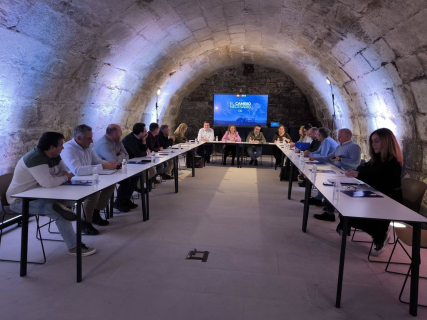
The deputy secretary for Institutional Regeneration of the “popular” party has presented to the media, at the Calado of the Centro de la Cultura del Rioja, the main lines of the Partido Popular’s electoral program on Agriculture and Livestock, before taking part in a sector meeting with representatives from Agriculture and Livestock to detail the content to the OPAS of La Rioja.
Gamarra has emphasized “what the sector has suffered” because “they have not been able to have more paperwork, they have not been able to have more taxes, and they have not been able to have less support from a Ministry of Agriculture that has left them abandoned at the most important moments.”
“From now on, what we are proposing to them is something completely different,” she stressed. In this regard, she defended “eliminating and substantially reducing bureaucracy, so that in the end the farmer, the rancher, can devote themselves to what their activity is and not have to spend the whole day filling out paperwork.”
The candidate reiterated that the sector must “have a government that isn’t thinking all day about how to squeeze it and make money off it, but about how to support it in a moment of rising costs like the one they are living through.”
As the lead candidate for the Lower House, she proposed “tax cuts” that “allow, in the end, them to have much more capacity to cope with the costs they are being subjected to and, on the other hand, that there be sufficient room for them to be able to have profitability in order to survive, and profitability to make their holdings profitable.”
Negotiation of the PAC and protection of the primary sector
“That is what a government is for, not to put obstacles in their way,” she pointed out, emphasizing that “that government that protects them will be that of Alberto Núñez Feijóo, which, among other things, will protect them with the upcoming negotiation of the PAC where we are .
playing a lot and for which a strong government is needed, a government with the capacity to manage, a government with the capacity to negotiate.”
He has ensured that "we will not get up from the table in the negotiation of the PAC until that PAC is a PAC necessary for our interests, for the interests of the people of La Rioja", because "the future of our agriculture and of our livestock farming will be guaranteed" with it.
Gamarra has also emphasized that "to protect also means to protect the livestock farmer from the wolf, something that has not happened during this entire legislature; a legislature in which we have been able to see how the wolf has sat on the Council of Ministers, from an absolutely ideologized policy, which has led to the livestock farmer being pursued instead of being protected from those threats, such as a wolf at certain moments".
The 'popular' representative has also defended "protecting our products from threats from abroad; protections at the border, just as we talk about the protection of borders from the point of view of irregular immigration", and she has insisted that "nothing that does not meet the conditions that we require in Spain can enter Spain, and that requires border controls that must be deployed and that do not exist at these moments". "And of course that reciprocity, what you demand of me, I will demand of you," she added.
Commitment to wine and the Food Chain Law
As for the wine-growing sector, Gamarra criticized that the Government of Pedro Sánchez "within its ideology does not carry out the protection of wine; and when you do not carry out the protection of wine, nor the consideration of wine as a food, obviously you are already part of a political position harmful to our designation of origin and, in the end, to everything that the wine-growing sector means in our autonomous community".
She has guaranteed that "what we guarantee to the entire wine-growing sector is that the Partido Popular will continue to defend wine and the identity of wine; and we are going to continue to defend it, and that means, from the point of view of the legislation that has to be developed".
In addition, she has emphasized that "in a changing world in which consumption is falling, first of all you have to work from that perspective of wine as a food, of responsible consumption, and to safeguard the sustainability and the future of the wine-growing sector".
He has also indicated that it is necessary to go "hand in hand with the sector to address the reforms that are necessary and the measures that are necessary to make wine not only the present but also the future, and that depends on decisions that, alongside the appellations, will have to be made and for which a responsive ministry is needed and a ministry that, evidently, is the greatest collaborator of the designations of origin."
Regarding the role of intermediaries, Gamarra has argued that "it is essential that the Food Chain Law be reformed so that it is truly effective so that, in the end, the producer can have a product that they sell on the market that is sustainable and that is profitable and, therefore, not deficit-producing."