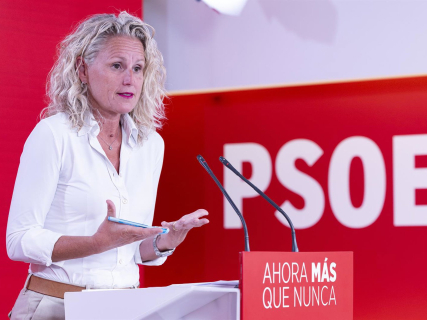

The spokesperson of the PSOE, Montse Mínguez, has described the situation that Ceuta and Melilla are going through as an "extraordinary migratory pressure" derived from the irregular entry of tens of thousands of people, and has lashed out at the Popular Party for its "political opportunism," reproaching it that, once again, it has not positioned itself "on the side of the State."
According to her denunciation, in the face of this "extraordinary migratory pressure," the PP "does not start by offering collaboration" but resorts "to the usual": "it never distinguishes what is a national emergency from what is political opportunism." She made these criticisms this Saturday in statements sent to the media.
Mínguez laments that the main opposition party "starts from scratch to attack the Government, starts from scratch to request appearances when the crisis is still being managed," instead of closing ranks at a moment she considers exceptional.
The also secretary of Studies and Programs of the PSOE contrasts the attitude of the PP with what, in her opinion, happens in other countries: "In any serious country, in the face of an emergency situation, whatever it may be, the opposition stands by the State. In Spain, the opposition, the Popular Party, stands in front of a camera." In this context, she also recalls the stance that the PP maintained during the recent fires that have affected Spain.
She emphasizes that neither climate change, nor the fires, nor migratory pressure make distinctions between voters, and that, for this reason, citizens demand that their political representatives "do not do so either."
Calls for responsibility and a sense of State
"They expect responsibility and they expect a sense of State. And that is exactly where this Government stands, because when Spain has a problem, citizens expect us all to rise to the occasion for Spain," Mínguez asserts, stressing that the PSOE continues "to extend a hand to all political parties and also to the Popular Party."
The crisis has intensified following the massive entry, this Thursday, of about 50,000 migrant people into Ceuta from Morocco, an episode that has left at least 67 deceased.
Of that contingent of 50,000 people, more than 48,000 have already been returned to Morocco in less than 48 hours, according to government sources. The same sources emphasize that "none of the people who crossed irregularly into Ceuta has left the city towards the Peninsula, nor could they have done so."